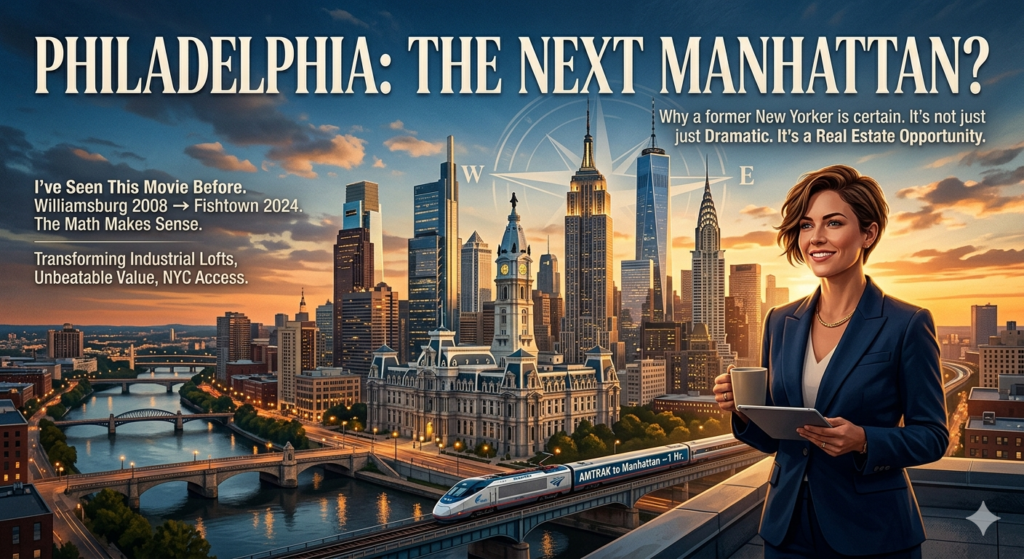
I know how that headline sounds. Dramatic. Maybe even a little unhinged.
But hear me out — because I’ve actually lived this comparison in real time.
After my divorce, I did what any newly single woman with no reason to stay put would do: I moved. A lot. LA, New York, Williamsburg specifically — which, if you know, you know — then New Jersey, then DC. I’m the kind of person who’s always had a list of cities I still want to live in. Honestly I still do.
But somewhere between unpacking boxes for the fifth time and watching my rent check disappear into someone else’s mortgage again, I started seeing cities differently. Not just as places to live — but as markets. As opportunities. As things that are either about to get very expensive, or already are.
And Philadelphia? Philadelphia is about to get very expensive.
I’ve seen this movie before
Williamsburg was my favorite neighborhood in the world. Not the Williamsburg it is now — I mean the before version. The raw, creative, slightly chaotic version where artists and broke twenty-somethings lived in converted warehouses because the rent was actually affordable.
Then the coffee shops came. Then the boutique hotels. Then the $4,000/month apartments.
I watched that transformation happen in real time. And when I got to Philadelphia, I felt that same energy. That same before feeling.
Old factories turning into loft apartments. Warehouses becoming restaurants. Young people flooding in from New York because they literally cannot afford Brooklyn anymore. Neighborhoods like Fishtown and Northern Liberties feeling like Williamsburg circa 2008.
Except Philadelphia isn’t a neighborhood. It’s an entire city. With its own skyline, its own culture, its own history. That’s why I don’t think it’s the next Williamsburg.
I think it’s the next Manhattan.
The math actually makes sense
Here’s what people who haven’t lived in multiple major cities don’t fully appreciate: Philadelphia is absurdly underpriced relative to what it offers.
I paid over $3,000/month in rent for years. In LA, in New York, in DC — that was just normal. That was cheap for those markets actually.
In Philadelphia? That same $3,000/month buys you a mortgage payment on a real house. In a real neighborhood. With a backyard sometimes.
And here’s the kicker: Amtrak to Manhattan is about an hour. DC is even closer. So you can live in Philadelphia, pay Philadelphia prices, and still work in New York or DC if you need to. That arbitrage is not going to last forever.
Remote work made people realize they don’t have to pay Manhattan prices to have Manhattan access. Philadelphia was the obvious answer. And people are figuring that out fast.
The physical transformation is already happening
This is the part that really gets me.
Drive through certain parts of Philadelphia right now and you’ll see it — beautiful old industrial buildings being converted into luxury lofts. The design is actually stunning. Not the generic “luxury apartment” look you see everywhere. Real character, real architecture, real craftsmanship.
Manhattan went through this exact same phase. Tribeca, Meatpacking, Chelsea — all industrial, all “sketchy,” all now some of the most expensive real estate in the world.
Philadelphia has entire neighborhoods of that same bones. And they’re being transformed right now, while the prices still make sense.
Why this matters if you’re investing
I moved to Philadelphia partly because after years of expensive cities, I needed to breathe financially. Broke and tired of watching money evaporate.
But what I found here wasn’t just relief. It was opportunity.
If you’re a real estate investor — or want to be one — cities in transformation are where generational wealth gets built. Not after the transformation. During it. When everyone else is still saying “Philadelphia? Really?”
Yes. Philadelphia. Really.
I still have a list of cities I want to live in someday. But right now, Philadelphia is exactly where I want to be investing. Because I’ve seen what comes next.
And what comes next looks a lot like Manhattan.