Why Local Zoning Real Estate Rules Matter More Than Any Federal Policy
Every time there’s a new administration, people start waiting for the government to fix housing affordability.
Spoiler: don’t hold your breath.
I’ve been studying the Philadelphia real estate market obsessively for a while now, and one thing keeps coming up — the biggest barriers to affordable housing aren’t happening in Washington. They’re happening at the city and county level. In the zoning offices. In the permit departments. In the local fee structures that make building new housing so expensive that developers just… give up.
This is a local zoning real estate problem. And federal policy is not going to solve it.
What Federal Policy Can and Can’t Do
Federal housing policy can do some things — loosen lending regulations, make financing easier, encourage more construction through incentives.
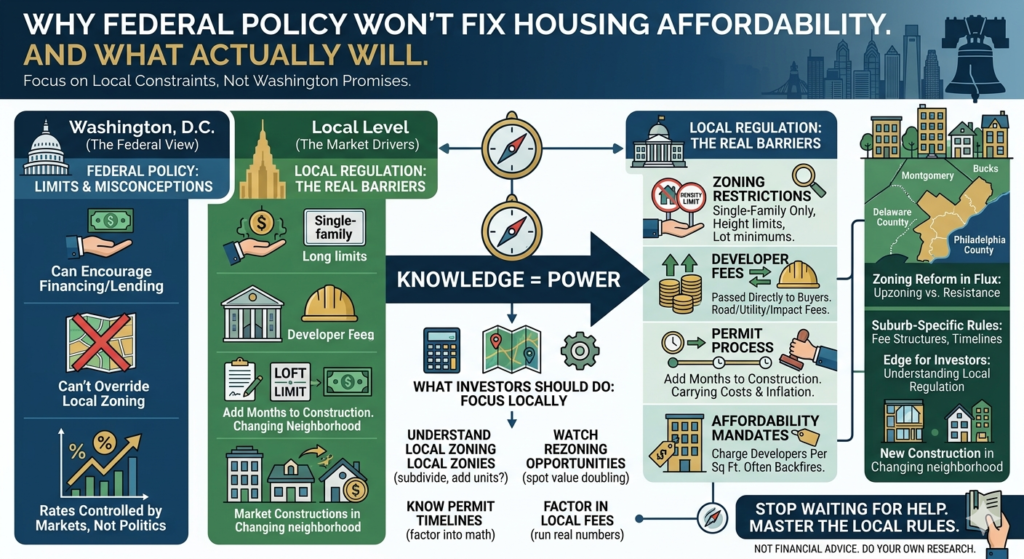
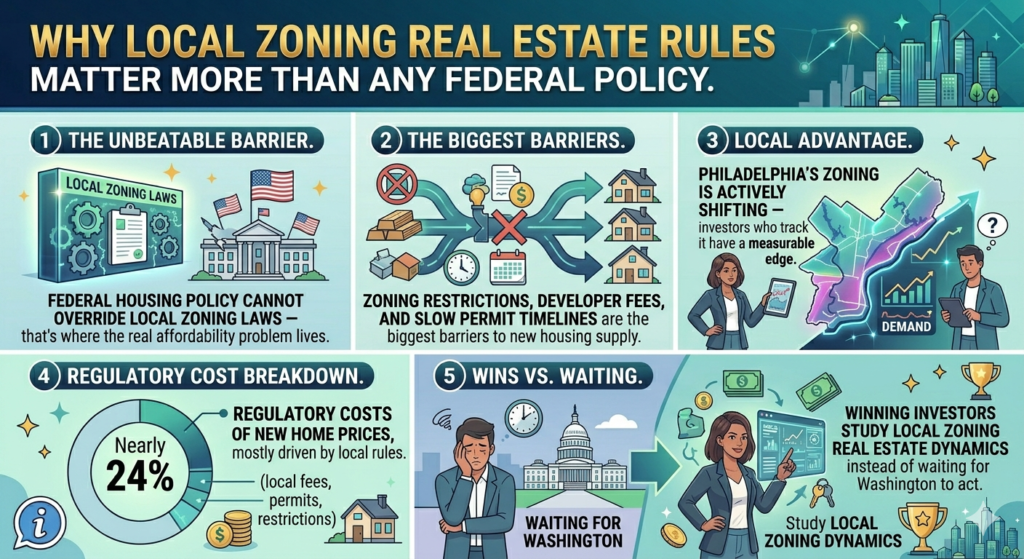
What it can’t do is override local zoning laws. And local zoning real estate regulation is where the real problem lives.
Mortgage rates? Controlled by the market, not politicians. Anyone waiting for a policy announcement to bring rates down is going to be waiting a long time.
Why Local Zoning Real Estate Regulations Slow Down Supply
Here’s what actually slows down housing supply — and it has nothing to do with who’s in the White House:
Zoning restrictions that limit what can be built where. Single-family only zones. Height restrictions. Lot size minimums. These rules were often written decades ago and haven’t kept up with population growth or demand.
Developer fees that get passed directly to buyers. In some cities, developers are charged for road upgrades, sidewalk improvements, utility infrastructure — costs that get baked into the price of every unit they build. The result? Fewer units get built, and the ones that do are more expensive.
Lengthy permit processes that add months — sometimes years — to construction timelines. Every month a project sits waiting for approval is a month of carrying costs, interest, and inflation eating into the budget.
Affordability mandates that charge developers per square foot to fund low-income housing elsewhere. The intention is good. The execution often backfires — because when you make it more expensive to build, you get less building.
Understanding local zoning real estate rules in your target market isn’t optional. It’s the whole game. According to the National Association of Realtors, regulatory costs now account for nearly 24% of the final price of a newly built single-family home — and most of that comes from local, not federal, policy.
What This Means for Philadelphia
Philadelphia has its own version of all of this.
The city has been working on zoning reform for years — with mixed results. Some neighborhoods are loosening restrictions to allow more density. Others are fighting tooth and nail to keep things exactly as they are.
The suburbs around Philadelphia — Montgomery County, Bucks County, Delaware County — each have their own zoning rules, their own fee structures, their own permit timelines. If you’re planning a development project in this region, local zoning real estate knowledge isn’t a bonus skill. It’s the baseline.
This is part of why I find the Philadelphia market so interesting right now. The city is changing. Old industrial buildings becoming apartments. New construction popping up in neighborhoods that were ignored for decades. Investors who understand where the zoning is loosening — and where it isn’t — have a real edge.
If you’re running numbers on a Philadelphia deal, the Philadelphia Deal Finder can help you think through neighborhood-level factors before you commit.
So What Should Investors Do?
Stop waiting for federal policy to make your market easier. It probably won’t.
Instead, focus on what you can actually research and control:
Understand local zoning before you buy. Is the area upzoning? Can you add a unit? Can you subdivide? Local zoning real estate rules vary block by block in some cities — Philadelphia included.
Know the permit timeline in your target market. A 6-month permit process changes your holding cost math significantly.
Watch for rezoning opportunities. Land that gets rezoned from single-family to multi-family can double in value overnight.
Factor in local fees when you’re running your numbers. Developer fees, impact fees, and affordability charges are real costs that affect your bottom line.
The investors who win in this market aren’t the ones waiting for the government to make things easier. They’re the ones who understand local zoning real estate dynamics — and know how to play within them.
Not financial advice — just someone doing a lot of research and asking a lot of questions.