How to Buy a Property at Online Auction: What Zillow, Hubzu, and Auction.com Don’t Tell Beginners (Part 1)
If you want to buy property online auction style — through Zillow, Hubzu, or Auction.com — this is everything I found out after going down the rabbit hole myself.
I’ve been scrolling Zillow like it’s my second job lately — running numbers, saving listings, trying to find something that actually makes sense in Philadelphia’s current market. And then I started noticing listings with no price. Just a button that says “Auction.”
Click it, and suddenly you’re watching a countdown timer and a number climbing in real time. I had no idea what I was looking at. So I did the research.
Wait — What Even Is a Zillow Auction Listing?
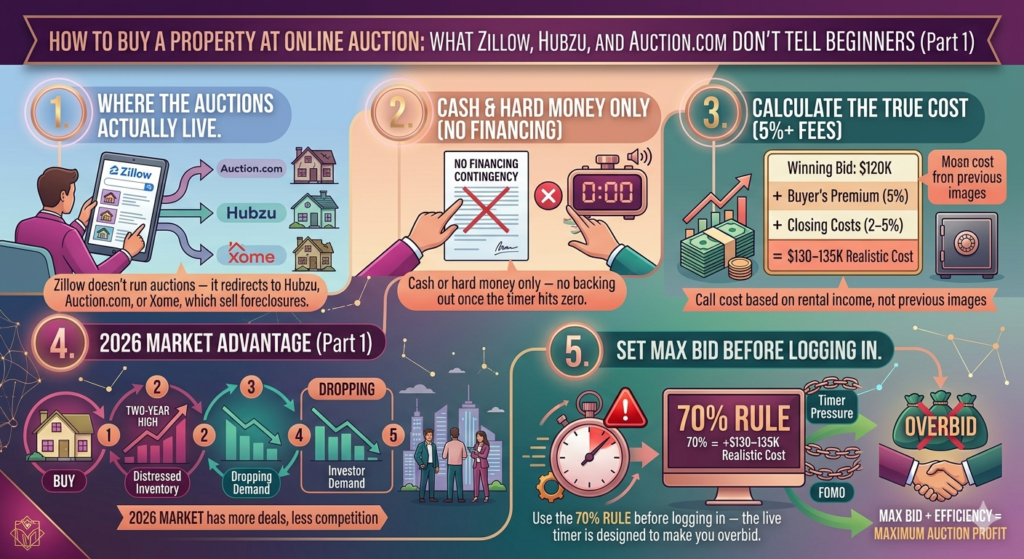
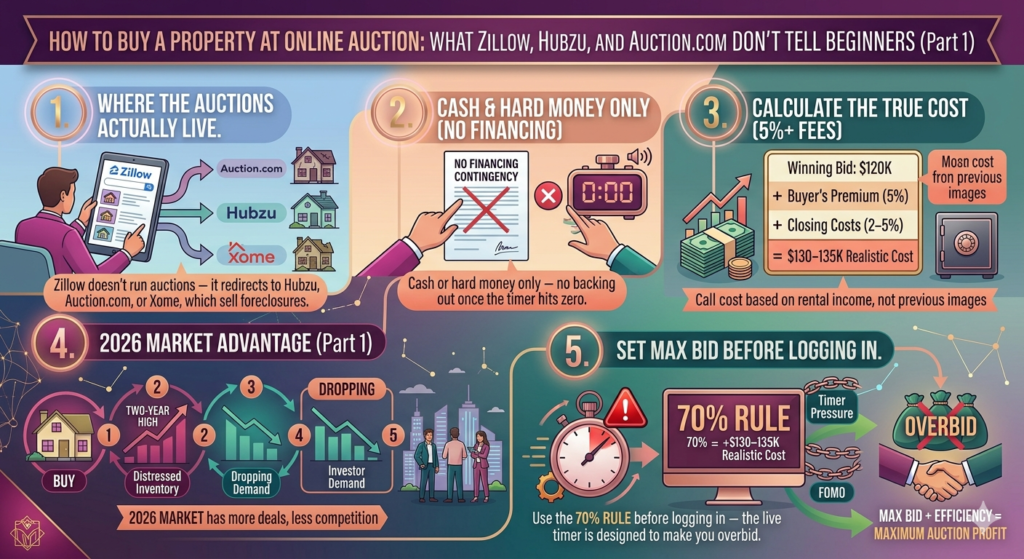
Zillow doesn’t actually run auctions itself. When you click an auction listing on Zillow, it redirects you to a third-party platform — usually Hubzu, Auction.com, or Xome. These are the actual auction companies. Zillow is just showing you their inventory.
These platforms cover foreclosures (repossessed by the bank), tax lien sales, government or county sales, and private investor auctions. The price is low because the seller — usually a bank or lender — just wants to recover what they’re owed. They’re not trying to maximize profit. That’s the opportunity.
The Two Things That Confused Me Most
When I started clicking through listings, I noticed two very different setups:
Reserve price listings — a minimum bid is set. If no one bids at or above that amount, the auction resets. You can’t submit below that number.
Live bidding listings — an active auction happening in real time. You can watch the number climb as other bidders compete. It feels like eBay, except the stakes are a hundred thousand dollars.
Both require you to have financing completely sorted out before you even think about clicking “Bid.” Which brings us to the most important rule.
The Most Important Rule to Buy Property Online Auction Style: Cash or Hard Money Only
“Cash or hard money only. No financing contingencies.” This is not negotiable.
Once that timer hits zero, you own the property — warts and all. No inspection period, no appraisal contingency, no backing out. Hard money lenders can move in 5–10 days, but you need one lined up before auction day, not after you win.
Run your numbers before you log in with the Hard Money Loan Calculator — so you know exactly what your carrying costs look like from day one.
How to Buy Property Online Auction: Step by Step
Step 1: Register on the platform
Most platforms require pre-registration — personal ID, proof of funds, agreeing to terms. Some require a refundable deposit just to participate. This can take a day or two. Don’t skip it — you can’t bid without it.
Step 2: Research the property hard
Properties foreclosed in early 2025 had been in the foreclosure process for an average of 671 days — nearly two years of sitting vacant, unmaintained, possibly vandalized. You typically can’t do a full inspection before bidding. Add 20–30% on top of your renovation estimate as a buffer.
Run your ARV. Know your max bid before you log in.
Step 3: Understand the fees — they add up
Buyers typically pay a buyer’s premium around 5% of the winning bid, plus technology fees. On a $120,000 property, that’s $6,000+ before closing costs. Closing costs run another 2–5%. So a $120,000 winning bid realistically costs $130,000–$135,000 out of pocket. Budget for this from the start.
Step 4: Set your max bid and don’t go over it
Hubzu has an Auto-Bid system — you set a maximum and the platform raises your bid automatically in small increments. Use it. It keeps you from getting emotional in a live auction and overbidding.
If bidding goes past your number, let it go. There will be another deal.
One more thing: Hubzu uses an anti-sniping mechanism — if someone bids in the final moments, the platform extends the deadline by 15 minutes. Don’t count on winning by swooping in at the last second.
Step 5: You win — now what?
You’ll need to put down a deposit immediately — sometimes a certified check for $5,000, sometimes a percentage of the winning bid. Then you typically have 30 days to close.
Always choose your own title company if the platform gives you the option, even if it means forgoing free title insurance from the auction company. You want neutral representation.
What Kind of Deals Can You Actually Find Right Now?
The 2026 auction market is showing an interesting pattern: completed auction sales are down, but scheduled auctions are up. Supply of distressed properties is at two-year highs while investor demand has dropped — meaning more inventory and potentially less competition.
For buyers who know how to buy property online auction style — and who’ve done the math — this is a decent moment to be looking. Philadelphia specifically has a steady stream of bank-owned and distressed properties showing up on these platforms.
Use the Sheriff Sale Bid Calculator to stress-test your max bid before you’re sitting in front of a live timer.
The Honest Reality Check
Online auctions are exciting. The prices look incredible. The timer creates urgency. And occasionally — with the right preparation — they produce real deals.
But they also produce expensive mistakes for buyers who didn’t do the math, didn’t have financing lined up, or got caught up bidding past their number. The platform doesn’t care about your budget. The timer doesn’t pause while you call your lender.
Go in prepared or don’t go in at all.
Part 2 covers Philadelphia Sheriff Sales — a completely different type of auction run through the courthouse, with its own rules, risks, and process. If online auctions feel like eBay, Sheriff Sales feel like the Wild West.
Not financial advice — just someone doing a lot of research and asking a lot of questions.