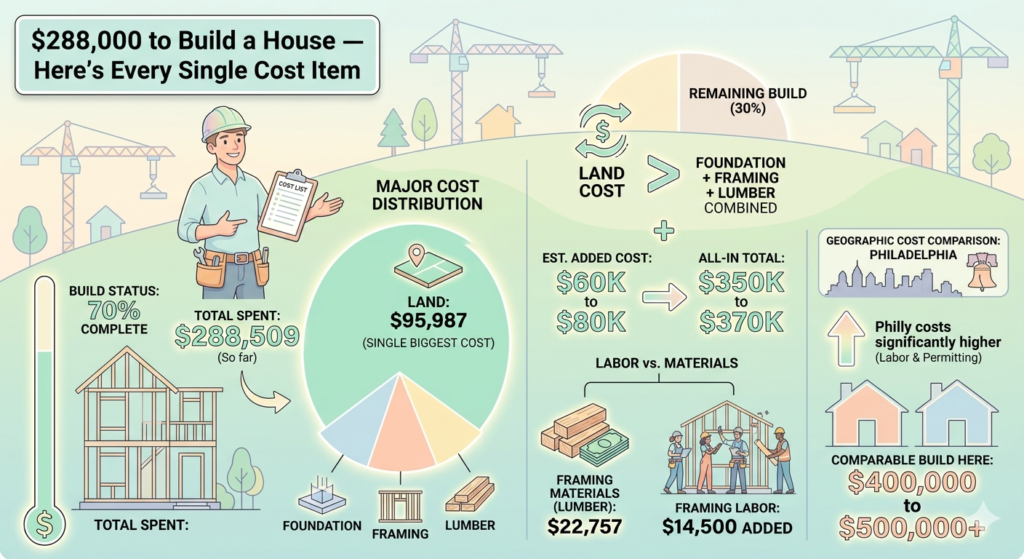
Cost to build a house is something almost nobody breaks down transparently. I came across a video recently where a young builder in his 20s — already building 13 homes simultaneously — shared every single cost item on one of his current builds. The house is about 70% done and he’s already spent $288,509.
You almost never see this level of transparency about what building a house actually costs. So I’m sharing the full breakdown here.
The Full Cost to Build a House Breakdown (70% Complete)
Land & Pre-Construction
| Item | Cost |
|---|---|
| Land purchase | $95,987 |
| Closing costs | $9,404 |
| Appraisal & survey | $950 |
| Blueprints & engineering plans | $1,570 |
| Building permit | $470 |
Site Work
| Item | Cost |
|---|---|
| Site preparation, lot grading & bringing in dirt | $1,550 |
| Porta potty | $344 |
| Trash removal | $1,184 |
| Stamped driveway & walkway | $9,594 |
Foundation & Structure
| Item | Cost |
|---|---|
| Slab foundation | $22,000 |
| Lumber package | $22,757 |
| Framing labor | $14,500 |
| Exterior sheeting (in progress) | $11,000 |
Windows & Doors
| Item | Cost |
|---|---|
| Window package | $4,542 |
| Main door deposit | $2,000 |
| Rear sliding door deposit | $2,400 |
| Garage doors | $2,800 |
Mechanical Systems
| Item | Cost |
|---|---|
| Water meter | $1,000 |
| Plumbing | $5,100 |
| Electrical | $3,885 |
| HVAC system | $8,750 |
Interior
| Item | Cost |
|---|---|
| Insulation | $3,800 |
| Sheetrock material | $3,678 |
| Sheetrock labor | $1,561 |
| Tape & texture | $4,789 |
| Tile material | $5,000 |
| Tile installation labor | $3,641 |
| Cabinet fabrication (in progress) | $9,369 |
Roofing
| Item | Cost |
|---|---|
| Roofing material | $5,461 |
| Roofing labor | $1,427 |
Total so far: $288,509 — at roughly 70% complete
What’s Still Left in the Cost to Build a House
At 70% complete, significant costs are still coming:
- Paint (interior & exterior)
- Flooring (hardwood, carpet)
- Countertops and appliances
- Fixtures — lighting, plumbing fixtures, hardware
- Landscaping and final cleanup
- Punch list items
Conservatively, that’s another $60,000 to $80,000+ depending on finish level. Total all-in cost to build a house: roughly $350,000 to $370,000 including land, or $260,000 to $280,000 for the structure alone.
What Jumps Out When You Study the Cost to Build a House
Land is the biggest single line item. At $95,987, the lot is more expensive than the foundation, framing, and lumber combined. People don’t always think about this when they say “I want to build instead of buy.” You’re not escaping the land cost — you’re just paying it separately.
Labor is a significant portion of every trade. Framing labor alone was $14,500 on top of the $22,757 lumber package. Tile labor was $3,641 on top of $5,000 in materials. When people estimate cost to build a house per square foot, they consistently underestimate labor.
Mechanical systems add up fast. Plumbing, electrical, and HVAC together came to $17,735 — before fixtures, which come later.
Some items are deposits, not final costs. The door and window items are listed as deposits, meaning final numbers could be higher.
Cost to Build a House in Philadelphia vs This Market
This build appears to be in a lower cost-of-living market — likely the South or Southeast based on land price and permit costs. The cost to build a house in Philadelphia looks very different.
What would be higher here:
Labor — union trades in Philly run significantly higher than Southern markets.
Permits — Philadelphia permit costs and timelines are notoriously more expensive and slower.
Land — depending on the neighborhood, Philly lot prices vary wildly.
A comparable build in Philadelphia could easily run $400,000 to $500,000+ all-in depending on location and finishes. According to HUD.gov, construction costs in mid-Atlantic urban markets like Philadelphia consistently run 20–35% higher than national averages — driven primarily by labor costs and regulatory requirements.
That’s why a lot of local investors focus on value-add renovations rather than ground-up construction. The cost to build a house here often makes renovation and creative acquisition strategies pencil out better.
Is the Cost to Build a House Worth It?
In markets where land is cheap and labor costs are lower, building can make a lot of sense — especially if you’re doing it repeatedly, where you develop systems and contractor relationships that bring costs down over time.
In Philadelphia, the math is harder. Unless you find a very specific opportunity where new construction fills a market gap, renovation often wins on cost to build a house comparisons.
Either way, seeing a real breakdown like this takes the mystery out of what a build actually costs — and gives you a real baseline before you ever talk to a lender or a GC.
Use the House Build Cost Calculator to model your own cost to build a house — plug in your land cost, construction estimates, and finish level to see your full all-in number before you break ground.
Not financial advice — just someone doing a lot of research and asking a lot of questions.