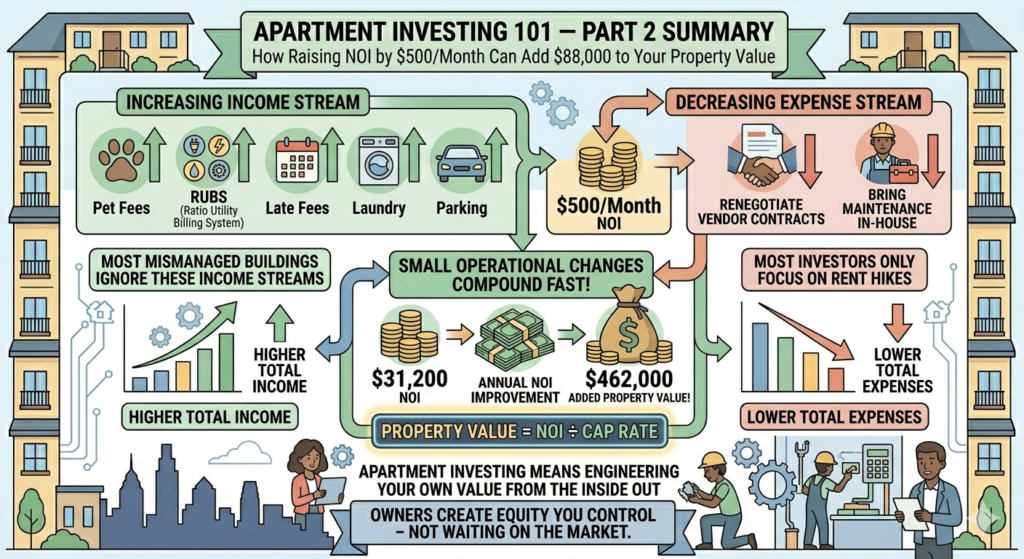
Raise NOI rental property value — that’s the formula most multifamily investors know but few actually execute beyond just hiking rents. If you already know that Property Value = NOI ÷ Cap Rate, the obvious question is: how do you actually raise NOI?
Most people jump straight to raising rents. That’s the lazy version. It comes with real risk — turnover is expensive, bad press travels fast, and in some markets, aggressive rent hikes invite regulatory headaches. There’s a smarter way to do this.
Two Ways to Raise NOI Rental Property Value
NOI = Gross Income − Operating Expenses
That means you can move the needle in two directions: increase income or decrease expenses. Most investors only focus on rents. The smart ones work both sides.
Income Side: How to Raise NOI Rental Property Income Beyond Rent
Pet Fees
Full disclosure — I have two cats. I’ve been on the tenant side of this conversation more times than I’d like to admit. Pet fees have gone from nonexistent or $25/month to $70+ in New Jersey plus a non-refundable $500 deposit. As a cat owner, it stings. My cats are clean, well-trained, and honestly cause less damage than most humans.
But as an investor studying how to raise NOI rental property value? The math doesn’t lie.
If you have a 16-unit building and 8 tenants have pets paying $50/month:
8 × $50 × 12 = $4,800/year in additional NOI
At a 6.75% cap rate: $4,800 × 14.80 = $71,040 in added property value
From pet fees alone.
RUBS (Ratio Utility Billing System)
If you’re currently paying water, trash, or gas as part of the rent — stop. RUBS lets you bill tenants back for utilities proportionally based on unit size or occupancy. It’s legal in most states, and it’s one of the fastest ways to raise NOI rental property income without touching rents.
A 16-unit building paying $1,200/month in water bills that gets fully passed through to tenants:
$1,200 × 12 = $14,400/year back in NOI
$14,400 × 14.80 = $213,120 in added property value
From a billing system change. Not a renovation.
Late Fees
If your leases don’t have a clearly enforced late fee policy, you’re leaving money on the table. A standard $50–$75 late fee, consistently applied, adds up — and it trains tenants to pay on time, reducing administrative headache.
Laundry, Parking, Storage
Coin laundry that’s been broken for two years? Fix it. Unused parking spots? Charge for them. A storage unit in the basement nobody’s using? $50/month per unit adds up fast. These are the kinds of things a previous owner let slide — and that’s exactly your raise NOI rental property opportunity.
Expense Side: Where the Real Money Hides
Renegotiate Everything
Landscaping, pest control, trash removal, insurance — when did the current owner last get competing bids? Most haven’t in years. Getting two or three quotes on every vendor contract is boring work, but it moves the NOI needle without touching a single tenant.
Bring Maintenance In-House
If the building is large enough, hiring a part-time maintenance person instead of calling an outside contractor for every small fix can significantly cut costs. A $25/hour handyman on retainer beats a $150 service call every time.
Fix Deferred Maintenance Early
Spending money to make money. A leaky roof that becomes a mold problem, or a broken HVAC that leads to tenant turnover, costs way more than the original fix. Addressing deferred maintenance right after acquisition protects your income stream and reduces vacancy — which directly supports your raise NOI rental property strategy.
The Full Math: Raise NOI Rental Property Value With No Major Renovation
| Improvement | Annual NOI Impact |
|---|---|
| Pet fees (8 units × $50/mo) | +$4,800 |
| RUBS (utilities passed through) | +$14,400 |
| Late fees + misc income | +$2,400 |
| Vendor renegotiation savings | +$6,000 |
| Reduced maintenance costs | +$3,600 |
| Total NOI Increase | +$31,200/year |
At 6.75% cap rate: $31,200 ÷ 0.0675 = $462,222 in added property value
From operational improvements. No major renovation. No luxury upgrades. Just running the building like a business.
According to BiggerPockets, RUBS implementation and pet fee policies are among the fastest and most commonly overlooked ways to raise NOI rental property value — with implementation costs near zero and immediate NOI impact upon lease renewal.
The Mindset Shift Behind Raise NOI Rental Property Strategy
This is what separates apartment investing from flipping. With a flip, you’re betting on ARV based on what the market will pay. With a multifamily, you’re engineering the value yourself through operations.
You’re not waiting for the neighborhood to carry you. You’re building the numbers from the inside out.
Use the Multi-Unit Cash Flow Calculator to model your own raise NOI rental property scenario — plug in current income, projected improvements, and cap rate to see exactly how much value you could create before you make any offer.
Not financial advice — just someone doing a lot of research and asking a lot of questions.