Apartment Investing 101, Part 1
I’ve been obsessed with single-family flips for a while now. Find a distressed property, fix it up, sell it for more than you put in. Simple enough math, right?
But the more I dig into multifamily investing, the more I realize — it’s a completely different game. And honestly? The rules are way more in your favor once you understand them.
Here’s the thing that changed how I think about real estate entirely: a 16-unit apartment building is not priced like a house. It’s priced like a business.
How Single-Family Homes Are Valued (And Why That’s Limiting)
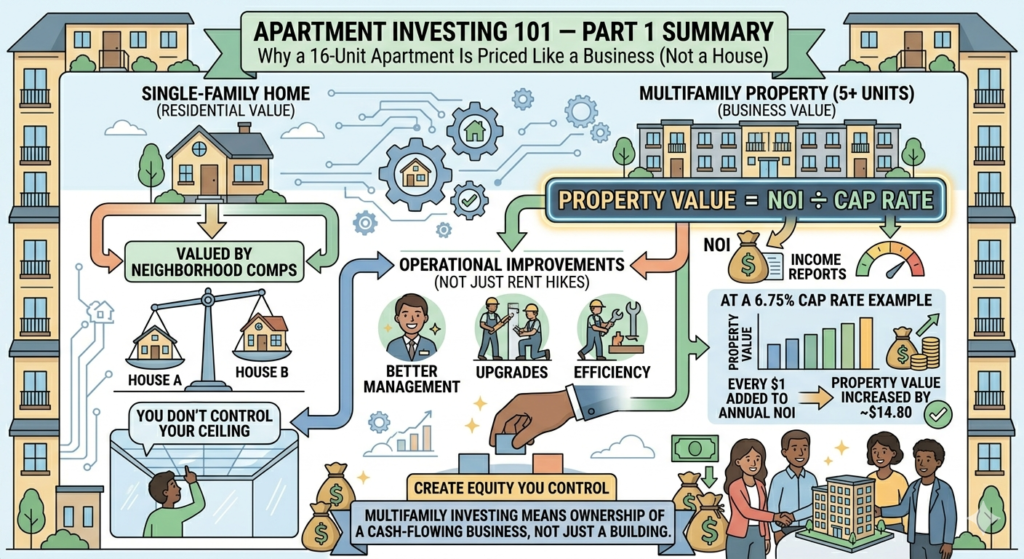
When you buy a 3-bedroom row house in Germantown, the price is based on comps — what similar houses nearby sold for recently. That’s it. You don’t control it. The neighborhood controls it.
You could gut-renovate every inch of that house, put in quartz countertops and heated floors, and if the comps don’t support it? You’re capped. The market decides your ceiling.
This is why flipping single-family homes has a built-in limitation. You’re always chasing the neighborhood’s value, not creating your own.
How Apartment Buildings Are Valued (This Is Where It Gets Interesting)
Multifamily properties — we’re talking 5+ units — are valued completely differently. Instead of comps, they’re priced based on income. Specifically, something called Net Operating Income, or NOI.
The formula is simple:
Property Value = NOI ÷ Cap Rate
Let me break that down.
NOI (Net Operating Income) = Total rental income + any other income (pet fees, laundry, parking) minus operating expenses (property management, maintenance, insurance, taxes). Not including your mortgage payment.
Cap Rate (Capitalization Rate) = The expected return rate in a given market. In Philadelphia, you’re generally looking at somewhere in the 6–8% range depending on the neighborhood and property type.
So if a 16-unit building brings in $130,000 NOI per year, and the local cap rate is 6.75%:
$130,000 ÷ 0.0675 = $1,925,925 property value
That’s how the math works. And here’s why this changes everything.
You Can Actually Control the Value
With a single-family home, you’re at the mercy of your neighbors’ sale prices. But with a multifamily property, you control the NOI — which means you control the value.
Think about what that means in practice. If you find a 16-unit building that’s being mismanaged — deferred maintenance, below-market rents, no pet fees, no utility billing — there’s a gap between what it’s currently worth and what it could be worth once you run it properly.
That gap is your opportunity.
Let’s say the building is currently generating $115,000 NOI. At a 6.75% cap rate:
$115,000 ÷ 0.0675 = $1,703,703 value
Now you buy it, spend a year fixing deferred maintenance, getting rents to market rate, adding pet fees and a RUBS (Ratio Utility Billing System) program. NOI goes up to $130,000.
$130,000 ÷ 0.0675 = $1,925,925 value
You just created $222,000 in value — not by waiting for the neighborhood to change, but by running the property like a business.
The $1 Rule That Blew My Mind
Here’s the part that genuinely stopped me mid-scroll when I first understood it.
At a 6.75% cap rate, every $1 you add to annual NOI adds roughly $14.80 to the property’s value.
So if you figure out how to reduce landscaping costs by $200/month — that’s $2,400/year in NOI improvement. Which translates to:
$2,400 × 14.80 = $35,520 in added property value
From a landscaping contract renegotiation.
This is the math that makes multifamily so powerful. Small operational improvements compound into serious equity — fast.
Why This Matters If You’re Starting Out
I’m not saying go buy a 16-unit apartment tomorrow. I’m not there yet either. But understanding how these properties are valued completely reframes how you look at real estate as a wealth-building tool.
Single-family investing is great for learning the ropes — and flipping is still my entry point. But multifamily is where the math starts working at a different level. You’re not just buying real estate. You’re acquiring a cash-flowing business where you set the terms.
In Part 2, I’m going to break down the specific ways you can increase NOI without just raising rents — because honestly, rent hikes alone are lazy strategy and they come with real risks. There’s a smarter way to do this.
Not financial advice — just someone doing a lot of research and asking a lot of questions.