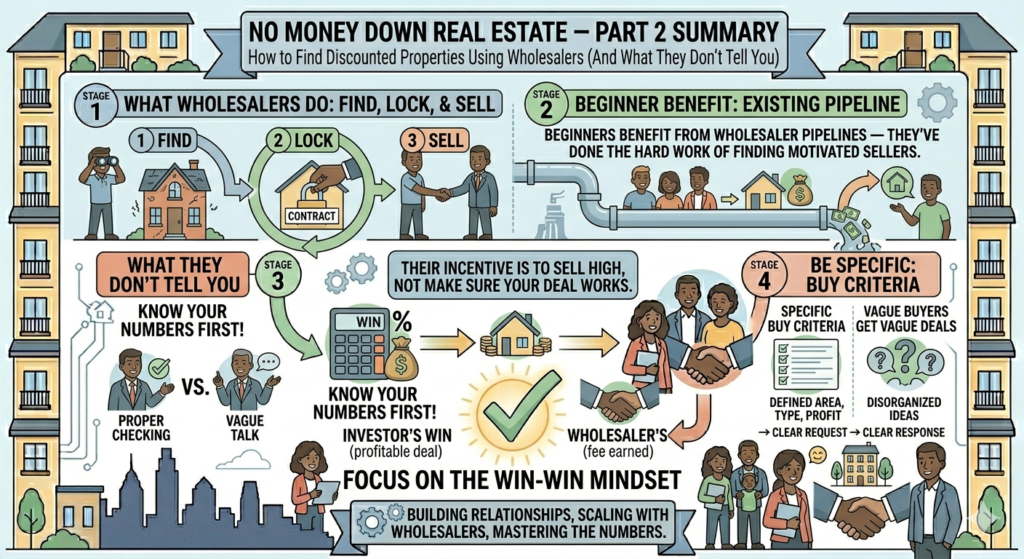
Real estate wholesalers are one of the most underutilized deal sources for beginning investors — and one of the most misunderstood. If OPM only works when the deal is good enough that someone wants to fund it, then finding those deals is the other half of the equation.
A private lender or hard money lender isn’t going to hand you $300,000 for a mediocre property at full market price. They need margin. Which means you need margin. And that means finding properties priced below what they’re actually worth.
Easier said than done — unless you know how real estate wholesalers work.
What Is a Real Estate Wholesaler?
A real estate wholesaler finds deeply discounted properties — usually distressed, often off-market — and puts them under contract. Then instead of buying the property themselves, they sell that contract to an investor for a fee.
The wholesaler never owns the property. They’re selling you the right to buy it at a negotiated price. Their profit is the spread between what they locked it up for and what you pay them for the contract.
Simple example:
| Real estate wholesaler locks up distressed property at | $110,000 |
| ARV of the property | $200,000 |
| Assignment fee to you | $125,000 |
| Wholesaler profit | $15,000 |
| Your entry point vs ARV | $75,000 below ARV before repairs |
That gap is your opportunity. Your rehab budget, your profit, your equity — it all lives in that spread.
Why Beginners Should Pay Attention to Real Estate Wholesalers
When you’re starting out, finding off-market deals yourself is hard. It takes time, systems, marketing dollars, and negotiation experience. Direct mail campaigns, driving for dollars, cold calling motivated sellers — all of that works, but it’s a grind with a steep learning curve.
Real estate wholesalers have already done that work. They’re out there every single day looking at houses, talking to sellers, negotiating contracts. It’s their full-time job.
Connecting with good local wholesalers gives you access to a deal pipeline you didn’t have to build yourself. That’s valuable — especially early on.
The Part Real Estate Wholesalers Don’t Always Tell You
Wholesalers make money on the spread. Which means their incentive is to sell the contract for as much as possible — not necessarily to make sure your deal pencils out.
Some real estate wholesalers are great. They know the market, they’re honest about condition, they want repeat buyers so they bring you real deals.
Others will overprice the assignment fee, underestimate repairs, or push deals that don’t actually work for an investor. They’re counting on you not knowing the numbers well enough to catch it.
This is why you have to know your numbers before you talk to a wholesaler. Not after.
You need to be able to run ARV quickly. Estimate repairs at least roughly. Know your hard money lender’s criteria. If you can’t evaluate the deal independently, you’re at their mercy.
The real estate wholesaler is a tool. A useful one. But you’re the one who has to decide if the deal actually works.
How to Find Good Real Estate Wholesalers in Philadelphia
This is more relationship-based than people expect.
Real estate investor meetups. Philadelphia has active REI groups. Show up consistently. Real estate wholesalers are always there because investors are their customers. Introduce yourself, tell them what you’re looking for, ask to be on their list.
Facebook groups. Philadelphia real estate investing groups on Facebook are active. Wholesalers post deals there regularly. Even if the deals aren’t right for you yet, watching what gets posted teaches you what the market looks like.
BiggerPockets. Search for wholesalers in the Philadelphia area. Message them directly. Tell them your buy criteria.
Title companies and real estate attorneys. They see every transaction. They know who the active real estate wholesalers are. Building relationships here gets you referrals.
The goal is to get on three to five active wholesalers’ buyer lists and start receiving deals regularly. Most won’t be right for you. But you’re building pattern recognition every time you analyze one — even the ones you pass on.
According to BiggerPockets, real estate wholesalers account for a significant percentage of off-market deals acquired by active fix-and-flip investors — particularly in urban markets like Philadelphia where distressed inventory is high but competition for listed properties is fierce.
What to Tell Real Estate Wholesalers So They Bring You the Right Deals
Wholesalers work with a lot of buyers. If you’re vague about what you want, you’ll get everything — including a lot of deals that waste your time.
Be specific:
- “I’m looking for single-family or small multifamily in North and West Philadelphia.”
- “My max purchase price including assignment fee is X.”
- “I need at least 20% equity after repairs at ARV.”
- “I’m working with a hard money lender so I can close in 2–3 weeks.”
The clearer your criteria, the more useful you are to them as a buyer — and the better deals real estate wholesalers will bring you first.
The Win-Win Mindset With Real Estate Wholesalers
It’s okay if the wholesaler makes good money on the deal.
Getting territorial about a wholesaler’s $20,000 assignment fee is a losing mindset. If you’re still buying at $40,000 below what the property is worth after repairs — who cares? The deal works. That’s what matters.
And if you treat real estate wholesalers well — close when you say you will, don’t renegotiate at the last minute, give them quick answers — they’ll bring you their best deals first. That relationship compounds over time.
Use the Philadelphia Deal Finder to cross-reference any wholesaler deal against current Philadelphia market data before you commit — knowing your ARV cold is what keeps you from overpaying on an assignment fee.
Not financial advice — just someone doing a lot of research and asking a lot of questions.