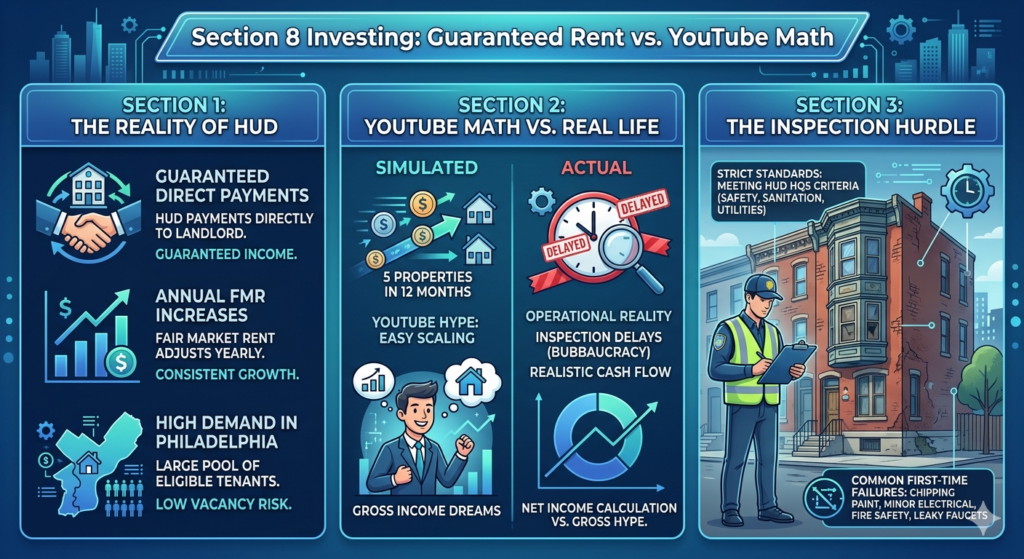
Section 8 rental income investing gets pitched as the ultimate passive income hack. Guaranteed rent from the government. Stable tenants. Annual rent increases built right in. Three years to 153 properties.
I’m not saying it’s wrong. I’m saying let’s actually look at what Section 8 is, what the real advantages are, and what those YouTube simulations conveniently leave out.
What Is Section 8 Rental Income?
Section 8 is the common name for the Housing Choice Voucher Program, administered by HUD. Here’s how it works:
- A qualified tenant receives a housing voucher from their local Public Housing Authority (PHA)
- The voucher covers a portion of their rent — sometimes the majority, sometimes almost all of it
- The tenant pays the difference (typically 30% of their income)
- The landlord receives the government portion directly from the PHA every month
For landlords, the appeal is obvious: a significant chunk of your rent check comes from the federal government, not from a tenant who might lose their job or skip town.
In Philadelphia, Section 8 rental income is administered through the Philadelphia Housing Authority. The program is active, the voucher holders are plentiful, and the demand for qualified landlords is real.
The Genuine Section 8 Rental Income Advantages
Guaranteed partial payment. The government portion arrives on time, every month, regardless of what’s happening in the tenant’s life. If a tenant loses their job, your HUD payment still comes in. That’s meaningful stability compared to a fully market-rate tenant who might be one paycheck away from missing rent.
Annual rent increases. HUD publishes Fair Market Rents (FMR) annually. As FMRs increase, you can request rent adjustments. In Philadelphia, FMRs have been moving up in recent years.
Tenant screening pre-done (partially). Voucher holders have already gone through income verification with the PHA. That doesn’t mean you skip your own screening — you absolutely should — but there’s a baseline of documentation already established.
Lower vacancy in some markets. In Philadelphia specifically, demand for Section 8-qualified housing often exceeds supply. A well-maintained property in an eligible neighborhood can rent quickly to voucher holders.
The YouTube Section 8 Rental Income Math Problem
Here’s a simulation I’ve seen multiple times:
- Start with $10,000
- Buy first property with seller financing ($10K down)
- Generate $500/month cash flow
- Save $1,500/month combined
- Buy second property in 4 months
- Repeat until you have 5 properties in 12 months
- Collect $30,000/year passively and retire
Let me stress-test this against Philadelphia reality.
Finding seller-financed Section 8 properties with $5,000–$10,000 down: These deals exist. But they’re not common, they’re not easy to find, and they won’t fall into your lap because you watched a YouTube video. The sellers who offer low down payments via seller financing are usually highly motivated. You need deal-sourcing skills and relationships to access them consistently.
$500–$800/month cash flow per door: In some Philadelphia zip codes, this is achievable. In others, your expenses — taxes, insurance, maintenance, management — will eat most of that. The simulation assumes everything goes smoothly.
Scaling from 1 to 5 properties in 12 months: Each Section 8 rental income property requires a HUD inspection before a voucher holder can move in. If the property fails inspection — and older Philadelphia row homes often have issues — you’re doing repairs before you collect a dime.
The Real Challenges of Section 8 Rental Income Investing
HUD inspections are strict. Before a voucher holder can move in, a HUD inspector must approve the property. Chipped paint (lead paint concerns), faulty outlets, plumbing issues, window problems — all can fail inspection. If a property fails, you fix the issues and schedule a re-inspection. That’s time between purchase and first rent check.
You still manage the tenant relationship. The government pays their portion of the Section 8 rental income. But you’re still the landlord. You still handle maintenance requests. You still deal with lease violations. You still go through the eviction process if necessary — and evicting a Section 8 tenant has additional steps because the PHA is involved.
Property condition requirements are ongoing. HUD doesn’t just inspect at move-in. There are annual inspections. If your property falls below standards, you can lose the voucher — meaning you lose the government portion of rent — until repairs are made.
Source of income discrimination is illegal in Philadelphia. You cannot refuse to rent to someone solely because they have a voucher. You can screen Section 8 applicants the same way you’d screen any applicant — income ratios, rental history, references — but the voucher itself cannot be grounds for rejection.
According to HUD.gov, Section 8 rental income properties that fail annual inspections are immediately suspended from the program until deficiencies are corrected — making proactive property maintenance non-negotiable for landlords who rely on government-backed rent.
Is Section 8 Rental Income Worth It in Philadelphia?
For the right investor and the right property — yes.
The investors who do well with Section 8 rental income in Philadelphia tend to share a few traits: they maintain their properties proactively, they screen tenants carefully within legal limits, they understand the PHA paperwork process, and they’re optimizing for stability and low vacancy rather than maximum rent.
The investors who struggle tend to buy the cheapest possible properties, do minimal maintenance, and wonder why they’re failing inspections and dealing with problem tenants.
Section 8 rental income rewards good landlords. It punishes negligent ones more visibly than the market-rate rental market does.
The Snowball Is Real — Just Slower
The core concept — using rental income to accelerate savings and buy the next property faster — is genuinely sound. More income equals shorter time to next down payment.
What the simulations get wrong is the timeline:
- Finding your first seller-financed Section 8 deal might take 3–6 months of active searching
- HUD inspection and move-in process adds 30–60 days before first rent check
- Realistic cash flow after expenses might be $300–$500/door, not $500–$800
- Scaling to 5 properties in a year is aggressive for someone doing this while working full time
The snowball works. It just rolls a little slower than the YouTube version.
Use the Multi-Unit Cash Flow Calculator to model your Section 8 rental income scenario — plug in HUD payment standards for your Philadelphia zip code and realistic expense ratios before you make any offer.
Not financial advice — just someone doing a lot of research and asking a lot of questions.