Land flipping for beginners starts with a number that stopped me cold: $763. For land near water.
The person who bought it didn’t visit it. Didn’t call anyone. Sat at their computer, did their research on Google Earth, checked the county records, and clicked bid. A few weeks later they listed it online for $3,500 and sold it.
No contractors. No tenants. No evictions. No phone calls. Just land — bought cheap, sold for more.
I’ve been down a rabbit hole ever since.
What Is Land Flipping for Beginners?
Land flipping for beginners is exactly what it sounds like. You buy raw, undeveloped land — usually at a tax sale or through motivated sellers — at a significant discount. Then you sell it to someone else for more than you paid.
No renovation. No rehab. No tenants. No management.
The land just sits there between the time you buy it and the time you sell it. Which is fine, because land doesn’t break.
This is different from house flipping, which requires contractors, timelines, surprise repairs, and a lot of coordination. Land flipping for beginners at the entry level is one of the simplest real estate strategies that exists — and one of the least talked about.
How Tax Sales Create the Land Flipping for Beginners Opportunity
When a property owner stops paying taxes, the county eventually auctions the property to recover what’s owed. This applies to land too — not just houses.
And here’s the thing about raw land at tax sales: there’s less competition. Most investors at tax auctions are looking for houses they can flip or rent. Vacant land parcels — especially in rural areas — get fewer bids. Sometimes they sell for nothing more than the back taxes owed.
That’s where the $763 lake-adjacent parcel comes from. Someone wasn’t paying taxes on a piece of land. The county auctioned it. Most investors in the room were looking for houses. One person recognized the land flipping for beginners opportunity, did their homework, and walked away with a waterfront-adjacent parcel for less than a car payment.
The Google Earth Due Diligence Process for Land Flipping for Beginners
Here’s what makes land flipping for beginners uniquely suited to doing entirely from your computer.
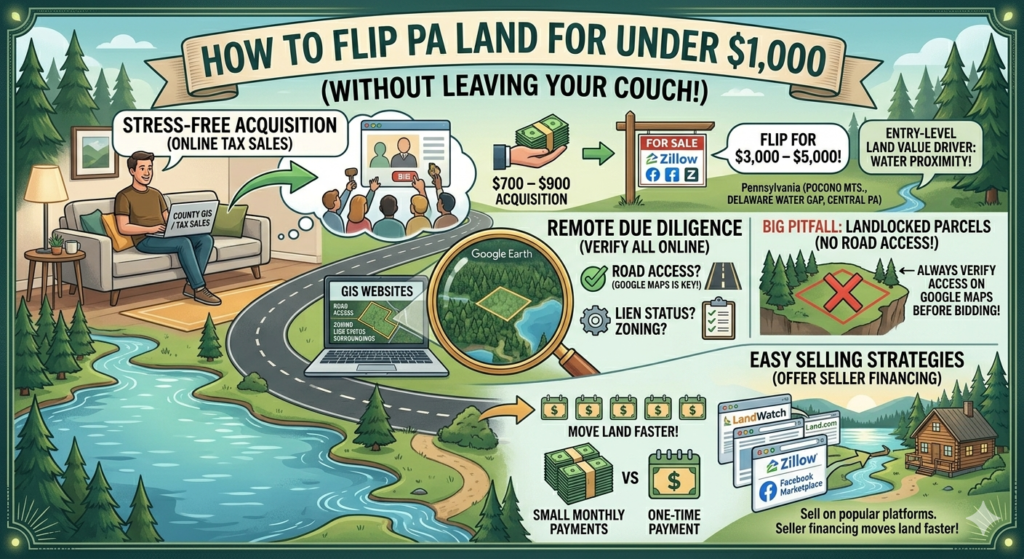
Question 1: Is there road access?
Open Google Earth or Google Maps. Find the parcel. Is there a road that touches the property? If yes — good. If the parcel is surrounded by other private land with no public road access, that’s a landlocked parcel. These are very hard to sell. Pass.
Question 2: What’s around it?
Zoom out. What’s the context? Is it near water — a lake, river, creek? That adds value. Is it near other developed properties? Near a town? Near recreational areas? Or is it in the middle of absolute nowhere with nothing for miles?
Water access is the single biggest value driver for raw land at the entry level. A parcel near a lake or river that costs $800 at tax sale can sell for $3,000–$5,000 to someone who wants a camping spot or a future cabin site.
Question 3: What are the zoning and restrictions?
Every county has a GIS website where you can look up any parcel by address or parcel ID number. This tells you the zoning designation — residential, agricultural, commercial, conservation. A parcel zoned conservation or located in a flood plain may have significant restrictions. Know before you bid.
Question 4: Are there liens?
At a Judicial Tax Sale in Pennsylvania, most liens are wiped clean. At an Upset Sale, they’re not. Know which type of sale you’re bidding at, and verify the lien status through the county tax claim bureau before you bid.
The Water Rule: Land Flipping for Beginners’ Most Important Filter
If I’m looking at land parcels for under $1,000, the single filter I care most about is proximity to water.
Lakes, rivers, ponds, creeks — any natural water feature near a parcel dramatically increases its appeal to buyers:
- Camping buyers want a spot near water — they’ll pay more
- Future cabin buyers dream about water views — they’ll pay more
- Recreational buyers — hunters, fishers, hikers — want land near natural features — they’ll pay more
A $700 parcel in the middle of a flat agricultural field might sit on the market for months. A $900 parcel with a creek running through it can sell in a week to someone who just wants a quiet place to camp on weekends.
This is the land flipping for beginners due diligence filter I apply first on Google Earth: is there water anywhere near this thing?
How to Sell Land After Land Flipping for Beginners Purchases
Once you own a parcel, selling it is simpler than most people expect.
Where to list:
- Zillow — yes, Zillow lists vacant land
- LandWatch.com — specifically for land buyers
- Facebook Marketplace — surprisingly active for land sales
- Land.com and LandFlip.com — dedicated land listing sites
- Craigslist — still works for lower-priced parcels
What to include in your listing:
- Clear description of the parcel size and location
- Screenshots from Google Earth showing the property and surroundings
- County GIS map showing the parcel boundaries
- Any notable features (water nearby, road access, trees)
Seller financing to move it faster:
One technique land flippers use is offering seller financing. Instead of requiring the buyer to pay $3,000 upfront, you let them pay $300 down and $100/month for 30 months. You end up with more money total, and the lower barrier to entry means your land sells faster.
This sounds complicated but it’s not — there are simple promissory note templates specifically for land seller financing, and because the amounts are small, it’s much lower stakes than seller financing on a house.
How to Flip Land for Under $1,000 (Without Leaving Your Couch)
By pinotnoirmom / May 13, 2026
Land flipping for beginners starts with a number that stopped me cold: $763. For land near water.
The person who bought it didn’t visit it. Didn’t call anyone. Sat at their computer, did their research on Google Earth, checked the county records, and clicked bid. A few weeks later they listed it online for $3,500 and sold it.
No contractors. No tenants. No evictions. No phone calls. Just land — bought cheap, sold for more.
I’ve been down a rabbit hole ever since.
What Is Land Flipping for Beginners?
Land flipping for beginners is exactly what it sounds like. You buy raw, undeveloped land — usually at a tax sale or through motivated sellers — at a significant discount. Then you sell it to someone else for more than you paid.
No renovation. No rehab. No tenants. No management.
The land just sits there between the time you buy it and the time you sell it. Which is fine, because land doesn’t break.
This is different from house flipping, which requires contractors, timelines, surprise repairs, and a lot of coordination. Land flipping for beginners at the entry level is one of the simplest real estate strategies that exists — and one of the least talked about.
How Tax Sales Create the Land Flipping for Beginners Opportunity
When a property owner stops paying taxes, the county eventually auctions the property to recover what’s owed. This applies to land too — not just houses.
And here’s the thing about raw land at tax sales: there’s less competition. Most investors at tax auctions are looking for houses they can flip or rent. Vacant land parcels — especially in rural areas — get fewer bids. Sometimes they sell for nothing more than the back taxes owed.
That’s where the $763 lake-adjacent parcel comes from. Someone wasn’t paying taxes on a piece of land. The county auctioned it. Most investors in the room were looking for houses. One person recognized the land flipping for beginners opportunity, did their homework, and walked away with a waterfront-adjacent parcel for less than a car payment.
The Google Earth Due Diligence Process for Land Flipping for Beginners
Here’s what makes land flipping for beginners uniquely suited to doing entirely from your computer.
Question 1: Is there road access?
Open Google Earth or Google Maps. Find the parcel. Is there a road that touches the property? If yes — good. If the parcel is surrounded by other private land with no public road access, that’s a landlocked parcel. These are very hard to sell. Pass.
Question 2: What’s around it?
Zoom out. What’s the context? Is it near water — a lake, river, creek? That adds value. Is it near other developed properties? Near a town? Near recreational areas? Or is it in the middle of absolute nowhere with nothing for miles?
Water access is the single biggest value driver for raw land at the entry level. A parcel near a lake or river that costs $800 at tax sale can sell for $3,000–$5,000 to someone who wants a camping spot or a future cabin site.
Question 3: What are the zoning and restrictions?
Every county has a GIS website where you can look up any parcel by address or parcel ID number. This tells you the zoning designation — residential, agricultural, commercial, conservation. A parcel zoned conservation or located in a flood plain may have significant restrictions. Know before you bid.
Question 4: Are there liens?
At a Judicial Tax Sale in Pennsylvania, most liens are wiped clean. At an Upset Sale, they’re not. Know which type of sale you’re bidding at, and verify the lien status through the county tax claim bureau before you bid.
The Water Rule: Land Flipping for Beginners’ Most Important Filter
If I’m looking at land parcels for under $1,000, the single filter I care most about is proximity to water.
Lakes, rivers, ponds, creeks — any natural water feature near a parcel dramatically increases its appeal to buyers:
- Camping buyers want a spot near water — they’ll pay more
- Future cabin buyers dream about water views — they’ll pay more
- Recreational buyers — hunters, fishers, hikers — want land near natural features — they’ll pay more
A $700 parcel in the middle of a flat agricultural field might sit on the market for months. A $900 parcel with a creek running through it can sell in a week to someone who just wants a quiet place to camp on weekends.
This is the land flipping for beginners due diligence filter I apply first on Google Earth: is there water anywhere near this thing?
How to Sell Land After Land Flipping for Beginners Purchases
Once you own a parcel, selling it is simpler than most people expect.
Where to list:
- Zillow — yes, Zillow lists vacant land
- LandWatch.com — specifically for land buyers
- Facebook Marketplace — surprisingly active for land sales
- Land.com and LandFlip.com — dedicated land listing sites
- Craigslist — still works for lower-priced parcels
What to include in your listing:
- Clear description of the parcel size and location
- Screenshots from Google Earth showing the property and surroundings
- County GIS map showing the parcel boundaries
- Any notable features (water nearby, road access, trees)
Seller financing to move it faster:
One technique land flippers use is offering seller financing. Instead of requiring the buyer to pay $3,000 upfront, you let them pay $300 down and $100/month for 30 months. You end up with more money total, and the lower barrier to entry means your land sells faster.
This sounds complicated but it’s not — there are simple promissory note templates specifically for land seller financing, and because the amounts are small, it’s much lower stakes than seller financing on a house.
What Can Go Wrong in Land Flipping for Beginners
Landlocked parcels. No road access means no buyers. Always verify access on Google Maps before bidding.
Mobile home parcels. Some cheap parcels have old mobile homes on them — removal costs, potential environmental issues, title problems. Unless you know what you’re doing, avoid parcels with structures.
Overbidding at auction. Set a maximum bid based on your research and don’t go above it because you got caught up in the moment.
No market demand. Some parcels are cheap because nobody wants them. A parcel in a location with no recreational value, no development potential, and no access is hard to sell at any price. Do your research first.
Where to Start Land Flipping for Beginners in Pennsylvania
Pennsylvania’s tax sales — through Bid for Assets and individual county tax claim bureaus — include land parcels regularly.
Beyond Philadelphia County, the areas worth exploring for recreational land opportunities:
- Pocono Mountains (Monroe, Pike, Wayne Counties) — lake and mountain recreational land
- Delaware Water Gap area — near the national recreation area
- Central Pennsylvania (Clearfield, Clinton, Potter Counties) — hunting and timber land
- Susquehanna County — rolling hills, rural, relatively low prices
According to BiggerPockets, land flipping for beginners has grown significantly as a strategy precisely because it requires minimal capital, no construction knowledge, and can be executed entirely through online research — making it one of the most accessible entry points into real estate investing available.
Use the Land Potential Analyzer to evaluate any Pennsylvania parcel before you bid — check road access, zoning, water proximity, and comparable land sales before you click bid on anything.
Not financial advice — just someone doing a lot of research and asking a lot of questions.
What Can Go Wrong in Land Flipping for Beginners
Landlocked parcels. No road access means no buyers. Always verify access on Google Maps before bidding.
Mobile home parcels. Some cheap parcels have old mobile homes on them — removal costs, potential environmental issues, title problems. Unless you know what you’re doing, avoid parcels with structures.
Overbidding at auction. Set a maximum bid based on your research and don’t go above it because you got caught up in the moment.
No market demand. Some parcels are cheap because nobody wants them. A parcel in a location with no recreational value, no development potential, and no access is hard to sell at any price. Do your research first.
Where to Start Land Flipping for Beginners in Pennsylvania
Pennsylvania’s tax sales — through Bid for Assets and individual county tax claim bureaus — include land parcels regularly.
Beyond Philadelphia County, the areas worth exploring for recreational land opportunities:
- Pocono Mountains (Monroe, Pike, Wayne Counties) — lake and mountain recreational land
- Delaware Water Gap area — near the national recreation area
- Central Pennsylvania (Clearfield, Clinton, Potter Counties) — hunting and timber land
- Susquehanna County — rolling hills, rural, relatively low prices
According to BiggerPockets, land flipping for beginners has grown significantly as a strategy precisely because it requires minimal capital, no construction knowledge, and can be executed entirely through online research — making it one of the most accessible entry points into real estate investing available.
Use the Land Potential Analyzer to evaluate any Pennsylvania parcel before you bid — check road access, zoning, water proximity, and comparable land sales before you click bid on anything.
Not financial advice — just someone doing a lot of research and asking a lot of questions.