Sober living investment clicked for me in a way that purely financial strategies never have. I don’t write about this from a distance — I lived through something that looks a lot like what Sober Living houses are designed to address. So let me explain the numbers first, and then why this one is personal.
My Story First
I immigrated to the United States at 30 for marriage. I didn’t grow up here. I didn’t have a foundation of friendships or family nearby. When my marriage ended, I was alone in a country that still didn’t fully feel like mine, with a language I was still learning, and an ADHD brain that was already working overtime just to keep up with daily life.
I did what a lot of people do when they don’t know what else to do. I found people to drink with. ADHD and alcohol are a brutal combination. My brain, which already struggled with focus and regulation, became completely unmanageable. I couldn’t hear conversations clearly. I couldn’t learn. My English stopped improving. Everything felt like static.
Two years ago, I stopped drinking.
The buzzing stopped. I could think again. I could plan. I could sit down and actually do something — like start a real estate investing blog, research Philadelphia Tax Sale properties until midnight, and drive around South Philly looking at buildings I want to buy someday.
Sobriety didn’t fix everything. But it gave me back my brain. And with my brain back, I could actually build something.
I say all of this because when I started researching sober living investment, I didn’t just see a business model. I saw people who needed what I had somehow found on my own — a stable, calm, substance-free environment where they could get their brains back too.
What Sober Living Actually Is
A Sober Living home — sometimes called a recovery residence — is a shared housing environment for people in recovery from drug or alcohol addiction. Residents live together, split costs, follow house rules, support each other, and gradually rebuild their lives.
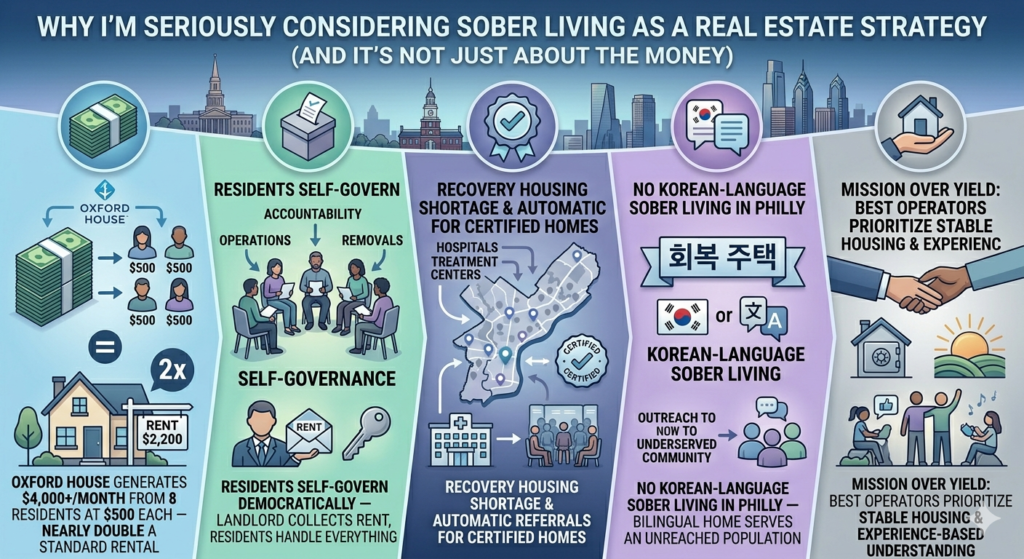
The most well-known sober living investment model is Oxford House — a national nonprofit running since 1975. Oxford Houses are democratically self-governed by the residents themselves. No paid staff, no house manager, no professional oversight. The residents elect their own officers, set their own schedules, and hold each other accountable.
The rules are simple:
- Stay sober. Any resident who relapses is immediately voted out.
- Pay your share of expenses.
- Don’t be disruptive.
That’s it. Everything else is up to the house.
The Sober Living Investment Numbers
A typical Oxford House accommodates 8 to 15 residents. Each resident pays an equal share of rent and utilities — averaging $400 to $600 per month depending on location.
8 residents × $500/month = $4,000/month in gross rent.
From one house.
Compare that to renting the same house to a single family for $2,200/month. The sober living investment model generates nearly double the income — from the same physical property.
And the vacancy risk is lower than you’d expect. Philadelphia has one of the highest rates of substance use disorder and overdose deaths in the United States. The demand for stable, peer-supported recovery housing far exceeds the supply. Oxford House maintains a national vacancy board at oxfordvacancies.com — and there are almost always more people looking for spots than available beds.
As a landlord renting to an Oxford House:
- You register your property with Oxford House Inc.
- Residents move in and self-govern
- You collect rent
- The residents handle everything else — including removing anyone who relapses or stops paying
You’re not managing a house. You’re providing a house that manages itself.
Why Philadelphia Is the Right Market for Sober Living Investment
Philadelphia’s recovery housing shortage is documented and ongoing. The city’s behavioral health system actively seeks referral partners for people exiting detox, inpatient treatment, and incarceration.
If you operate a certified sober living investment property in Philadelphia — certified through PARR, the Pennsylvania Alliance of Recovery Residences — you become a referral destination for the entire city’s treatment infrastructure. Your beds fill through relationships, not advertising.
There’s also a gap I’ve noticed personally: there is almost no Korean-language Sober Living in Philadelphia.
The Korean American community here is not immune to addiction. But the language barrier, the cultural stigma, and the lack of culturally appropriate resources mean that many Korean Americans who need help don’t find it. A bilingual recovery home — run by someone who understands both cultures, who has lived the isolation of being an immigrant alone in a new country — could serve a population that nobody else is serving.
What It Actually Takes to Start a Sober Living Investment Property
Option A: Rent your property to an Oxford House
The simplest sober living investment path. Oxford House Inc. lists properties on their website for groups of residents looking for a home. You provide the house, they provide the residents and the self-governance structure. You collect rent and stay out of the operations.
Option B: Open your own certified Sober Living home
More involved, but more control. In Pennsylvania:
- Form an LLC or nonprofit
- Get PARR certification (voluntary but strongly recommended for referrals)
- Hire or designate a house manager
- Establish house rules, intake process, and resident agreements
- Build referral relationships with treatment centers and hospitals
Pennsylvania does not require a license to operate a non-clinical Sober Living home — but PARR certification significantly improves your credibility and referral access.
Property requirements for sober living investment:
- Multiple bedrooms (6–10 minimum for economic viability)
- Common areas — living room, kitchen, dining
- Accessible location near public transit, employment, and recovery meetings
- Safe neighborhood
What I Actually Want to Do With Sober Living Investment
I’ll be honest: I’m not looking at this purely as a yield play.
I want to cook for people. I want to create a space where someone who is trying to get their life back can come home to a real meal, a clean room, and people who understand what they’re going through.
The business has to work financially. Rent has to cover costs. That’s not negotiable. But the reason I want to do this isn’t the cash flow.
It’s that I know what it feels like to be in a country that doesn’t fully feel like yours, to be struggling with something you can barely name, to not have the right support around you. And I know what it felt like when things got better.
My sister has spent years working in shelters helping women in difficult situations. Between her experience with vulnerable populations and my experience navigating sobriety, immigration, and rebuilding — we might actually be the right people to do this.
It’s not a tomorrow plan. But it’s on the list.
According to HUD.gov, recovery housing is a federally recognized component of the continuum of care for substance use disorder — and cities with documented housing shortages like Philadelphia receive priority consideration for federal behavioral health funding that supports recovery residence development.
Use the Rental Property ROI Calculator to model your sober living investment returns — plug in the per-resident rate, number of beds, and operating costs to see how the income compares to conventional single-family rental at the same property.
Not financial advice — just someone doing a lot of research, a lot of soul-searching, and asking a lot of questions.