If you read Part 1, you already know the difference between tax foreclosure and mortgage foreclosure — and why Bid4Assets is the place to start if you’re just getting your feet wet with Philadelphia Sheriff Sales.
Now let’s talk about what you actually do when you pull up a listing.
Because here’s the thing — Bid4Assets gives you an address and a starting bid. That’s it. Everything else, you have to go find yourself. And if you don’t know where to look, you’re basically bidding blind.
I’ve been going through real listings and building out a research routine. Here’s exactly how I do it.
Step 1: Look Up the Property on OPA First
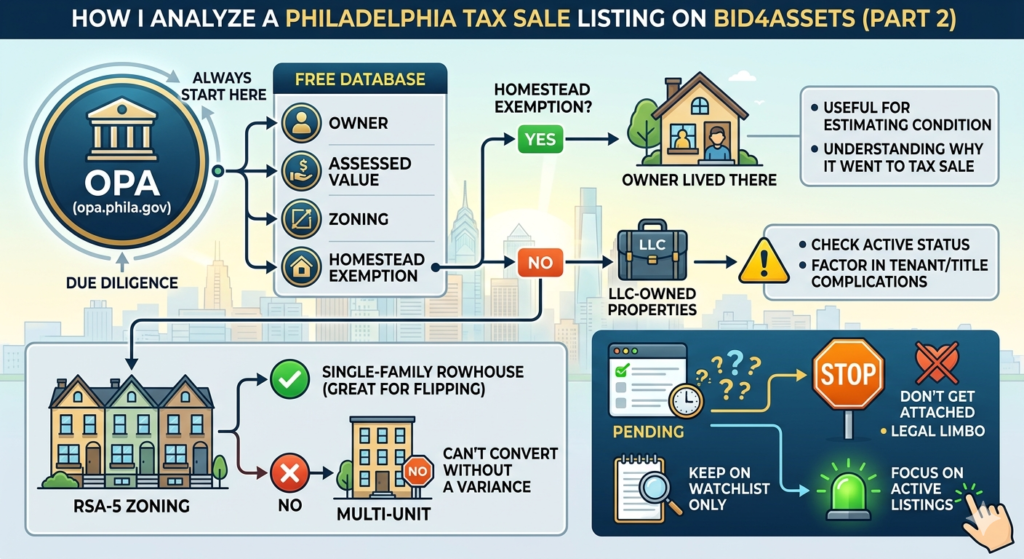
The first thing I do with any philadelphia tax sale bid4assets listing is plug the address into OPA — the Office of Property Assessment at opa.phila.gov.
It’s free, no login required, and it tells you almost everything you need to know before you go any further:
- Who owns it (and whether it’s an LLC or a real person)
- The official assessed value
- Zoning classification
- Building size, bedroom count, year built
- Whether Homestead Exemption was active
Take maybe five minutes here before you do anything else. It’ll save you a lot of wasted energy on properties that don’t make sense.
What Is Homestead Exemption and Why Does It Matter?
On the OPA page, you’ll sometimes see Homestead Exemption: Yes.
This just means the previous owner was living there as their primary residence — they weren’t using it as a rental or investment property. Philadelphia offers a property tax discount to owner-occupants, and that’s what Homestead Exemption is.
Why does this matter to you as a buyer?
A few reasons:
- It tells you the condition story. Owner-occupied properties are often better maintained than long-term rentals or vacant properties.
- It tells you something went wrong recently. If someone was living there and still lost it to a tax sale, it usually means a financial hardship situation — not a landlord who just stopped caring.
- It affects your rehab estimate. An owner-occupied home that’s been lived in for 20 years looks very different from a vacant rental that’s been ignored.
Not a dealbreaker either way — just useful context.
When the Owner Is an LLC: What to Look For
Sometimes you pull up OPA and the owner isn’t a person — it’s something like “1234 Maple St LLC” or “Philly Holdings Group LLC.”
This changes your analysis a little.
LLCs buying distressed properties are usually investors. Which means:
- The property was likely already a rental
- There may be tenants still inside (which complicates your timeline significantly)
- The LLC may have other liens or judgments that could cloud the title
- It’s worth doing a quick search on the LLC in Pennsylvania’s business registry to see if it’s even still active
An inactive or dissolved LLC that owns a property heading to tax sale is actually a red flag worth noting — it sometimes means the property has been completely abandoned by whoever was managing it.
None of this means don’t bid. It means go in with eyes open and factor in extra due diligence time.
RSA-5 Zoning: What It Means in Plain English
When you’re looking at Philadelphia tax sale properties on Bid4Assets, you’ll see zoning codes all over the place. The most common one in residential neighborhoods is RSA-5.
RSA-5 = Residential Single Family Attached, 5th density category
In plain English: it’s zoned for a standard rowhouse. One unit, attached on the sides to neighboring properties.
This matters because:
- You cannot legally convert it to a multi-unit rental without going through a zoning variance process (which takes time and money)
- It’s great for a flip — buy, renovate, sell to an owner-occupant
- It’s also fine for a single-family rental
- But if your strategy requires two units or more, RSA-5 is not your friend without additional steps
Always check the zoning before you get excited about a property. A beautiful rowhouse in a good neighborhood means nothing if the zoning doesn’t match your exit strategy.
Why Is Everything “Pending”?
If you’ve spent more than ten minutes on Bid4Assets, you’ve noticed that a huge percentage of listings show “Pending” status.
This threw me off at first. Pending what? Pending who?
Here’s what’s actually happening:
Philadelphia’s tax sale process moves slowly. A property can be flagged for tax sale, listed, and then sit in legal limbo for months — sometimes years — while the city works through the court process, the owner files objections, or payment arrangements get negotiated.
“Pending” usually means one of these:
- The owner made a last-minute payment or payment plan
- There’s an active legal challenge or bankruptcy filing
- The property is still going through the court confirmation process
- The sale happened but hasn’t been fully recorded yet
The practical takeaway: don’t fall in love with a Pending property. Keep it on your watchlist, but focus your energy on active listings. Pending can flip back to available — or it can disappear entirely.
Putting It All Together: My Quick Analysis Routine
When I pull up a philadelphia tax sale bid4assets listing now, here’s my order of operations:
- OPA lookup — owner name, assessed value, zoning, Homestead Exemption
- LLC check — if it’s an LLC, search Pennsylvania business registry
- Zoning check — does RSA-5 (or whatever the code is) match my exit strategy?
- Homestead Exemption — owner-occupied or investor-owned?
- Status check — Active or Pending? If Pending, move on for now
- Starting bid vs. assessed value — is there actual room here?
- Neighborhood pulse — what are similar properties actually selling for?
That last one is where the Sheriff Sale Bid Calculator comes in handy — it helps you work backward from ARV to figure out your max bid before you get caught up in auction excitement.
It’s not a perfect system. I’m still learning. But having a routine means I’m not just randomly clicking through listings hoping something jumps out.
What’s Next
Part 1 covered the difference between tax and mortgage foreclosure. Part 2 is what you just read — the actual research routine.
Part 3 is going to get into the numbers: how to figure out if the starting bid actually makes sense, what ARV means in a Philadelphia context, and how to avoid the most common mistake beginners make at auction (spoiler: it involves getting emotional about a property before you’ve run the math).
Stay tuned.