BRRRR strategy beginners make the same mistake I made on my first LA flip — outsourcing the knowledge along with the labor.
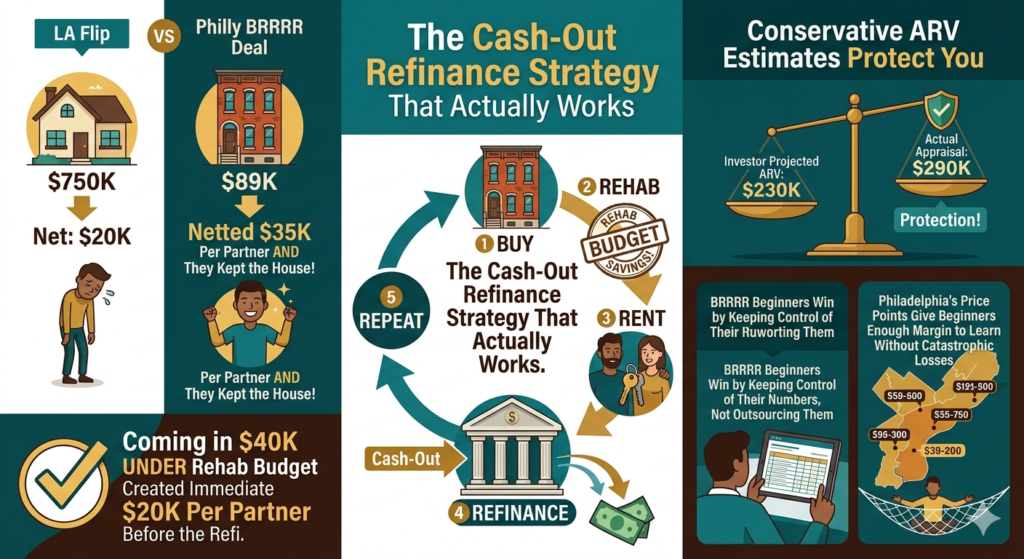
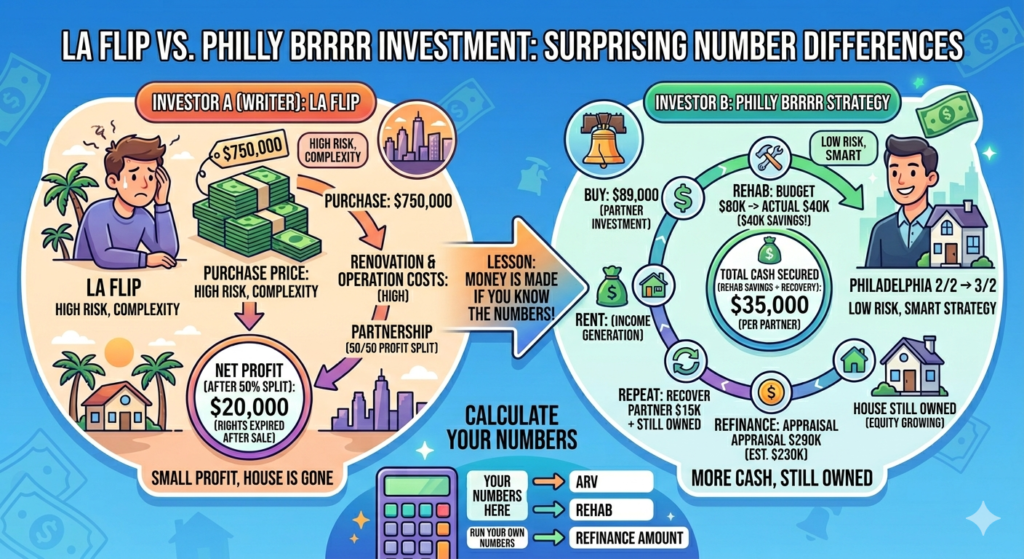
After everything — the renovation, the fees, the holding costs, the split — I walked away with about $20,000.
Twenty thousand dollars. On a three-quarter-million-dollar deal.
I wasn’t mad exactly. It was my first flip. I learned a ton. But I also remember thinking… this doesn’t feel right.
The BRRRR Strategy Beginners Should Study: A $89K Philadelphia Deal
Fast forward to now. I’m deep in the Philadelphia market, studying deals constantly, and I came across an investor’s story that stopped me mid-scroll.
Here’s what happened:
He bought a 2bed/2bath for $89,000. His partner covered the purchase price and renovation costs. They budgeted $80K for rehab — and only spent $40K. That $40K in savings? Split evenly. Each partner pocketed $20K just from coming in under budget.
They also bumped the layout from 2 bedrooms to 3 — which matters a lot for appraisal value.
The investor conservatively estimated ARV at $230K. The actual appraisal came in at $290K.
Then they did a cash-out refinance. Each partner pulled out another $15K.
Total per partner: $35,000 — and they still own the property.
No sale. No exit. The house is sitting there building equity while they’ve already been paid.
A few years back, I did my first house flip in LA. Purchase price somewhere in the $700K–$800K range. Very LA, very stressful, very “oh god what am I doing.” I handed off most of the heavy lifting to a company that co-managed the project, and we split the profits 50/50.
Why BRRRR Strategy Beginners Outperform Traditional Flippers
Why did I walk away with less on a deal 8x the size?
In LA, margins are brutal. High purchase prices, high labor costs, buyers who expect perfection. One surprise — and there’s always a surprise — eats your profit fast.
But the bigger issue was that I didn’t really know what I was doing. I outsourced the knowledge along with the labor. I handed over control — and with it, a huge chunk of the upside.
This investor did something different. He kept his numbers conservative on purpose. Underestimate your ARV, spend less than you planned on rehab, and let the deal surprise you.
That’s not luck. That’s discipline. And it’s exactly what BRRRR strategy beginners need to understand before they start.
According to BiggerPockets, the BRRRR method works best when investors build in conservative estimates at every stage — because every stage where you beat your estimate is money you keep.
What the BRRRR Strategy Beginners Calculator Actually Shows You
The real lesson here isn’t “buy cheap houses.”
It’s that the more you understand your numbers — rehab budget, ARV, refi math — the more of your own money you actually keep.
BRRRR strategy beginners need to run three numbers before they commit to any deal:
- Conservative ARV — what comparable renovated properties have actually sold for, not what you hope for
- Rehab budget with cushion — add 15–20% buffer to whatever your contractor tells you
- Cash-out refi math — what the new loan amount looks like at 75% LTV of your appraised value
Want to run your own BRRRR deal? The BRRRR Calculator will show you exactly what a cash-out refi could look like — plug in your numbers and see where you stand.
The Bottom Line for BRRRR Strategy Beginners
I’ve been studying this obsessively since moving to Philadelphia, and I’m still learning. But every time I dig deeper, I find more money I was leaving on the table before.
The Philadelphia market is where BRRRR strategy beginners have a real advantage — lower purchase prices, strong rental demand, and enough margin to absorb the learning curve without catastrophic losses.
Run your numbers before you commit. Know what you expect. Know what’s conservative. And know where you can come in under.