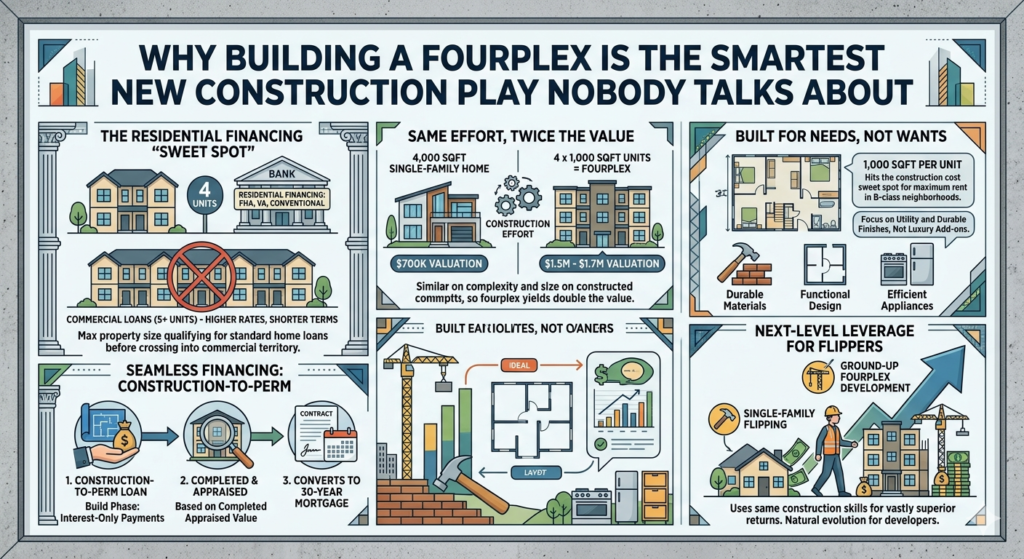
Building a fourplex is the sweet spot that most people in new construction completely overlook. Not a single-family spec home. Not a large apartment complex. Four units, built from the ground up, on a piece of land you control.
Here’s why the math is so compelling — and why the fourplex sits in a uniquely advantageous position that nothing else quite replicates.
The Magic Number: Why Building a Fourplex Changes Everything
In the eyes of lenders, there’s a hard line at 5 units.
1–4 units = residential asset. Conventional financing, FHA loans, VA loans, owner-occupant programs — all available.
5+ units = commercial asset. Higher down payments, stricter underwriting, shorter loan terms, balloon payments, higher rates.
This distinction is enormous. And it means building a fourplex — the largest property you can build while still accessing residential financing — occupies a uniquely powerful position.
You get:
- Commercial-level income (four rent checks per month)
- Residential loan terms (30-year fixed, low down payment options)
- Owner-occupant financing if you live in one unit
Nothing above four units gets you this combination. A fiveplex immediately crosses into commercial territory and the financing picture changes dramatically.
Building a fourplex is the ceiling of residential financing — and smart investors build right up to that ceiling.
Same Effort, Twice the Value When Building a Fourplex
Building a 4,000 square foot single-family home and building a fourplex with four 1,000 square foot units involves roughly the same construction process. Same foundation work. Same framing. Similar materials. Similar timeline. Similar contractor coordination.
The difference is what you end up with.
Single-family home (4,000 sqft):
- Valued by neighborhood comps
- One income stream
- Appraised at roughly $700,000 in many markets
Fourplex (4 × 1,000 sqft units):
- Valued by income (NOI ÷ Cap Rate)
- Four income streams
- Appraised at $1.5M–$1.7M based on rental income
Same construction effort. Potentially $800,000–$1,000,000 difference in value.
That gap exists because the valuation method is completely different. A single-family home is worth what similar homes nearby sold for. Building a fourplex produces an asset worth what its income generates — and you control that income.
The Numbers: Building a Fourplex to Create $1.7M in Value
Construction costs:
| Item | Cost |
|---|---|
| Land acquisition | $200,000 |
| Construction (4 units × ~$185/sqft × 4,000 sqft) | $740,000 |
| Soft costs (permits, architecture, engineering) | $60,000 |
| Financing costs (construction loan interest) | $45,000 |
| Contingency (10%) | $90,000 |
| Total all-in | ~$1,135,000 |
Income side:
- 4 units at $2,500/month: $120,000/year gross
- Vacancy (5%): -$6,000
- Operating expenses (20%): -$24,000
- NOI: ~$90,000/year
Valuation at 5.5% cap rate: $90,000 ÷ 0.055 = $1,636,000
Equity created: $1,636,000 − $1,135,000 = $501,000
Built in roughly 12–14 months from a vacant lot. That’s not a flip profit — that’s permanent equity in a cash-flowing asset you can refinance, hold, or sell.
How to Finance Building a Fourplex: The Construction-to-Perm Loan
Building a fourplex requires different financing than buying one. You can’t get a 30-year mortgage on a property that doesn’t exist yet.
The solution is a construction-to-permanent loan — a two-phase financing product.
Phase 1: Construction loan
- Covers land acquisition and construction costs
- You draw funds in stages as construction progresses
- Interest-only payments on the amount drawn
- Typically 12–18 months
Phase 2: Permanent conversion
- Once construction is complete and the property is appraised
- Loan automatically converts to a standard 30-year mortgage
- Based on the completed appraised value — not your construction costs
This is where the equity play happens. If you built for $1,135,000 and the property appraises at $1,636,000, your permanent loan is based on the $1,636,000 value. At 75% LTV:
$1,636,000 × 0.75 = $1,227,000 permanent loan
That loan pays off your construction loan balance and potentially returns cash to you — all while converting to a long-term fixed rate you can hold indefinitely.
Owner-Occupant Advantage When Building a Fourplex
If you’re willing to live in one of the four units, the financing picture gets even better.
As an owner-occupant on a 1–4 unit property, you can access FHA financing at 3.5% down, VA financing at 0% down if you qualify, or Fannie Mae’s conventional 5% down program with cancellable PMI.
Three units at $2,500/month = $7,500/month covering your mortgage, taxes, insurance, and then some. Your housing cost could approach zero — or actually generate cash flow — from day one of building a fourplex.
The 1,000 Square Foot Rule: Build for Needs, Not Wants
Build what the market needs, not what looks impressive in a rendition.
Four units at 1,000 square feet each is the sweet spot. Large enough for a family — two or three bedrooms, functional kitchen, adequate living space. Small enough to keep construction costs manageable and rents accessible to a wide tenant pool.
Resist the temptation to add premium finishes throughout. Every dollar you add to construction costs has to be justified by either higher rents or higher appraised value. A $2,500/month rent is achievable with a well-designed 1,000 square foot unit. The same unit with $50,000 in premium finishes might get $2,700. That $200/month increase does not justify $50,000 in additional construction cost.
Build practical. Build durable. Build what families actually need.
According to HUD.gov, demand for rental housing in the 2–4 bedroom range has consistently outpaced supply in mid-sized urban markets like Philadelphia — making building a fourplex with functional, family-sized units one of the most demand-aligned development strategies available.
Why Building a Fourplex Is on My Roadmap
I’ll be honest about where I am. I’m not building a fourplex tomorrow. My current focus is single-family flips — building experience, relationships, and capital.
But this is exactly the next step. Once you’ve done a flip or two, you understand construction. You have contractor relationships. You know how to manage a project timeline and a budget. You’ve seen what can go wrong and how to handle it.
That’s when building a fourplex starts to make sense. You’re not learning construction for the first time on a $1M+ project. You’re applying skills you already have to a bigger, more leveraged opportunity.
The gap between a single-family flip and building a fourplex from the ground up is smaller than most people think. And the outcome — half a million dollars in equity from a single project — is a different category of result entirely.
Use the House Build Cost Calculator to model your own fourplex build — plug in land cost, construction budget, and projected rents to see your equity position before you ever break ground.
Not financial advice — just someone doing a lot of research and asking a lot of questions.