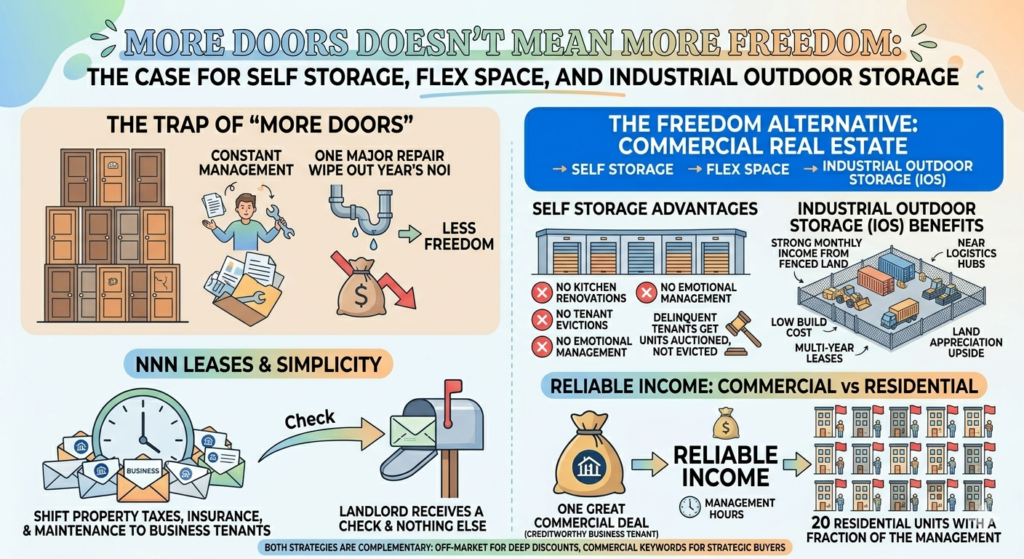
There’s a belief in real estate investing circles that goes something like this: the more doors you own, the freer you are. Get to 10 units. Then 20. Then 50. Each door is a step toward financial independence.
I’ve been questioning that assumption lately.
Not because rental properties don’t work — they do. But because the “more doors” mentality often leads investors toward the most competitive, most management-intensive asset class available: residential apartments. And there are commercial real estate alternatives that are less competitive, easier to manage, and potentially more profitable that most residential investors never consider.
Here’s what I’ve been looking at.
The Apartment Trap
Multifamily residential — duplexes, triplexes, apartment complexes — is where most real estate investors start. And for good reason. The concept is intuitive. The financing is accessible. The demand is consistent.
But the multifamily market has become intensely competitive. Institutional investors, private equity funds, and individual investors are all chasing the same asset class. Prices have risen to reflect that competition. Cap rates have compressed. The margin for error on acquisitions has shrunk.
And then there’s the management reality.
One investor who ran 450 residential units described the experience this way: a single HVAC system replacement or major roof repair could wipe out an entire year’s net operating income. You’re managing individual tenants — people going through divorces, job losses, evictions — across dozens of units simultaneously. The complexity scales with every door you add.
“More doors equals more freedom” only holds if those doors are generating clean, predictable income with manageable maintenance. For many multifamily operators, what they actually have is a second job that follows them everywhere.
Commercial Real Estate Alternatives: Three Worth Knowing
Self Storage
Self storage is one of the most misunderstood commercial real estate asset classes. From the outside, it looks boring — a collection of metal buildings with roll-up doors. From the inside, the economics are interesting.
Why it works differently than apartments:
There are no kitchens to renovate. No bathrooms to upgrade. No tenants complaining about appliances. The “unit” is an empty metal box. When a tenant stops paying, you auction their unit — no eviction process, no court dates, no months of lost rent while the legal process unfolds.
The value-add play:
Many self storage facilities are owned by original operators who’ve held them for decades and haven’t optimized pricing, occupancy, or systems. An acquiring investor can implement modern management software, dynamic pricing, and a delinquency auction system — and move occupancy from 70% to 90%+ relatively quickly.
That occupancy improvement translates directly into NOI, which translates directly into value at a commercial cap rate. The same math we’ve talked about before: every dollar of NOI improvement multiplies into property value at the cap rate.
The tenant relationship:
You’re renting to people storing stuff, not people living their lives. The emotional stakes are lower. The management intensity is lower. The regulatory environment is simpler.
Industrial Outdoor Storage (IOS)
This one is genuinely underappreciated and worth understanding.
Industrial Outdoor Storage is exactly what it sounds like — fenced, paved or gravel outdoor space used to store trucks, trailers, heavy equipment, containers, or construction materials. No building required. Just land, a fence, lighting, and basic security.
Who rents it:
- Trucking and logistics companies needing trailer parking
- Construction companies storing equipment between jobs
- Distributors needing overflow container storage
- Fleet operators
Why the economics work:
The capital cost to create an IOS property is dramatically lower than building a warehouse or flex space. You’re essentially improving raw land — grading, fencing, lighting, maybe paving. That keeps your cost basis low relative to the income you can generate.
And the income can be substantial. Trucking companies and logistics operators need this space badly in markets near distribution hubs, ports, or major highway corridors. Monthly rents per acre in strong markets are competitive with other industrial uses — and the tenant typically signs multi-year leases.
The land appreciation angle:
IOS properties tend to be located in industrial corridors near infrastructure — highways, rail, ports. These locations often appreciate as industrial demand grows. You’re generating income from the land use while the underlying land value increases.
In the Philadelphia area, the I-95 corridor, the Route 30 bypass, and areas near the Port of Philadelphia all have active demand for this type of space. It’s not a widely discussed asset class among residential investors — which is exactly what makes it interesting.
Triple Net (NNN) Leases — The Business Tenant Advantage
We’ve touched on NNN leases before, but it’s worth revisiting in this context because it illustrates the core difference between residential and commercial investing.
In a triple net lease, the tenant pays:
- Base rent (to you)
- Property taxes (directly)
- Building insurance (directly)
- Maintenance and repairs (directly)
As the landlord, you receive a check. That’s it. You’re not managing maintenance calls. You’re not dealing with insurance renewals. You’re not disputing property tax assessments. The tenant handles all of it.
The business tenant difference:
This structure works because your tenant is a business, not an individual. A business has reputational and operational reasons to maintain the space properly. They have long-term leases because moving disrupts their operations. They have professional management handling facilities issues.
Compare that to a residential tenant. Moving is inconvenient, but it’s not catastrophic. Letting maintenance slide is common. Lease terms are typically one year. The incentive structures are fundamentally different.
One well-structured NNN lease with a creditworthy business tenant can generate more reliable passive income than 20 residential units — with a fraction of the management involvement.
The “One Great Deal” Reframe
Here’s the mindset shift that ties all of this together.
The residential investing world celebrates portfolio size. How many doors do you have? How many units? The number becomes the measure of success.
Commercial real estate investors tend to think differently. One industrial building with five NNN tenants generating $300,000 in annual NOI is a life-changing asset. One self storage facility at 90% occupancy is a life-changing asset. One IOS property in a strong logistics market is a life-changing asset.
You don’t need 50 of them. You need the right one.
That doesn’t mean residential investing is wrong — it’s a legitimate path and the right choice for many investors, especially those starting out. But the assumption that more residential doors automatically leads to more freedom deserves to be questioned.
Sometimes fewer, better assets — with simpler management, stronger tenants, and cleaner income — is the actual path to what most investors are looking for.
Where This Fits on My Roadmap
I’m still in the early stages — studying the mechanics, building the relationships, working toward that first deal. Residential flipping is my entry point because it builds construction knowledge and capital.
But I’m keeping my eyes on commercial. Self storage. Flex space. Industrial outdoor storage. These are the asset classes I’m studying alongside the residential fundamentals — because I’d rather understand the full landscape now than discover these options exist five years and 20 residential doors later.
The doors aren’t the destination. The income is. And the path to the income isn’t always the one everyone else is walking.
Not financial advice — just someone doing a lot of research and asking a lot of questions.