The commercial real estate opportunity most investors are missing right now isn’t hiding. It’s sitting in plain sight, marked down, and most people are too scared to look at it.
Ken McElroy has been investing in commercial real estate through multiple cycles. His read on 2026: this is the best buying window since 2010. Here’s the math behind that claim — and what it means for investors who are paying attention.
Why Commercial Real Estate Values Dropped — And Why That’s the Point
The buildings didn’t get worse. The financing environment changed.
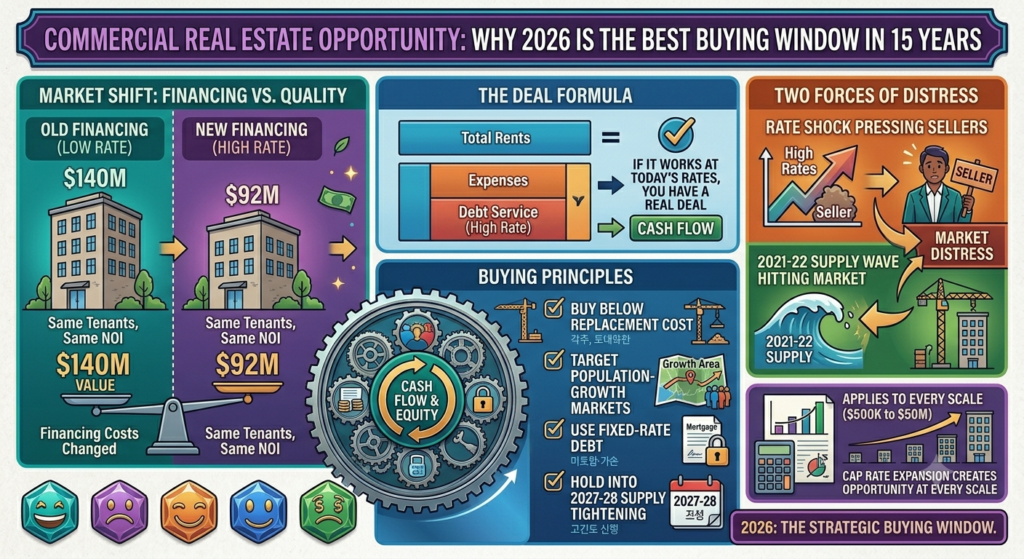
When interest rates rose sharply, mortgage payments on commercial properties increased significantly. Higher debt service meant less cash flow reaching investors. Less cash flow meant investors needed to buy at lower prices to hit their return targets. Lower prices meant cap rates went up and asset values went down.
A building that was worth $140 million two years ago is trading at $92 million today. The tenants are the same. The location is the same. The NOI is roughly the same. What changed is the cost of capital — and that change created a commercial real estate opportunity for buyers who can underwrite the deal at today’s rates and still make the numbers work.
This is how commercial real estate cycles have always worked. The math, not the headlines, is what matters.
The Math Behind the Commercial Real Estate Opportunity
Commercial real estate is valued on income, not comparable sales. That makes the formula straightforward:
Total rents − operating expenses − debt service = cash flow
The commercial real estate opportunity right now is that prices have fallen enough in many markets that deals are penciling out from day one — even at current interest rates. You don’t need rates to drop to make money. You need to buy at a price where the existing NOI supports the debt service and still produces positive cash flow.
That’s the screen. If the deal cash flows at today’s rates with today’s rents, you have a margin of safety. If it only works assuming rates drop or rents increase, you’re speculating, not investing.
Run your numbers through the DSCR Calculator before you commit to any commercial deal. If the debt service coverage ratio doesn’t work at current market rates, the commercial real estate opportunity isn’t there yet — regardless of what the seller’s proforma says.
Why the Next 1 to 2 Years Are the Window
The current soft spot in commercial real estate has two causes working together.
First: the rate shock. Higher borrowing costs hit buyers and existing owners simultaneously. Owners who financed at low rates and now face refinancing at 6%+ are under pressure. Some are selling. Some are in distress. That’s where motivated sellers come from.
Second: the supply wave. Projects that started in 2021 and 2022 — when rates were near zero and developers were optimistic — are now delivering. New supply hitting the market while demand is soft means vacancy is up in some sectors, rents are flat, and landlords are offering concessions to attract tenants.
These two forces together create the commercial real estate opportunity. Prices are down, sellers are motivated, and competition from other buyers is thin because most investors are still sitting on the sidelines waiting for certainty.
According to the Federal Reserve Bank, commercial real estate debt outstanding continues to mature through 2026 and into 2027, meaning distressed seller pressure isn’t going away soon — which is exactly why the buying window remains open.
What to Buy — And What to Avoid
Not every discounted asset is a commercial real estate opportunity. Some are discounted because they deserve to be.
Buy below replacement cost. If you can acquire a building for less than it would cost to build new, you have structural protection. Construction costs have risen sharply — a building that costs $15 million to build today trading at $10 million gives you a margin that’s hard to replicate.
Target population and job growth markets. Soft markets in growing cities are temporary. Soft markets in shrinking cities are permanent. The commercial real estate opportunity is in places where the underlying demand — population, employment, household formation — is still moving in the right direction.
Use fixed-rate debt. The strategy is to buy now, lock in fixed-rate financing, generate cash flow through the soft period, and hold into the next cycle. Real estate typically runs in 8 to 12-year cycles. The current supply overhang is projected to clear by 2027 to 2028 — at which point supply drops, vacancy tightens, and rents move up again.
Avoid deals that only work on paper. If the proforma assumes rents increasing 5% annually or cap rates compressing back to 2021 levels, walk away. The commercial real estate opportunity is in assets that produce cash flow today, not assets that might produce cash flow if everything goes right.
What This Means for Smaller Investors
Most of the conversation about commercial real estate cycles focuses on institutional-scale assets. But the same dynamics play out at every price point.
Smaller mixed-use buildings, neighborhood retail strips, and small office properties in secondary markets are experiencing the same cap rate expansion and seller pressure as the large assets. The commercial real estate opportunity is available at $500,000 just as it is at $50 million — the math is the same, the scale is different.
For investors building portfolios from scratch, the current environment rewards patience on price and discipline on underwriting. Find the market, find the distressed seller, run the numbers at today’s rates, and buy below replacement cost. That combination is what the best commercial real estate opportunity in 15 years actually looks like in practice.
Not financial advice — just someone doing a lot of research and asking a lot of questions.