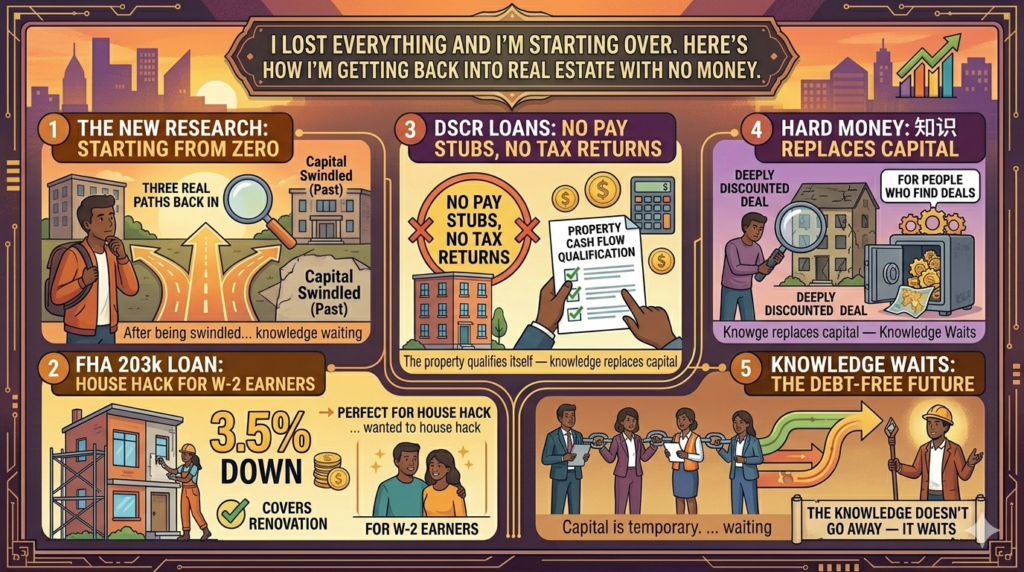
FHA 203k loan strategy was the first thing I researched when I realized I had to start completely over.
I moved to Philadelphia. I started over. And I’ve been studying every single day, trying to figure out how someone who knows real estate gets back into the game when the capital is gone.
This post is what I’ve found. Not theory. Not inspiration. The actual mechanisms.
Path 1: FHA 203k Loan Strategy — For People With a W-2
If you have traditional employment — a W-2, pay stubs, consistent documented income — the FHA 203k loan strategy is one of the most powerful tools available for getting back in.
- 3.5% down payment. On a $300,000 property, that’s $10,500.
- Covers renovation costs. Wraps purchase and rehab into one loan.
- House hacking. Buy a duplex, live in one unit, rent the others. Renters pay your mortgage.
The FHA 203k loan strategy is specifically designed for people who want to buy a property that needs work — and finance the purchase and the renovation together. For someone starting over with limited cash but steady income, this is the door.
I’ve done this before. Three flips in California. I had capital, confidence, and momentum. And then I got swindled — by people I trusted. A significant amount of money, gone.
According to HUD.gov, the FHA 203k program has been helping buyers finance renovation projects since 1978 — it’s not a new trick, it’s a proven tool most people just don’t know about.

Path 2: DSCR Loans — For People Without a Pay Stub
DSCR stands for Debt Service Coverage Ratio. The lender’s question isn’t “how much do you make?” It’s “will this property make enough rent to cover the mortgage?”
No pay stubs required. No two years of tax returns. If the property generates enough rental income to cover the debt service, you can qualify. This was built for real estate investors — entrepreneurs, self-employed, people whose income doesn’t fit a W-2 box.
- Down payment: 15–25%
- Rates slightly higher than conventional
- More equity from day one — which is protection
Want to see if a rental property qualifies? Run it through the DSCR Loan Qualifier before you talk to a lender.
Path 3: Hard Money — For People Who Can Find Deals
Hard money lenders don’t care about your income. They care about the deal. If you find a property at a significant discount with strong ARV, a hard money lender will finance it based purely on the asset.
The cost: 8–12% annual interest plus points. Expensive and short-term. But for someone who knows how to find deals — which I do, from doing this three times — hard money removes the income requirement entirely. The knowledge is the asset.
Which Path Is Right for You?
- W-2 job: FHA 203k loan strategy + house hack. Let tenants fund your mortgage.
- Self-employed: DSCR loan. The property qualifies, not you.
- Deal-finding skills: Hard money. Find deeply discounted deals. Execute fast.
- None of the above: Find a partner. You bring knowledge. They bring capital. Split the profit.
Where I Am Right Now
I came to Philadelphia after losing more money than I want to say. I’ve been studying every day. Building back.
What losing everything taught me: capital is temporary. Knowledge isn’t. The understanding of how deals work, what makes a property valuable, how to read a neighborhood’s trajectory — that doesn’t go away. It waits.
The system has room for us. You just have to know which door to knock on.
Not financial advice — just someone doing a lot of research and asking a lot of questions.