Fix and flip loan financing changed the way I think about real estate entirely. I used to think getting a loan for an investment property worked the same way as getting a mortgage for your house — dig up two years of tax returns, prove your income, explain every deposit in your bank account for the last 12 months, and hope the underwriter is having a good day.
Then I found out how fix and flip loans actually work. And honestly? It’s a completely different game.
The Bank Problem Nobody Talks About
Here’s something that struck me recently. If you walk into a traditional bank and say “I have $20,000 to $30,000 and I want to buy an investment property,” they’re going to grill you. Where did that money come from? Can you prove your income? What’s your debt-to-income ratio?
But if you walk in trying to finance a $20 million commercial property with $5 million down? Suddenly everyone’s very accommodating.
Traditional banks are designed for W-2 employees with steady paychecks and clean paper trails. They’re not designed for someone trying to build wealth through real estate one deal at a time.
Which is exactly why the fix and flip loan exists.
What Is a Fix and Flip Loan?
A fix and flip loan — sometimes called a hard money loan or bridge loan — is a short-term loan designed specifically for investors who are buying a property, rehabbing it, and selling it — usually within 6 to 12 months.
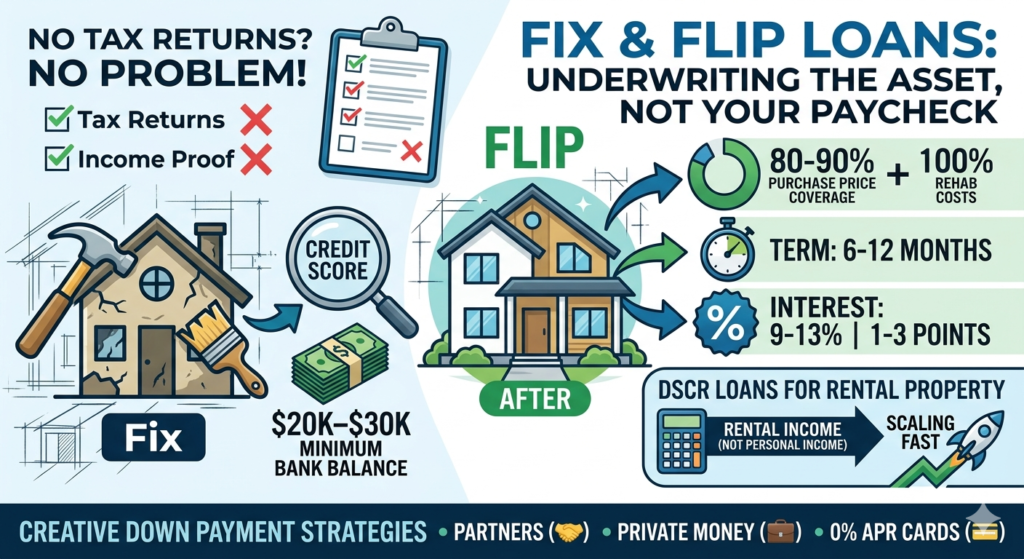
The biggest difference from a conventional mortgage: they don’t ask for your tax returns or proof of income.
Instead, what fix and flip loan lenders care about:
- The deal itself — specifically the ARV (after repair value)
- Your credit score (typically 650+ is workable, 680+ is better)
- Cash in the bank — usually $20,000 to $30,000 minimum
- Your experience level (some lenders care more about this than others)
They’re underwriting the asset, not your W-2.
Why Cash in the Bank Matters More Than Your Income
Fix and flip loan lenders don’t need you to prove a salary — but they do want to see liquidity. The $20K to $30K in your account tells them you can cover holding costs, unexpected repairs, and loan payments while the project is running.
It’s actually a more logical way to evaluate a real estate investor. Your tax return tells them what you made last year. Your bank balance tells them whether you can execute a deal right now.
For people who are self-employed, have irregular income, or structure their finances in ways that minimize taxable income — very common among small business owners — this is huge. You’re not being penalized for running your finances like an entrepreneur.
How Fix and Flip Loans Are Structured
Here’s the general structure you’ll see with most fix and flip loan lenders:
Loan-to-Cost (LTC): Many lenders will finance 80–90% of the purchase price plus 100% of the rehab costs, up to 65–75% of ARV total.
Interest rates: Higher than conventional — typically 9–13% depending on the lender, your credit, and the deal.
Points: Expect 1–3 points upfront (1 point = 1% of the loan amount).
Term: Usually 6 to 12 months, sometimes up to 18.
Draws: Rehab funds are released in draws as work is completed — not all at once.
Yes, a fix and flip loan costs more than a bank loan. But for a deal closing in 6 months with $40,000 in profit, paying an extra few thousand in interest is just a cost of doing business.
DSCR Loans: The Hold Strategy
Fix and flip loans are for short-term plays. But what if you want to hold the property as a rental? That’s where DSCR loans come in — and they work on the same no-income-documentation principle.
DSCR = Monthly Rent ÷ Monthly Mortgage Payment
A DSCR of 1.0 means rent exactly covers the payment. Most lenders want 1.1 to 1.25. Your debt-to-income ratio? Largely irrelevant.
Big institutional investors have been using DSCR loans for years — it’s one of the reasons they can scale so fast. Individual investors are now using the same tool. The fix and flip loan gets you in, the DSCR loan lets you hold.
What About Getting the Down Payment Together?
This is where investors get creative. Some use business credit cards with 0% intro periods (12–18 months) to fund repairs or cover holding costs while waiting on a draw. If the flip closes before the intro period ends, you’ve essentially borrowed money for free. The risk is obvious — if the deal takes longer than expected, you’re sitting on high-interest debt with no exit. Not a beginner move.
More commonly, investors piece together down payments through:
- Personal savings
- A partner who brings capital while you bring the deal and sweat equity
- A private money lender — usually someone you know personally who wants a return
- Home equity from a property you already own
According to BiggerPockets, the fix and flip loan market has grown significantly over the past five years as more investors realize conventional financing simply wasn’t built for the way real estate investors actually operate.
Who Fix and Flip Loans Are Actually For
Fix and flip loan financing makes the most sense when:
- You’ve identified a good deal with real equity spread
- You have $20K–$30K+ in the bank
- Your credit is in decent shape (650+)
- You can manage or oversee a rehab project
- You have a clear exit — either sell or refinance into a DSCR loan
The higher cost of capital means you need a deal with enough margin to absorb it. But for investors who can’t qualify for conventional financing, a fix and flip loan opens doors that would otherwise stay shut.
The barrier to entry isn’t really the money. It’s knowing which type of financing fits which type of deal — and then finding a lender who works with investors at your level.
Use the Fix Flip Loan Qualifier to see which fix and flip loan programs you’d qualify for before you start calling lenders.
Not financial advice — just someone doing a lot of research and asking a lot of questions.