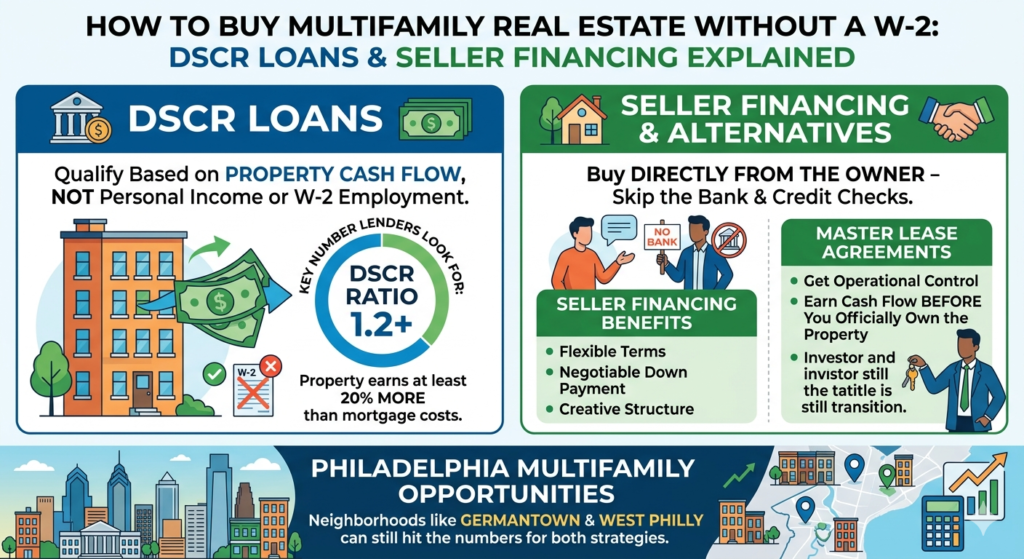
Buying multifamily without W2 income is more possible than most people think. If you’ve been told you can’t buy an apartment building because you don’t have a traditional job, I want to push back on that — because there are two legitimate strategies that don’t care about your employment status at all. They care about the deal.
Why Traditional Loans Don’t Work for Buying Multifamily Without W2
Most conventional mortgages are built around one assumption: you have a steady job and a pay stub to prove it. W-2, tax returns, two years of employment history — the whole thing.
But what if you’re self-employed? What if your tax returns show low income because you write everything off? What if you just left your 9-to-5 and you’re investing full time now?
That’s where most people get stuck. They have cash, they have motivation, they find a deal — and then the bank says no.
There are two ways around this that actually work for buying multifamily without W2 income.
Strategy #1: DSCR Loans — The Property Qualifies, Not You
DSCR stands for Debt Service Coverage Ratio. Instead of qualifying you based on your income, the lender qualifies you based on whether the property makes enough money to cover its own mortgage.
DSCR = Gross Rental Income ÷ PITI
Most lenders want to see a DSCR of 1.2 or higher. That means the property brings in at least 20% more than it costs to carry.
Here’s what you typically need for buying multifamily without W2 via DSCR:
- Credit score around 660+
- 20–25% down payment
- Property cash flows at 1.2+ DSCR
- No W-2, no tax returns, no proof of personal income required
- Works for 4 to 50 unit multifamily properties
Real example:
A $1 million 8-unit building with 25% down. Gross rental income of $116,000 a year. DSCR comes out to 1.32. Lender approves it — even with zero W-2 income — because the building pays for itself with room to spare.
The property qualifies, not you. That’s the whole game.
Some DSCR lenders also offer interest-only payment options, allow gifted down payments, and work with foreign nationals. It’s a non-QM loan product, so terms vary by lender — you have to shop around.
Strategy #2: Seller Financing — No Bank, No Credit Check, No Problem
This one is more creative, but it’s been around forever. Instead of going through a bank, you work out a deal directly with the seller.
The most common version for multifamily is a Master Lease Agreement:
- You don’t buy the property outright at first
- The seller keeps the legal title temporarily
- You take over operations — collect rent, manage tenants, run the property
- You make monthly payments to the seller
- After an agreed-upon term (usually around 5 years), you buy them out
No bank. No credit check. No underwriting. This is buying multifamily without W2 at its most accessible.
When does a seller actually agree to this?
Seller financing works when the seller has a problem you can solve:
- Burnt-out landlords who want passive income without the headaches
- Sellers trying to defer capital gains taxes — getting paid over time is a tax advantage for them
- Properties with deferred maintenance that won’t qualify for traditional financing
- Owners dealing with vacancies, bad management, or personal situations like health issues or relocation
Real example:
Same $1 million 8-unit building structured as seller financing:
- 10% down ($100K)
- 5% interest-only payments to the seller
- 5-year term
- Result: approximately $25,000 annual cash flow and a 25% cash-on-cash return
Way better returns than the DSCR loan scenario — because you put less down and cut the bank out entirely.
Which Strategy for Buying Multifamily Without W2 Should You Use?
It depends on the deal and the seller.
DSCR loans are more straightforward — there’s an actual lender involved, it’s a real loan, you close like a normal transaction. You need the property to cash flow well and you need 20–25% down.
Seller financing takes more negotiation and you have to find motivated sellers — but the returns can be significantly better and the barrier to entry is lower.
A lot of investors use both depending on the situation. DSCR for properties where the numbers work cleanly, seller financing when you find a burnt-out landlord who wants out.
According to the Mortgage Bankers Association, DSCR loan volume has grown significantly over the past three years as more self-employed investors and business owners shift away from income-documented financing — making buying multifamily without W2 more accessible than ever before.
Buying Multifamily Without W2 in Philadelphia
Philadelphia is a decent market for both strategies right now. There’s a real inventory of older multifamily properties — rowhouses converted to duplexes, small apartment buildings — and you do run into owners who’ve been landlording for decades and are tired.
DSCR lenders are active in Philly. And the rent-to-price ratios in neighborhoods like Germantown, West Philly, and Kensington are still strong enough that properties can hit that 1.2 DSCR threshold.
You don’t need a W-2. You need a good deal and the right structure.
Use the DSCR Calculator to check whether a specific Philadelphia property hits the 1.2 threshold before you approach any lender — DSCR or otherwise.
Not financial advice — just someone doing a lot of research and asking a lot of questions.