The more I study multifamily real estate, the more I realize that the best investors aren’t just buying properties — they’re finding value that the previous owner completely missed. I’ve written about this before with the misplaced fence story that generated $300K out of what looked like a headache. This one is different, but the mindset is exactly the same: look at what’s already there and ask what it could become.
I came across a breakdown recently from a multifamily investor who found $1.4 million in hidden value on an apartment complex. Not through renovation. Not through adding units. Not through raising rents on existing tenants.
Through parking spaces.
The Setup: Too Much Parking
The property already had eight garages that were rented out to tenants. Garages are popular — people use them for storage, dedicated parking, keeping a car out of the weather. The existing eight were doing fine.
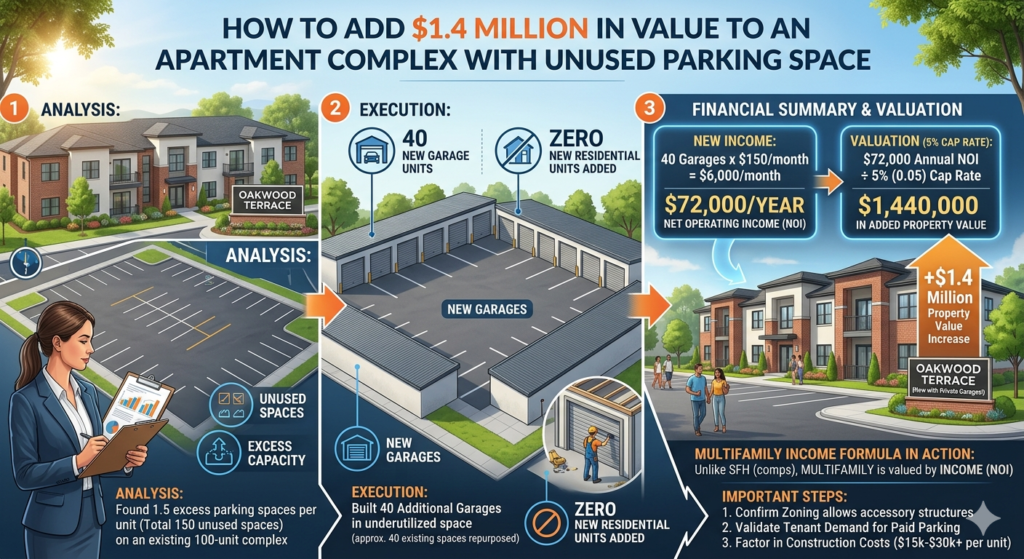
But when this investor looked at the overall lot, he noticed something: the property had 2.5 parking spaces per unit. And realistically, most tenants only need one.
That gap — 1.5 spaces per unit sitting underutilized — represented a massive amount of physical space that was generating zero income.
His idea: build 40 additional garages on that excess parking area and rent each one for $150 a month.
The Math (This Is the Part That Matters)
Here’s where it gets interesting, and why multifamily investing works differently from single family.
40 garages × $150/month = $6,000 in additional monthly income
$6,000 × 12 months = $72,000 in additional annual income
Now here’s the multifamily piece. In commercial real estate, a property’s value isn’t determined by comps the way a single family home is. It’s determined by income — specifically, by dividing the net operating income by the cap rate for that market.
So if the cap rate in this market is 5%:
$72,000 ÷ 0.05 = $1,440,000 in added property value
That’s $1.4 million in value created from underutilized asphalt. No new units. No major renovation. Just garages on land that was already sitting there.
Why This Works in Multifamily But Not Single Family
This is one of the most important concepts to understand if you’re thinking about eventually moving into apartment investing — and it’s something I think about a lot given where I want to go with this.
Single family homes are valued based on what similar homes nearby sold for. You can renovate, update, and improve all you want, but the market sets a ceiling based on neighborhood comps.
Multifamily properties are valued based on income. That means every dollar of additional NOI (net operating income) you generate translates directly into property value — multiplied by the cap rate. In a 5% cap rate market, every $1 of annual income you add creates $20 of property value.
That’s the math that makes value-add multifamily so powerful. And it’s why investors who understand it look at a property completely differently than someone who’s only ever bought single family homes.
The previous owner of this complex saw eight garages and a parking lot. This investor saw $1.4 million waiting to be unlocked.
What You’d Actually Need to Pull This Off
It’s worth being realistic about what this strategy requires, because the math is clean but the execution has moving parts.
Zoning and permitting. Before you build 40 garages on a parking lot, you need to confirm that the municipality allows it. Accessory structures on multifamily properties have their own zoning rules, and in some cities, minimum parking requirements per unit are baked into the code — meaning you can’t just convert excess spaces without getting approval first.
Construction costs. Simple detached garage structures aren’t cheap at scale. Depending on materials and local labor costs, basic single-car garages can run anywhere from $15,000 to $30,000+ per unit to build. Forty garages is a significant capital outlay upfront before you see a dollar of return.
Demand validation. The $150/month figure only works if tenants actually want the garages. In urban markets where parking is scarce, demand is usually strong. In suburban markets with ample free parking, $150/month might be a stretch. Know your tenants and your market before you build.
Financing the construction. If you’re using a value-add loan or repositioning the asset, some lenders will fund improvements like this as part of the deal structure. Others won’t. Worth knowing before you buy.
The Philadelphia Angle
This strategy is particularly interesting to think about in Philadelphia, where parking is genuinely a pain point in a lot of neighborhoods. In areas like South Philly, parts of West Philly, and anywhere near Center City, dedicated parking and garage space commands real premium from tenants.
If you’re buying a multifamily property in Philadelphia and it happens to have a larger-than-necessary surface lot — which older properties in this city sometimes do — that excess space deserves a serious look before you assume it’s just parking.
The city’s zoning code does regulate accessory structures, so you’d need to run this by a local zoning consultant. But the concept is absolutely applicable here.
What I Took Away From This
My long-term goal is apartment development. Not tomorrow — I’ve got flipping, then single-family ground-up, then multifamily ahead of me on the roadmap. But I’m studying how experienced multifamily investors think now, because understanding this stuff early is what separates people who stumble into deals from people who engineer them.
The garage strategy is a clean example of value-add thinking at its best. You’re not hoping the market goes up. You’re not gambling on appreciation. You’re creating income where there was none, and letting the cap rate math do the rest.
$72,000 a year. 5% cap rate. $1.4 million in value.
That’s not magic. That’s just knowing how the math works.
Not financial advice — just someone doing a lot of research and asking a lot of questions.