If you want to learn how to flip land for profit, the first thing you have to do is stop looking at what’s already built.
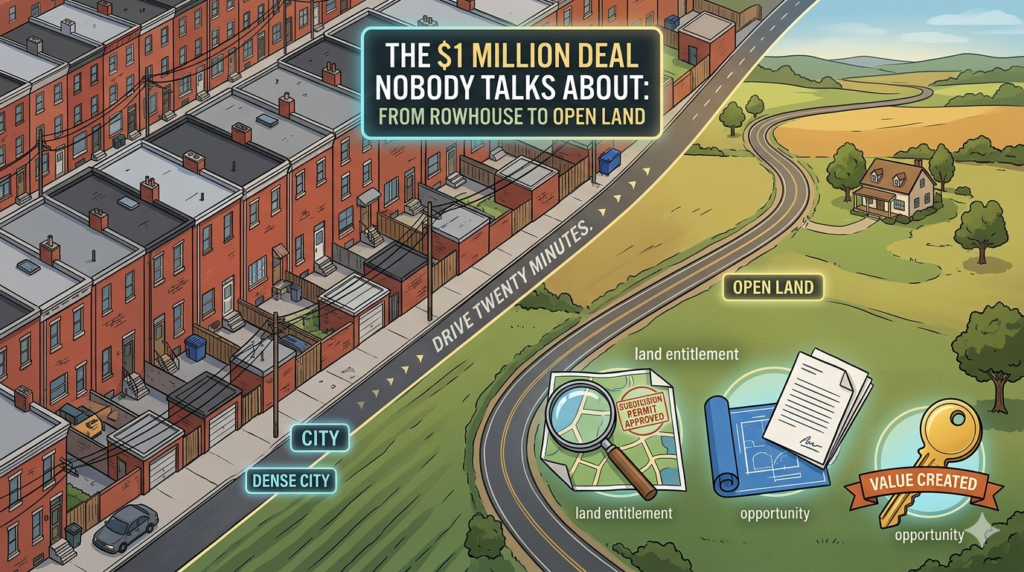
I live in a Philadelphia rowhouse neighborhood where the houses are stacked so close together you can hear your neighbor’s TV through the wall. Every lot is spoken for. Every inch of land has something on it.
So for a long time, I assumed the kind of strategy I kept seeing on TikTok — buy underutilized land, do the entitlement work, sell to a developer for massive profit — just wasn’t available to someone like me.
Then I started driving.
How to Flip Land for Profit: Twenty Minutes Changes Everything
Philadelphia has this quality that people who live in the city forget about: twenty minutes in almost any direction and you’re in a completely different world. I’ve driven through parts of Montgomery County, Delaware County, and Burlington County — pastoral, quiet, open fields, old farmhouses sitting on acres of land.
And I started seeing those properties differently. Not as charming countryside. As opportunity.
What Land Entitlement Actually Is
Here’s the core of how to flip land for profit — and why most people miss it entirely.
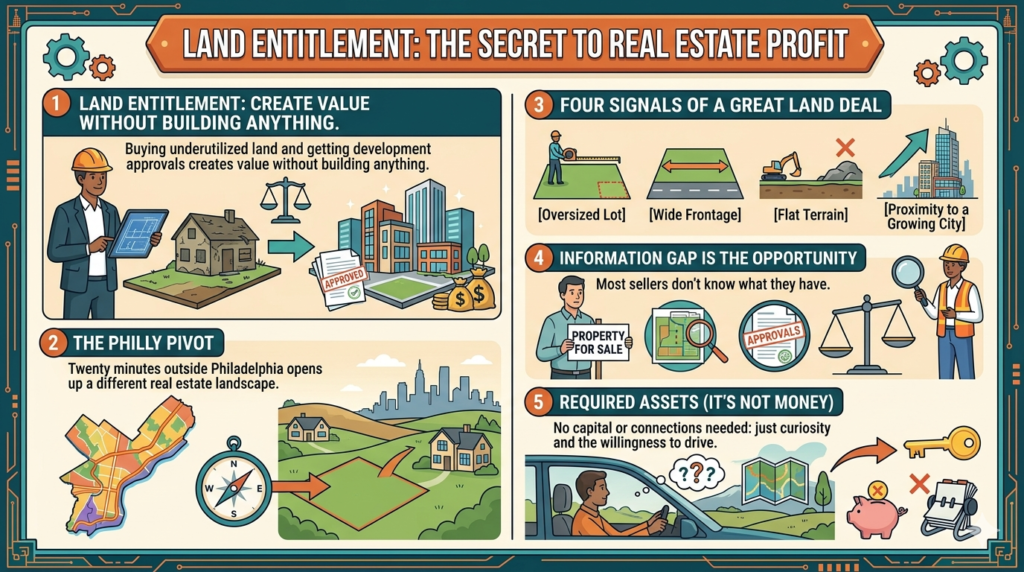
You find underutilized land: a property where the current use doesn’t reflect the land’s true potential. A small, aging house sitting on a lot that could comfortably fit four townhomes. A wide parcel with extensive road frontage in a corridor where new development is clearly heading.
You buy it before anyone else recognizes what it is. Then you do the entitlement work: obtaining the permits, approvals, and development rights that transform that raw land into something a builder can actually use.
The entitlement itself is where the value gets created.Curious what a rezoned parcel might actually be worth? The Rezoning ROI Calculator can help you rough out the numbers.A parcel approved for four houses is worth dramatically more than one approved for one house — even if not a single brick has been laid. You’ve created value through paperwork, research, and persistence.
The Four Things to Look For When You Flip Land for Profit
- A house on an oversized lot. The building doesn’t matter. What matters is whether the land is being used efficiently.
- Wide road frontage. More frontage means more subdivision options. Builders recognize this immediately.
- Flat terrain. Sloped land requires expensive grading. Flat land is cheap to build on.
- Proximity to a growing city. That pastoral farmhouse twenty minutes from Center City might be in exactly the right place at exactly the right time.
Why Land Is Still Mispriced
Most sellers don’t know what they have. The farmer who’s owned that flat parcel for forty years is thinking about it as farmland. The heir who inherited grandma’s oversized lot is thinking about selling the house — not the subdivision potential.
The information gap is the opportunity.
Want to see if a parcel has development potential? Run it through the Land Potential Analyzer before you make any moves.
How to Start Learning How to Flip Land for Profit in the Philadelphia Area
- Philadelphia Atlas (atlas.phila.gov) — look up any parcel’s zoning, dimensions, and ownership for free
- County GIS maps — from the air, an oversized lot is immediately obvious
- Drive the SEPTA rail corridors — underdeveloped land near stations is worth studying
- Talk to local planning departments — they’ll tell you what a parcel is zoned for and what approvals are required. This conversation costs nothing.
What Changed for Me
I live in a neighborhood of rowhouses. My street is fully built out. The opportunity seemed like it was for someone else.
But figuring out how to flip land for profit doesn’t require capital or connections to start. It requires curiosity. It requires driving twenty minutes outside your comfort zone, looking at a pastoral field, and asking: what could this become?
I’m still learning. I haven’t done a land entitlement deal. But I’ve started to see the landscape differently — not as scenery, but as inventory.
That shift in perspective, I’ve come to believe, is where every real estate career actually begins.
Not financial advice — just someone doing a lot of research and asking a lot of questions.