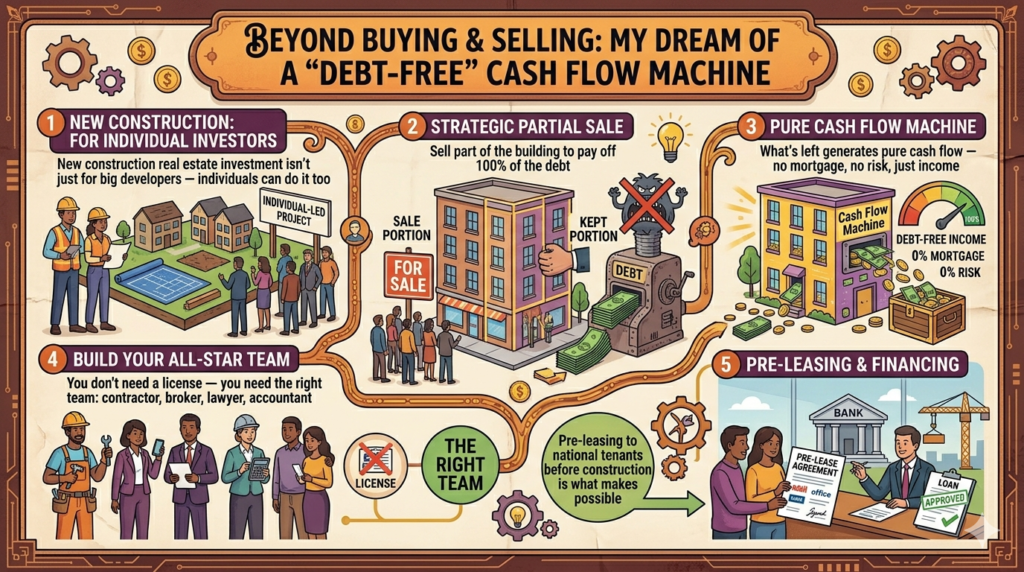
New construction real estate investment isn’t just for billionaire developers. That’s the assumption I had to completely unlearn.
I always thought building commercial properties — shopping centers, office buildings, mixed-use developments — was reserved for massive construction companies with deep pockets and special licenses. Not for someone like me, still learning the residential side of things.
Then I came across a strategy so counterintuitive it stopped me cold. And I haven’t stopped thinking about it since.
What New Construction Real Estate Investment Actually Looks Like at the Individual Level
Most people think of new construction real estate investment as build-and-sell. Get in, develop, cash out, move on.
This strategy is completely different. It’s a long-term play built around one goal: eliminating debt entirely and keeping the income forever.
Here’s the blueprint:
- Total investment: Buy land and construct a commercial building. Total cost (land + construction): $1 million.
- The twist: Instead of selling the whole thing — or keeping it with a massive mortgage — you sell only part of it.
- The goal of that partial sale: Generate exactly enough cash to pay off the entire $1 million investment.
- The result: You own the remaining portion completely free and clear. Capital recovered. Zero mortgage.
Why the Debt-Free Part Changes Everything
Because the remaining property has no debt, every dollar of rent becomes pure profit — minus basic operating costs.
In the scenario I studied, the investor locked in well-known national tenants before construction even finished. Think major fast-food chains or national retailers — the kind of tenants who sign long-term leases and actually show up every month.
The result? Roughly $100,000 a year in debt-free cash flow. No mortgage eating into it. Just income.Want to see how that cash flow actually holds up over time? Run it through the Debt-Free Cash Flow Calculator.”
That’s what makes new construction real estate investment so different from buying a rental with a loan on it. The debt is the risk. Eliminate the debt, and the income becomes almost bulletproof.
Can a Regular Person Actually Do This?
This is the part that got me.
Legally, any individual can be a developer. You don’t need a special license to be the owner who builds a property. The barrier isn’t legal — it’s complexity and capital.
To pull off this kind of new construction real estate investment, you need to build a team:
- Architects & Engineers — to design the vision
- Licensed General Contractor — to actually do the building
- Commercial Real Estate Brokers — to find the right land and pre-lease spaces to tenants before you break ground (which is what makes financing possible)
- Lawyers & Accountants — to handle contracts, the partial sale structure, and taxes
You’re not the musician. You’re the conductor. That’s a completely different skill set — and one that’s learnable.
Want to rough out what a new construction project might cost before you even talk to an architect? The Pre-Build Cost Estimator is a good starting point.
My Honest Take
I’m not ready for a million-dollar development deal today. I still have a lot to learn in the residential space — and I know it.
But just knowing this path exists for individual investors? It reframes everything. New construction real estate investment isn’t a fantasy for someone else. It’s a strategy with a clear structure, a learnable team model, and a very specific end goal.
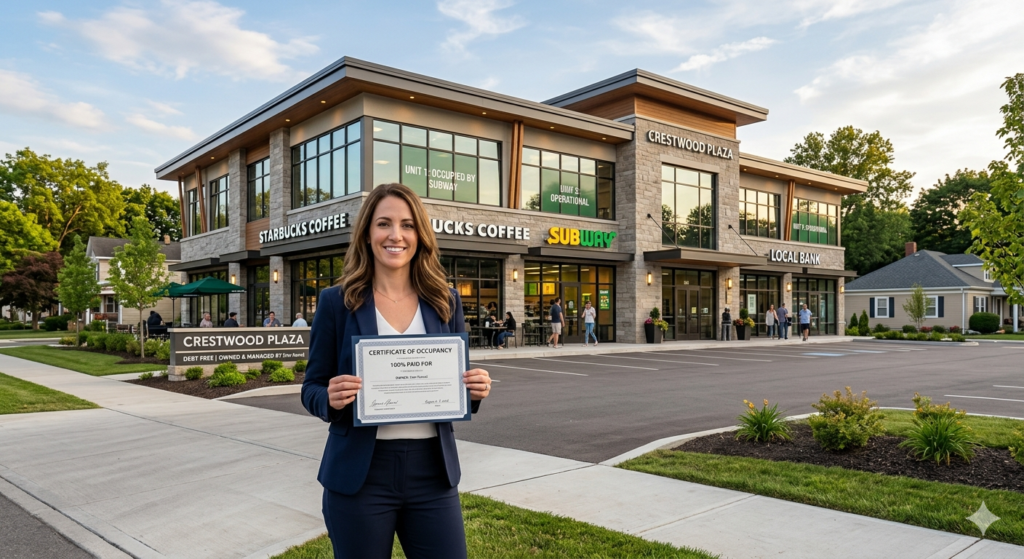
I keep imagining standing in front of a building I developed, holding a certificate of occupancy, knowing it’s 100% paid for.
That’s the daydream. And I’m starting to think it’s not as far off as it sounds.
Not financial advice — just someone doing a lot of research and asking a lot of questions.