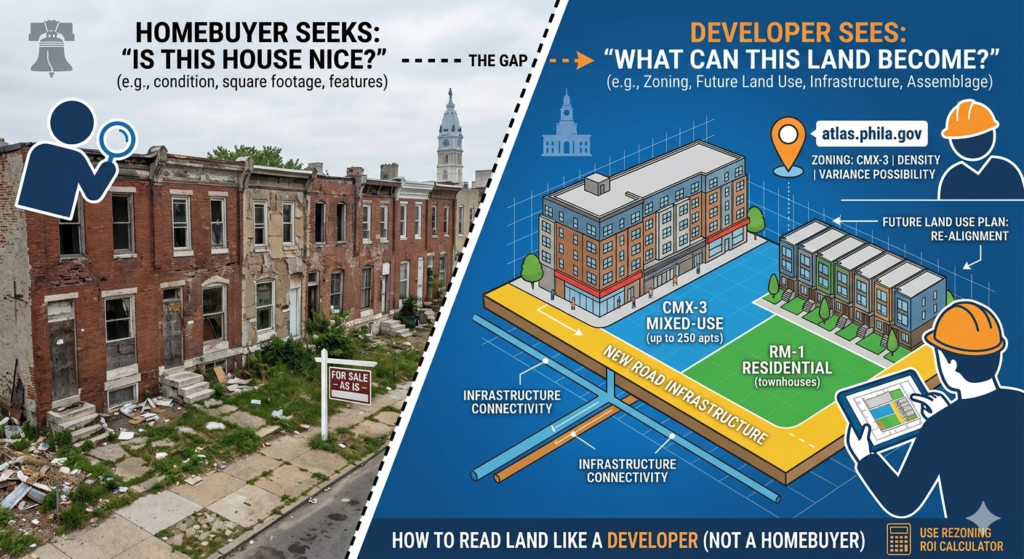
I was watching a video recently where someone was walking through a neighborhood full of beat-up, rundown houses. The kind of block most people would drive past and think “what a mess.”
But this person wasn’t looking at the houses.
They were looking at the land.
And what they saw wasn’t decay. It was a future 250-unit apartment complex on the front, townhouses on the back, and a brand new road running right through the middle. A self-contained mini city — hiding behind a row of crumbling rooftops.
That’s the difference between how a homebuyer sees real estate and how a developer sees it.
Homebuyer vs. Developer — Same Block, Different Reality
A homebuyer looks at a property and asks: “Is this house nice? Does it need work? What’s the square footage?”
A developer looks at the same property and asks: “What can this land become? What does the zoning allow? What’s the future land use plan for this area?”
Same block. Completely different question. Completely different opportunity.
The Three Things Developers Actually Look At
1. Zoning
Zoning tells you what’s legally allowed to be built on a piece of land. A lot zoned for mixed-use or commercial use in the right location isn’t worth what the current rundown house suggests — it’s worth what could be built there.
In Philadelphia, you can look up zoning on the city’s Atlas tool. A single address will tell you exactly what’s permitted — and sometimes what’s possible with a variance.
2. Infrastructure & Size
Can the land physically support development? Is there water, sewer, and road access? Is the lot big enough — or can adjacent lots be assembled together into something larger?
The video I watched pointed out that the site they were analyzing had the infrastructure in place and enough acreage to support a major development. That combination — zoning + infrastructure + size — is what makes land valuable.
3. The Future Land Use Map
This one is underused and underrated.
Most people only look at current zoning. Developers look at the Future Land Use Map — a document cities publish that shows what areas are planned to become over the next 10–20 years.
If a currently residential block is designated for mixed-use or commercial in the future land use plan? That’s a signal. Roads being rerouted through an area? That changes everything about how a neighborhood develops.
What This Looks Like in Philadelphia
Philadelphia has neighborhoods that look forgotten on the surface — but the zoning tells a different story.
Parts of North Philly, West Philly, and Kensington have land that’s zoned for densities far above what’s currently sitting on it. Developers who know how to read those maps are quietly assembling lots right now.
The people who bought in Fishtown ten years ago when it still “looked bad” were reading the land, not the buildings.
How to Start Seeing Like a Developer
You don’t need to be building 250 apartments to use this framework. Start small:
- Pick a neighborhood in Philly you’re curious about
- Pull up the Philadelphia Atlas (atlas.phila.gov) and look up the zoning
- Find the Philadelphia zoning code and see what that zone actually permits
- Google “[neighborhood name] future land use plan Philadelphia”
- Ask yourself: what’s the gap between what’s there now and what could be built?
That gap is where the money is.
Final Thought
The most valuable skill in real estate isn’t finding a good deal. It’s being able to see potential that others walk right past.
Next time you drive through a block that looks run-down, don’t look at the houses. Look at the land. Look at the zoning. Look at what the city has planned for that area in 20 years.
You might be looking at someone’s future mini city — and not even know it.
Thinking about a development play in Philadelphia? Check out the Rezoning ROI Calculator