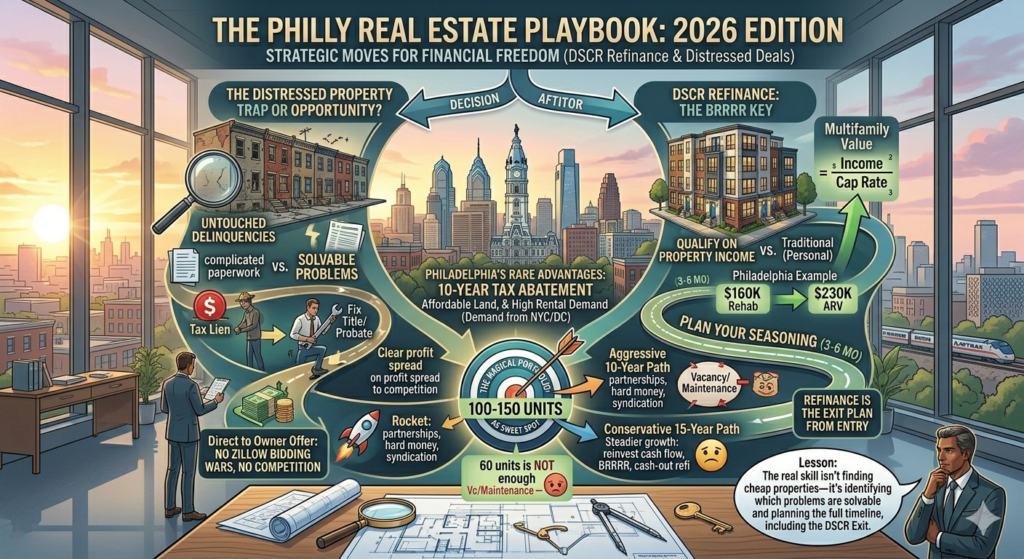
If you’ve been studying the BRRRR strategy, you’ve probably hit the same wall I did.
Buy. Rehab. Rent. Refinance. Repeat.
The first three steps make sense. But when you get to Refinance — the question becomes: refinance with what? Traditional banks want W-2 income, tax returns, debt-to-income ratios. If you’re self-employed, if your income is hard to document, or if you’re just starting to build a portfolio — traditional refinancing can be surprisingly difficult to pull off.
That’s where the DSCR loan comes in. And it changes everything about how the BRRRR strategy actually works in practice.
Quick BRRRR Recap
For anyone new to this:
B — Borrow money (hard money or private lender) to buy a distressed property
R — Rehab the property to increase its value
R — Rent it out to a tenant
R — Refinance out of the expensive short-term loan into long-term financing
R — Repeat with the next property
The goal of the refinance step is to replace the hard money loan — which typically runs 8-12% interest on a 12-24 month term — with something long-term and affordable. Ideally a 30-year fixed loan at a reasonable rate.
The problem: most conventional lenders don’t love this situation.
Why Traditional Refinancing Is Hard on BRRRR Deals
Traditional lenders look at you — your income, your tax returns, your debt-to-income ratio.
But BRRRR investors often look bad on paper:
- Self-employed with income that’s hard to document
- Multiple properties that show depreciation losses on taxes
- Limited W-2 income because they’re building a portfolio, not a salary
This is exactly the situation where DSCR loans were designed to help.
What Is a DSCR Loan?
DSCR stands for Debt Service Coverage Ratio.
Instead of qualifying you based on your personal income, a DSCR lender qualifies you based on the property’s income.
The formula:
DSCR = Monthly Rental Income ÷ Monthly Loan Payment
A DSCR of 1.0 means the rent exactly covers the mortgage. Most lenders want 1.1–1.25 or higher.
Example:
- Monthly rent: $1,800
- Monthly mortgage payment (PITI): $1,400
- DSCR: $1,800 ÷ $1,400 = 1.28 ✅
That’s it. The lender doesn’t care what you made at your job last year. They care that this property generates enough rent to cover its own debt.
How DSCR Fits Into the BRRRR Refinance Step
Here’s how the full sequence works when you combine BRRRR with a DSCR refinance:
Step 1 — Buy with Hard Money You find a distressed property. Hard money lender covers 80-90% of purchase price. You close fast.
Step 2 — Rehab You renovate. ARV goes up. Property is now worth significantly more than you paid.
Step 3 — Rent You place a tenant. Now you have documented rental income — a signed lease and ideally a month or two of actual rent collected.
Step 4 — DSCR Refinance You go to a DSCR lender with:
- New appraisal reflecting the renovated value
- Signed lease showing rental income
- DSCR calculation showing 1.1+ coverage
The lender approves based on the property’s income — not yours. You get a 30-year loan at a reasonable rate. Hard money gets paid off.
Step 5 — Repeat If the new loan is large enough, you may pull out some or all of your original investment. That capital goes into the next deal.
The Numbers in Practice
Let’s run a quick Philadelphia example:
| Purchase price | $120,000 |
| Rehab cost | $40,000 |
| Total invested | $160,000 |
| ARV after rehab | $230,000 |
| DSCR loan at 75% LTV | $172,500 |
| Hard money payoff | $160,000 |
| Cash back to you | $12,500 |
| Monthly rent | $1,600 |
| Monthly mortgage (est.) | $1,150 |
| DSCR | 1.39 ✅ |
You pulled $12,500 back out. Hard money is gone. You now have a 30-year loan on a property generating positive cash flow. And $12,500 to deploy on the next deal.
That’s the BRRRR cycle working the way it’s supposed to.
What DSCR Lenders Actually Look For
Every lender is slightly different, but here’s the general picture:
- Minimum DSCR: 1.0–1.25 (varies by lender)
- Minimum credit score: usually 620–680
- Property type: 1-4 units most common, some do 5+
- Seasoning: some lenders want you to have owned the property for 3-6 months before refinancing
- Lease: signed lease required, some want 2-3 months of rent history
The seasoning requirement matters for BRRRR specifically. If you plan to refinance right after the rehab, check with your lender upfront about their timeline requirements.
Philadelphia-Specific Notes
Philadelphia’s rental market makes DSCR refinancing relatively workable — rents have been rising and the numbers often pencil out.
A 2-bedroom in Germantown at $1,800/month on a property you bought and rehabbed for $160,000 — the DSCR math usually works.
The challenge in Philadelphia is finding properties where the post-rehab ARV supports the loan amount you need to pull out your capital. That comes back to buying right — making sure the purchase price + rehab costs are well below ARV before you start.
The Bottom Line
DSCR loans didn’t exist in their current form a decade ago. They’ve become one of the most important tools for real estate investors who want to scale without being limited by their personal income documentation.
For BRRRR investors specifically — they solve the exact problem that makes the refinance step difficult. The property qualifies itself.
If you’re planning your first BRRRR deal, talk to a DSCR lender before you close on the purchase. Understand their requirements upfront. Structure the deal knowing exactly what you’ll need to show at refinance time.
The strategy only works if the exit is planned before the entry.
Not financial advice — just someone doing a lot of research and asking a lot of questions.