Land entitlement investing is where the real money in real estate development happens — and most people have no idea it exists. I’ve done three flips. I study BRRRR strategies and seller finance and subdivision plays constantly. And then I came across land entitlement — and realized I’ve been looking at the shallow end of the pool.
The Money Is Made Before Anyone Picks Up a Shovel
Most people think real estate development works like this: buy land, build something, sell it, profit. The building is where the value gets created, right?
Wrong. Or at least — incomplete.
The real value creation in land entitlement investing happens before construction. It happens in the entitlement process — the work of getting a piece of raw land legally approved, zoned, and permitted for a specific use. That process, which most people find intimidating and confusing, is exactly where the biggest upside lives.
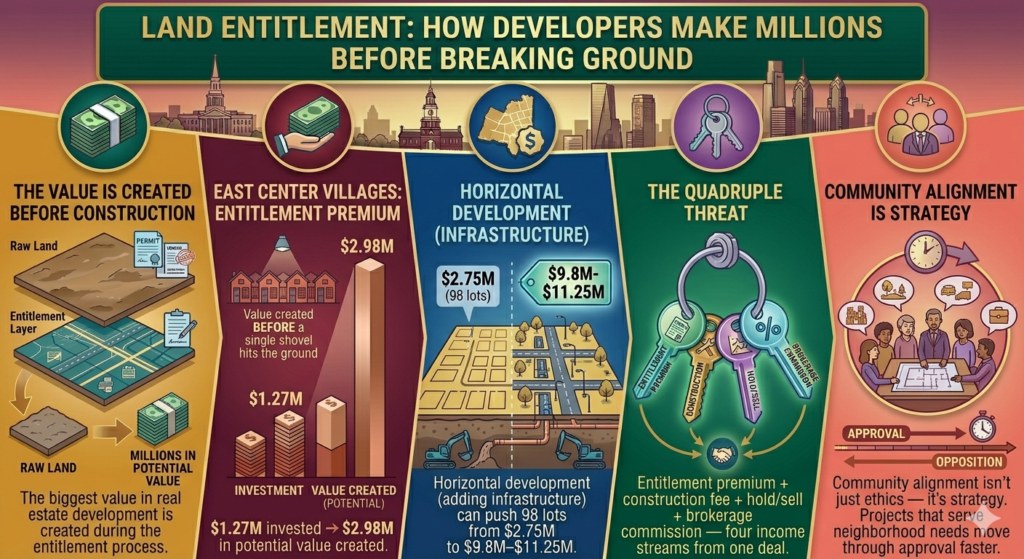
A Real Land Entitlement Investing Example: $1.27M In, $2.98M Out Before Breaking Ground
A developer acquires a piece of land for $1.15 million. Then spends roughly $120,000 on pre-development work:
- Civil engineering
- Rezoning applications
- Wetlands reports
- Boundary surveys
- Traffic impact assessments (TIA)
Total in: about $1.27 million.
Then the land entitlement investing work begins — not construction, but entitlement. Getting the land approved, zoned correctly, and subdivided into usable parcels.
Here’s what came out the other side:
The site got split into commercial and residential portions. The commercial parcel alone — just the land, no building — had an expected sale price of $1.5 million. That single sale essentially recovered the entire original land purchase price.
The residential portion yielded 98 lots. Those 98 lots received a paper lot offer of approximately $2.75 million — before a single home was built.
Total potential value created: nearly $3 million. From $1.27 million invested. Before anyone touched a bulldozer.
That’s not a flip. That’s not a rental. That’s a completely different game.
What Land Entitlement Investing Actually Is
Entitlement is the legal process of getting government approval to use land in a specific way. It includes:
Rezoning — changing or confirming the land’s permitted use (residential, commercial, mixed-use)
Subdivision — splitting one parcel into multiple legally distinct lots
Environmental clearances — wetlands, flood plains, soil studies
Infrastructure planning — roads, utilities, drainage
Community and city approval — public hearings, planning commission sign-offs
The reason most people don’t do land entitlement investing? It’s slow, it’s complicated, and it requires knowing how to work with local government. But that barrier to entry is also what makes it valuable. If it were easy, everyone would do it and the margins would compress.
In Philadelphia, entitlement is genuinely complex — the city’s zoning code is dense, the L&I process has quirks, and community input actually matters here more than in a lot of other markets. But that complexity also means less competition from people who understand it, and more opportunity for someone willing to do the homework.
Horizontal Development: The Next Level of Land Entitlement Investing
In the example above, the developer had an option to go further — what’s called horizontal development. Instead of selling entitled lots to another builder, they could install the actual infrastructure themselves: roads, water lines, sewer connections, electrical.
When you do that, each individual lot jumps in value from roughly $28,000 to $100,000–$115,000.
Multiply that across 98 lots: $9.8 million to $11.25 million in total land value.
From a $1.27 million starting point.
The difference between selling entitled paper lots and selling fully improved lots is the infrastructure investment — and it’s also where generational wealth gets built through land entitlement investing, because you’re now a developer, not just a flipper.
The Quadruple Threat: Four Ways to Make Money From Land Entitlement Investing
A developer who’s fully set up can capture value at four different points in a single land entitlement investing project:
1. Entitlement premium — the value created by going from raw land to approved, subdivided lots. Pure knowledge and process — no construction required.
2. Construction fee — if you build it yourself through your own GC, you capture the builder’s margin rather than paying it to someone else.
3. Hold or sell — once the project is complete, sell for a lump sum profit or hold and collect rental income long-term.
4. Brokerage commission — if you have a real estate license, you can represent yourself in the sale and capture the commission that would otherwise go to an agent.
Four revenue streams. One land entitlement investing deal.
I’m studying for my real estate license right now — mostly for my own investing. But reading this made me think about it differently. In the context of land entitlement investing, the license isn’t just a credential. It’s a fourth income stream baked into every transaction.
The Part of Land Entitlement Investing That’s Bigger Than Money
There’s something in this framework I keep coming back to — and it’s not the numbers.
Successful land entitlement investing isn’t just about getting government sign-off. It’s about genuinely understanding what a neighborhood needs and designing a project that serves those needs. When your project aligns with what the city and the community actually want, approvals move faster and opposition is lower.
That’s not idealism. That’s strategy.
Philadelphia is a city with deep neighborhood identity. Germantown, where I live, has been through decades of disinvestment and is now seeing renewed attention from developers — some of whom have not done a great job of listening to existing residents. The ones who do listen tend to have smoother paths through the approval process.
If I’m ever working on something at this scale, I want to be the developer who shows up to the community meeting before the application is filed — not the one who shows up to defend a plan nobody was asked about.
What Land Entitlement Investing Means for My Roadmap
My stated goal: flip → single new construction → multifamily → apartment developer.
I always thought of “apartment developer” as some distant finish line. But understanding land entitlement investing makes me realize it’s not as far away as it seems conceptually. The skills are learnable. The process is documented. The city planning department will literally answer your questions if you show up and ask.
The question isn’t just “what can I build here.” It’s “what could this land become if someone did the entitlement work?”
That’s a different question. And it leads to different opportunities — including the vacant lots and oversized parcels scattered through Philadelphia neighborhoods that most people scroll past on Zillow.
According to BiggerPockets, land entitlement investing is consistently cited by experienced developers as the highest-return phase of the development process — precisely because the value creation happens through knowledge and process rather than construction capital, making it accessible to developers who understand local zoning before they have significant construction budgets.
Use the House Build Cost Calculator to model the construction side of any land entitlement investing project — once you have entitled lots, plug in per-unit build costs to see your full development return before you commit to the infrastructure investment.
Not financial advice — just someone doing a lot of research and asking a lot of questions.