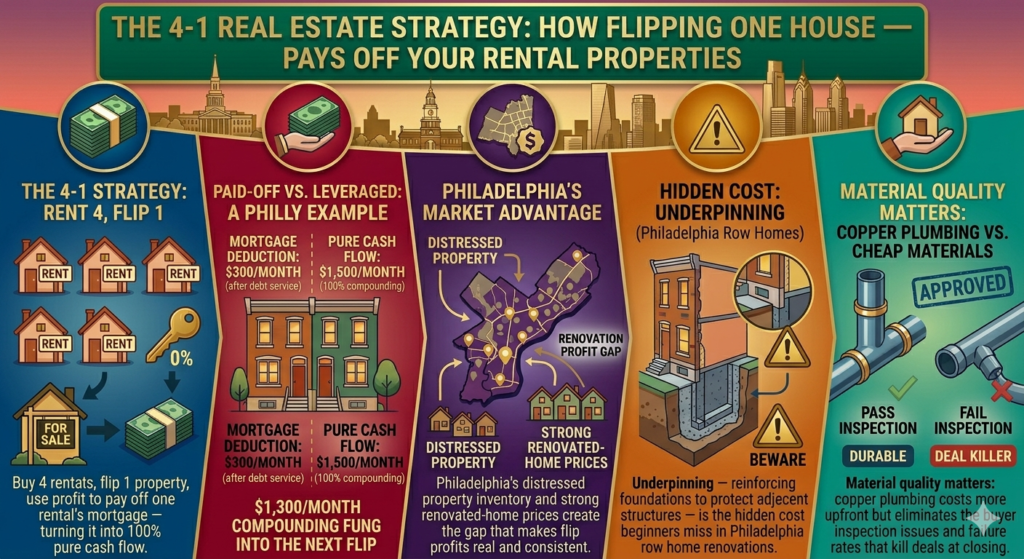
Fix and flip strategy used the right way isn’t just about making money on individual deals — it’s about using flip profits to eliminate debt on rental properties, turning them into pure cash flow machines faster than most people expect.
It’s called the 4-1 strategy. And once you understand the math, it’s hard to unsee.
The 4-1 Fix and Flip Strategy: The Basic Concept
The fix and flip strategy works like this:
Step 1: Buy 4 rental properties. Finance them with a conventional loan, DSCR loan, or hard money into a refinance. Each one has a mortgage. Each one generates some cash flow after expenses.
Step 2: Buy a 5th property — but this one uses the fix and flip strategy, not a rental play. Buy it distressed, renovate it, sell it at a profit.
Step 3: Take the flip profit and use it to pay off the mortgage on one of your 4 rental properties.
Step 4: That rental — now mortgage-free — generates 100% pure cash flow. Every dollar of rent goes straight to you with no debt service eating into it.
Step 5: Repeat.
The math compounds fast. Once you have one paid-off rental, you use its cash flow to help fund the next fix and flip strategy deal. The next flip pays off a second rental. Two paid-off rentals fund the next one even faster. Each cycle accelerates the one after it.
Why the 4-1 Fix and Flip Strategy Works Better Than Just Buying More Rentals
The standard advice is to keep buying rentals and let the mortgages pay themselves off over 30 years. That works. But it’s slow — and in the early years, each rental generates relatively thin cash flow because most of the rent goes to the mortgage.
The 4-1 fix and flip strategy short-circuits that timeline.
Instead of waiting 30 years for a mortgage to pay itself off, you use one strategic flip to eliminate one mortgage entirely — potentially in a year or two rather than three decades.
A paid-off rental generating $1,500/month is a fundamentally different asset than a leveraged rental generating $200/month after debt service. Same property. Same rent. But the paid-off version puts $1,300 more per month in your pocket.
That difference funds the next fix and flip strategy deal. Which pays off the next rental. Which funds the next flip faster.
The 4-1 Fix and Flip Strategy in Philadelphia
This strategy maps particularly well onto Philadelphia’s market — and here’s why.
Philadelphia has a large inventory of distressed properties available at significant discounts through conventional channels, wholesalers, and tax sales. The renovated property market in South Philly, Fishtown, Point Breeze, and surrounding neighborhoods commands strong prices from buyers.
That gap between distressed acquisition cost and renovated sale price is where fix and flip strategy profit comes from. And Philadelphia’s gap is real and consistent enough to make the 4-1 viable.
A rough Philadelphia example:
| 4 rentals at $300/month cash flow each | $1,200/month total |
| Fix and flip: buy at $80K, renovate for $40K, sell at $200K | ~$60,000–$70,000 profit |
| Use $60K to pay off mortgage on one rental | — |
| That rental now generates | $1,200/month |
| New total portfolio cash flow | $2,100/month |
One fix and flip strategy deal. One paid-off rental. Cash flow jumps from $1,200 to $2,100/month.
Do that again and you’re at $3,000+/month from the same 4 properties.
The Construction Side: What Actually Makes a Fix and Flip Strategy Work
The 4-1 strategy only works if your flips are actually profitable — which means your renovation has to come in on budget and on time.
Lock in your scope before you start.
The four things to have nailed down before any work begins: the scope of work, the budget with contingency built in, the layout and measurements, and the target sale price. Changing any of these mid-project is expensive. Changing them after demolition has started is very expensive.
The contingency isn’t optional. Budget 10–20% above your contractor’s estimate. Something always comes up.
Underpinning matters more than most beginners realize.
In Philadelphia’s dense row home neighborhoods, your property shares walls or sits adjacent to neighboring structures. When you’re doing foundation work on a gut renovation that touches the foundation, the adjacent building’s structure can be affected.
Underpinning is the process of reinforcing the foundation in a way that protects neighboring structures. Skip it and you risk destabilizing an adjacent building — creating legal liability, regulatory problems, and potentially catastrophic delays. Experienced developers budget for it automatically. Beginners discover it painfully.
Material quality has a long tail.
There’s a temptation in fix and flip strategy execution to use the cheapest materials that will pass inspection. But experienced developers favor materials that hold up — copper plumbing over cheaper alternatives being one consistent example.
The calculus: materials that cost slightly more upfront but reduce callbacks, buyer objections, and future liability are almost always worth it in a flip targeting buyers with conventional financing.
Show up to the site.
Developers who aren’t on-site regularly find out about problems when they’re expensive to fix. A framing mistake discovered during rough framing costs an afternoon. The same mistake discovered during drywall costs days. Discovered after finish work: potentially tear out and redo entirely.
The 4-1 Fix and Flip Strategy as a Roadmap
The 4-1 fix and flip strategy isn’t a get-rich-quick framework. It’s a systematic approach to converting flip income into permanent cash flow by eliminating debt one property at a time.
For someone starting with limited capital, it provides a structured sequence: build a small rental base, execute flips to eliminate debt on those rentals, use the increased cash flow to fund more activity, repeat.
For someone already holding rentals with mortgages, it offers a path to accelerate debt elimination without waiting 30 years for mortgages to pay themselves off.
The flipping skill set — finding distressed properties, managing renovations, selling effectively — is learnable. The rental income that results from a paid-off property is permanent. The combination of those two things is what makes the fix and flip strategy worth understanding.
According to BiggerPockets, investors who use fix and flip strategy profits to systematically eliminate rental mortgage debt consistently report reaching cash flow targets 5–10 years faster than investors who hold leveraged rentals and wait for natural amortization to run its course.
Use the Philly Flip Profit Calculator to model your fix and flip strategy numbers before you make any offer — plug in acquisition price, renovation budget, and target sale price to see exactly how much mortgage debt you can eliminate with each deal.
Not financial advice — just someone doing a lot of research and asking a lot of questions.