Class C multifamily investing is one of those strategies that gets overlooked because the buildings aren’t pretty. They’re older, a little tired-looking, and the rents are on the lower end. But here’s what I’ve been learning: in a market where interest rates are high and affordability is stretched thin, that’s exactly where the opportunity is.
I’ve been deep in research mode on this, and the numbers are actually kind of mind-blowing once you see how small operational changes translate into massive jumps in asset value. Let me break it down.
What Is Class C Multifamily Investing?
Before we get into the strategies, quick refresher on property classes.
Class A is the shiny new stuff — luxury buildings, prime locations, top-dollar rents. Class B is the middle ground — well-maintained, decent neighborhoods, stable tenants. And Class C? That’s usually buildings from the 1970s through the 1990s. They house workforce tenants — construction workers, restaurant staff, service industry people. The buildings aren’t falling apart, but they look their age and typically haven’t had a lot of love put into them.
That’s the opportunity. Most Class C buildings are owned by mom-and-pop landlords who’ve held the property for years without actively tracking market rents or investing in improvements. According to the National Apartment Association, affordable workforce housing is one of the most undersupplied segments in the current rental market. Demand is high. Supply is tight. And the current owners are leaving money on the table.
Why Class C Multifamily Investing Makes Sense Right Now
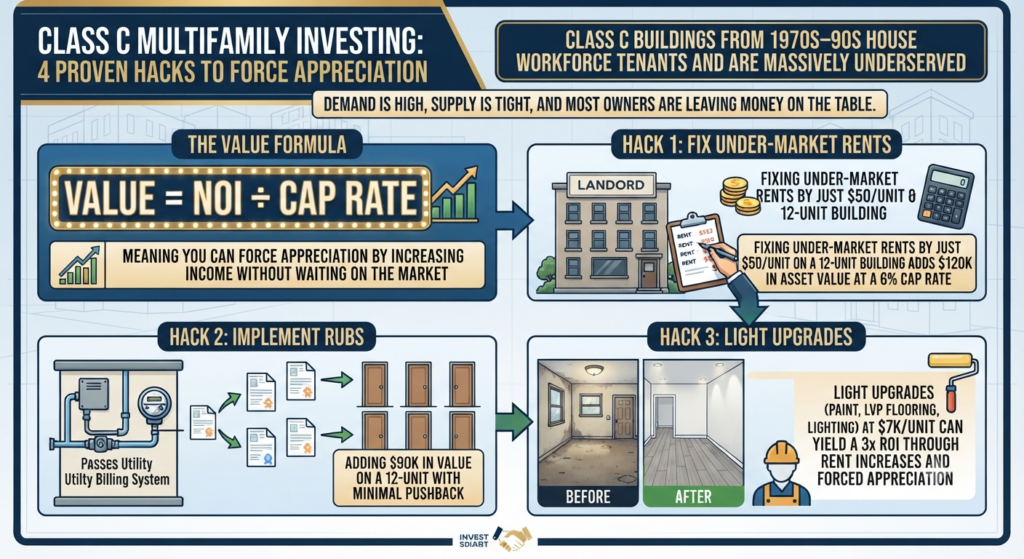
The core of class C multifamily investing is something called forced appreciation. In residential real estate, your property value is determined by comparable sales — what your neighbors sold for. But in commercial multifamily, value is driven by income. Specifically by your Net Operating Income (NOI).
The formula is simple: Value = NOI ÷ Cap Rate.
What that means in practice is that if you can increase your income or decrease your expenses, you directly increase the value of the asset. You don’t have to wait for the market to go up. You force it up yourself. That’s the whole game with class C multifamily investing — and it’s why I find it so interesting as a strategy.
4 Value-Add Hacks for Class C Multifamily Investing
Hack 1: Fix Under-Market Rents
This is the most obvious one, but it’s also the most impactful. Most C class buildings are renting units below market because the owner hasn’t kept up with what the market will actually bear.
Sites like Rentometer and Rentcast make it easy to pull comps and see what comparable units in the same area are actually renting for. If you buy a 12-unit building where rents are $50 below market across the board, that’s $600 a month in lost income — or $7,200 per year in NOI that should already be there.
At a 6% cap rate, that $7,200 in additional NOI translates to $120,000 in increased asset value. From one simple adjustment.
That’s the leverage that makes class C multifamily investing so powerful compared to single-family.
Hack 2: Implement RUBS
RUBS stands for Ratio Utility Billing System. If you’ve never heard of it, it’s basically a way to pass a portion of utility costs — water, sewer, trash, gas — back to tenants instead of absorbing them all yourself.
You’re not hitting tenants with massive bills. We’re talking $25 a month for a one-bedroom, $50 for a two-bedroom. Small enough that most tenants accept it without pushback — especially in today’s environment where everyone understands costs have gone up.
On a 12-unit building with six one-bedrooms and six two-bedrooms, RUBS adds $450 per month — or $5,400 per year — to your NOI. At a 6% cap rate, that’s another $90,000 in asset value created essentially out of thin air.
Class C multifamily investing rewards operators who pay attention to these details.
Hack 3: Light Cosmetic Upgrades
This is where class C multifamily investing gets interesting from a renovation standpoint. You don’t need to gut the units. You need to make them look like they belong in a B-class building.
The highest ROI improvements are usually:
Paint — a fresh coat including an accent wall makes a unit feel completely different. Cost is minimal. Impact is immediate.
LVP flooring — luxury vinyl plank is durable, looks great, and is significantly cheaper than hardwood. Replacing old carpet with LVP is one of the best dollar-for-dollar upgrades in rental property.
Lighting — swapping out dated fixtures for modern ones costs almost nothing and completely changes the feel of a space.
If you spend around $7,000 per unit on these kinds of light upgrades and can raise rent by $100 as a result, on a 12-unit building that’s $14,400 in annual NOI. At a 6% cap rate, asset value goes up by $240,000 — on an $84,000 total renovation investment. That’s roughly a 3x return on your renovation dollars.
Hack 4: Add Washer/Dryer Hookups
This one is underrated. Instead of buying and maintaining washer/dryer units yourself, you install the hookups and let tenants bring their own machines.
Tenants buy and maintain their own appliances. You take zero repair calls on laundry equipment. But you can charge more for the unit because in-unit laundry is a genuine amenity — especially in Class C buildings where shared laundry rooms are the norm.
It also makes the building significantly more attractive to future buyers when you go to sell. In class C multifamily investing, anything that differentiates your units from the competition without adding ongoing management headaches is a win.
The Real Play in Class C Multifamily Investing
What I love about this strategy is that you’re not gambling on the market. You’re engineering the outcome.
Small rent increases plus RUBS plus light renovations plus better amenities — stack all four of those on a 12-unit building and you’re looking at hundreds of thousands of dollars in forced appreciation that had nothing to do with what the market did.
That’s the thing about class C multifamily investing that doesn’t get talked about enough. The upside isn’t theoretical. It’s math.
I’m still in research and learning mode on this — haven’t pulled the trigger on a multifamily deal yet. But the more I dig into it, the more I think this is where serious long-term wealth actually gets built.
Not financial advice — just someone doing a lot of research and asking a lot of questions.