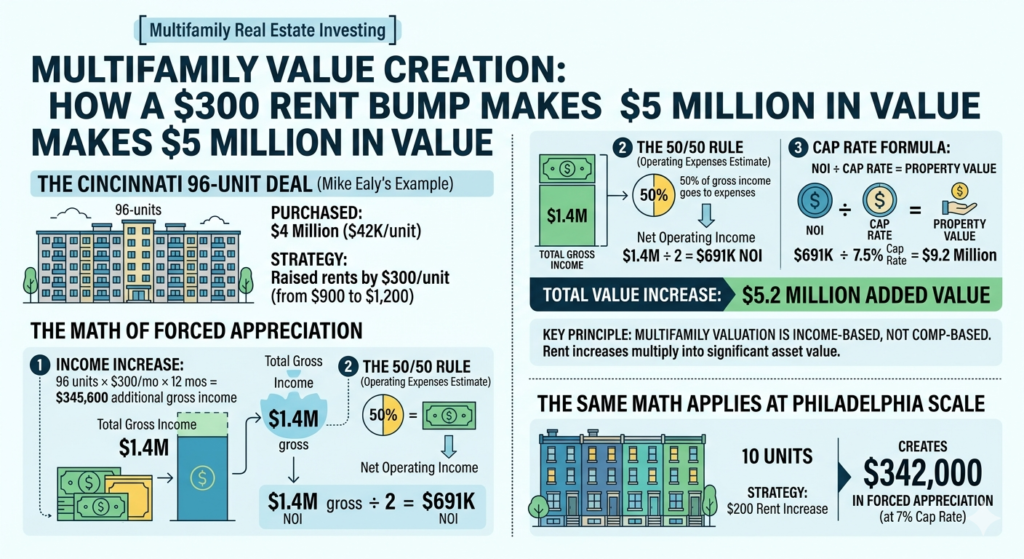
Multifamily real estate investing math hit me differently when I came across a TikTok video by Mike Ealy breaking down a 96-unit deal in Cincinnati. I watched it three times. Not because the numbers were complicated — because they were so simple and so powerful that I couldn’t believe I hadn’t seen this framing before.
He called it Millionaire Money Math. I call it the reason I’m starting to look beyond single-family rowhouses.
The Deal: 96 Units, $4 Million, and a Multifamily Real Estate Investing Lesson
The property: a 96-unit apartment building in Cincinnati. Mix of one and two-bedroom units, averaging 800 square feet. Purchase price: $4 million — roughly $42,000 per unit.
Current rents at time of purchase: $900 per month per unit. That’s $1.12 per square foot.
On the surface, this looks like a standard value-add multifamily real estate investing play. Buy a building where rents are below market. Improve the units. Raise the rents. Force appreciation.
What makes this deal interesting is the math on the back end.
Multifamily Real Estate Investing Math: The $300 Rent Increase
The strategy: bring rents from $900 to $1,200 per month — a $300 per unit increase. At $1.50 per square foot, still competitive for the Cincinnati market.
Here’s what that does to the income:
$1,200 × 96 units = $115,200 per month $115,200 × 12 = approximately $1,382,400 per year in gross income
That’s the gross number. Now comes the part that makes multifamily real estate investing fundamentally different from single-family.
The 50/50 Rule and Cap Rate: How Multifamily Real Estate Investing Turns $1.4M Into $9M
In multifamily real estate investing, commercial properties are valued based on income — not comparable sales. This is the key distinction that changes everything.
Mike Ealy uses what he calls the 50/50 rule as a quick underwriting tool: assume 50% of gross income goes to operating expenses (taxes, insurance, maintenance, management, vacancy). The remaining 50% is your Net Operating Income — NOI.
$1,382,400 × 50% = $691,200 NOI per year
Now divide that NOI by the cap rate — the rate of return investors expect in that market. At a 7.5% cap rate:
$691,200 ÷ 0.075 = $9,216,000
The building was purchased for $4 million. After stabilizing rents, it’s worth over $9 million. That’s $5 million in forced appreciation — created not by the market going up, but by operating the asset better.
That’s the Millionaire Money Math of multifamily real estate investing.
Why This Changes How I Think About Multifamily Real Estate Investing
I’ve been focused on Philadelphia rowhouses. Single-family. Small multifamily — duplexes, triplexes. And I still believe in that path as a starting point.
But this Cincinnati example shows something that single-family multifamily real estate investing simply can’t replicate at scale: when you raise rents on a multifamily property, you’re not just increasing cash flow. You’re multiplying the value of the entire asset by a factor determined by the cap rate.
A $300 rent increase on one rowhouse adds $300 a month to your pocket.
A $300 rent increase across 96 units — divided by a cap rate — adds $5 million to your net worth.
That’s not a small difference. That’s a different game entirely.
What Multifamily Real Estate Investing Math Looks Like in Philadelphia
Philadelphia has multifamily inventory. Not 96-unit buildings at $42,000 per unit — but 6-unit, 10-unit, 20-unit buildings in neighborhoods where rents are still below market and value-add opportunity is real.
The same multifamily real estate investing math applies at a smaller scale.
Buy a 10-unit building where rents are $200 below market. Renovate and raise rents by $200 per unit. Your NOI increases by $24,000 per year. At a 7% cap rate:
$24,000 ÷ 0.07 = $342,000 in forced appreciation
On top of whatever the market does on its own.
Multifamily real estate investing rewards people who understand how commercial valuation works. And once you understand it, you can’t un-see it.
According to BiggerPockets, the NOI-based valuation model that drives multifamily real estate investing returns means that operational improvements — not just market appreciation — are the primary driver of wealth creation in commercial real estate, making active asset management more valuable than passive market timing.
I’m Not There Yet. But I’m Studying.
I haven’t done a multifamily deal. I’m still working toward my Pennsylvania real estate license and building the foundation I need to do this right.
But the math is out there. The knowledge is free. The people who act on it are the ones who build real wealth.
Start with one unit. Learn the process. Understand the numbers. And keep your eyes open for the day when the scale starts to make sense.
Use the Rental Property Analyzer to run the multifamily real estate investing numbers on any deal — plug in current rents, market rents, unit count, and cap rate to see exactly how much forced appreciation a rent increase creates before you make any offer.
Not financial advice — just someone doing a lot of research and asking a lot of questions.