I’ve been deep in a research rabbit hole lately trying to figure out if multifamily real estate is actually worth it. And I keep finding the same thing — most content online is either super bullish (“buy apartment buildings, get rich!”) or super negative (“being a landlord is a nightmare”).
So when I came across an investor who was honest enough to say both at the same time, I paid attention.
This guy owns 84 properties total. Only 2 of them are multifamily. And he has a lot of feelings about that.
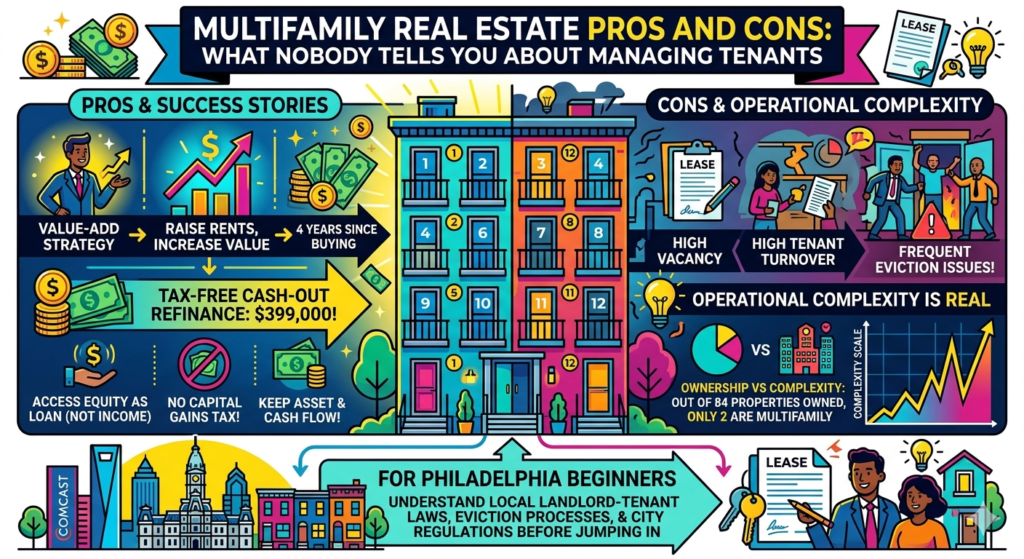
The Win: $399,000 Cash-Out With Zero Tax
Four years ago he bought 12 multifamily units in Glennan, Missouri — a long, low building with multiple doors, kind of motel-style. Not glamorous. But he ran a value-add strategy on it: raised all the rents, increased the property’s income, which increased its appraised value.
Then he did a cash-out refinance.
For anyone new to this like me — a cash-out refi is when you refinance your mortgage for more than you owe and pocket the difference as cash. Because it’s a loan, not income, you don’t pay taxes on it.
He pulled out $399,000. Tax free.
The property still cash flows about $30,000 a year on top of that.
That’s the part that made me sit up straight. He didn’t sell the building. He didn’t pay capital gains tax. He just borrowed against the equity he’d built and walked away with nearly $400K in cash — while still owning the asset and collecting rent.
This is the strategy I keep reading about — use debt as a tool instead of selling. And seeing a real example with real numbers makes it click in a way that abstract explanations don’t.
The Reality Check: 84 Properties and Only 2 Are Multifamily
Here’s where it gets interesting.
Out of 84 properties, he’s chosen to keep only 2 as multifamily. That’s not an accident. He’s clearly figured out something about what works for him — and multifamily, despite the big win, has been a headache.
The issues he describes:
High vacancy. Finding tenants consistently is harder than it sounds, especially in a lower-cost market where units rent for $650 to $950 a month.
High turnover. Tenants at that price point often don’t stay long. Many don’t even finish out a 12-month lease.
Problem tenants. Evictions, squatting, property damage. These aren’t hypotheticals — they’re regular occurrences he deals with at that rent level.
He’s not complaining exactly. He’s just being honest that the operational side of managing affordable multifamily is genuinely difficult, and it eats into the returns in ways that don’t show up in the spreadsheet.
What This Means for Someone Like Me
I’m still learning all of this. I’m not at the point of buying 12 units in Missouri. But I find it really useful to hear from someone who’s actually done it — the good and the messy.
A few things I’m taking away from this:
The value-add + cash-out refi combo is real and powerful. Raise rents → raise value → borrow against equity → keep the asset. That’s a legitimate wealth-building loop if you can execute it.
But tenant quality matters a lot. The rent level you’re targeting affects who you’re renting to, which affects how much time and stress you’re spending on management. This isn’t a judgment on tenants — it’s just a reality of the business that I think gets glossed over in a lot of “buy multifamily” content.
And property management matters too. If you’re not managing it yourself, you need a good team. If you are managing it yourself, you need to be realistic about what that actually involves.
For Philadelphia specifically — the multifamily market here looks different from rural Missouri. Rent levels are higher, which potentially means a different tenant profile. But Philadelphia also has its own set of landlord-tenant laws, eviction processes, and city regulations that add complexity. Something I’m still learning about.
So Is Multifamily Worth It?
Based on what I’ve read and watched — yes, the financial upside is real. The cash-out refi example alone is enough to make anyone pay attention.
But I think the honest answer is: it depends on your tolerance for operational complexity. Multifamily isn’t passive income, especially at the affordable end of the market. It’s a business. You’re managing people, not just properties.
For a beginner like me, that’s a useful thing to know before jumping in.
Not financial advice — just someone doing a lot of research and asking a lot of questions.