Multifamily value add investing isn’t always about renovation. Sometimes it’s about looking at what’s already there and asking what it could become.
I’ve written about this before — the misplaced fence story that generated $300K out of what looked like a headache. This one is different, but the mindset is exactly the same. I came across a breakdown from a multifamily investor who found $1.4 million in hidden value on an apartment complex. Not through renovation. Not through adding units. Not through raising rents.
Through parking spaces.
The Setup: Too Much Parking
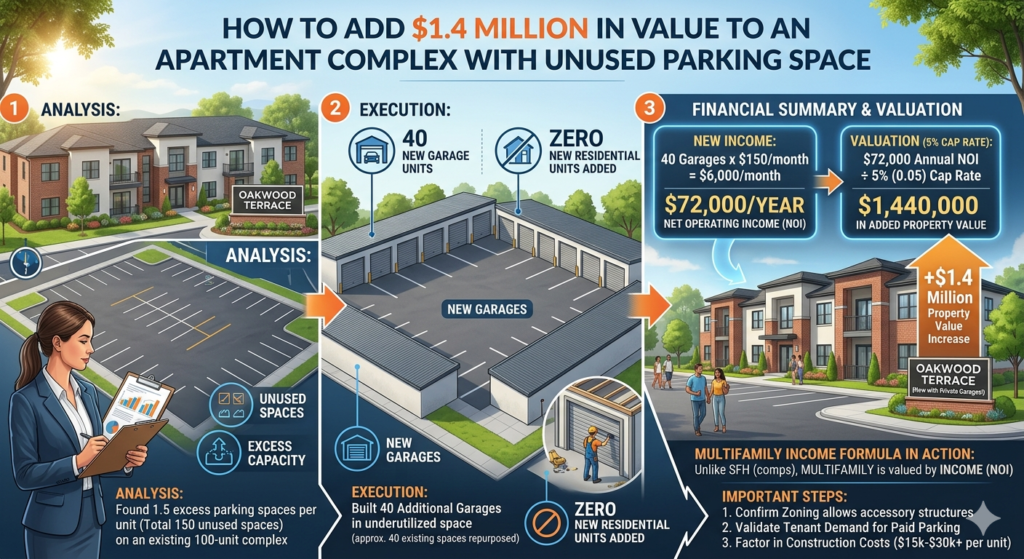
The property already had eight garages rented out to tenants. But when this investor looked at the overall lot, he noticed something: the property had 2.5 parking spaces per unit. Most tenants only need one.
That gap — 1.5 spaces per unit sitting underutilized — represented a massive amount of physical space generating zero income.
His multifamily value add idea: build 40 additional garages on that excess parking area and rent each one for $150 a month.
The Math Behind This Multifamily Value Add Strategy
Here’s where it gets interesting — and why multifamily investing works completely differently from single family.
40 garages × $150/month = $6,000 in additional monthly income
$6,000 × 12 months = $72,000 in additional annual income
In commercial real estate, a property’s value isn’t determined by comps. It’s determined by income — specifically, by dividing the net operating income by the cap rate for that market.
At a 5% cap rate:
$72,000 ÷ 0.05 = $1,440,000 in added property value
That’s $1.4 million in multifamily value add from underutilized asphalt. No new units. No major renovation. Just garages on land that was already sitting there.
Why Multifamily Value Add Works Differently Than Single Family
This is one of the most important concepts to understand if you’re thinking about eventually moving into apartment investing.
Single family homes are valued based on what similar homes nearby sold for. You can renovate all you want, but the market sets a ceiling based on neighborhood comps.
Multifamily properties are valued based on income. Every dollar of additional NOI you generate translates directly into property value — multiplied by the cap rate. In a 5% cap rate market, every $1 of annual income you add creates $20 of property value.
That’s the math that makes multifamily value add so powerful. The previous owner saw eight garages and a parking lot. This investor saw $1.4 million waiting to be unlocked.
What You’d Actually Need to Pull This Off
The math is clean but the execution has moving parts.
Zoning and permitting. Before you build 40 garages on a parking lot, confirm the municipality allows it. Accessory structures on multifamily properties have their own zoning rules, and minimum parking requirements per unit are often baked into the code.
Construction costs. Basic single-car garages can run $15,000–$30,000+ per unit to build. Forty garages is a significant capital outlay before you see a dollar of return.
Demand validation. The $150/month figure only works if tenants actually want the garages. In urban markets where parking is scarce, demand is usually strong. Know your tenants and your market before you build.
Financing the construction. Some lenders will fund improvements like this as part of a value-add loan structure. Others won’t. Worth knowing before you buy.
According to BiggerPockets, parking and storage additions are among the highest-ROI multifamily value add improvements in urban markets — precisely because the construction cost is low relative to the income-driven valuation impact.
The Philadelphia Angle on Multifamily Value Add
This strategy is particularly interesting in Philadelphia, where parking is genuinely a pain point in a lot of neighborhoods. In South Philly, parts of West Philly, and anywhere near Center City, dedicated parking and garage space commands a real premium from tenants.
If you’re buying a multifamily property in Philadelphia and it has a larger-than-necessary surface lot — which older properties in this city sometimes do — that excess space deserves a serious look before you assume it’s just parking.
The city’s zoning code does regulate accessory structures, so you’d need to run this by a local zoning consultant. But the concept is absolutely applicable here.
Use the Multi-Unit Cash Flow Calculator to model your multifamily value add scenario — including additional garage income and the cap rate impact on property value — before you make any offer.
Not financial advice — just someone doing a lot of research and asking a lot of questions.