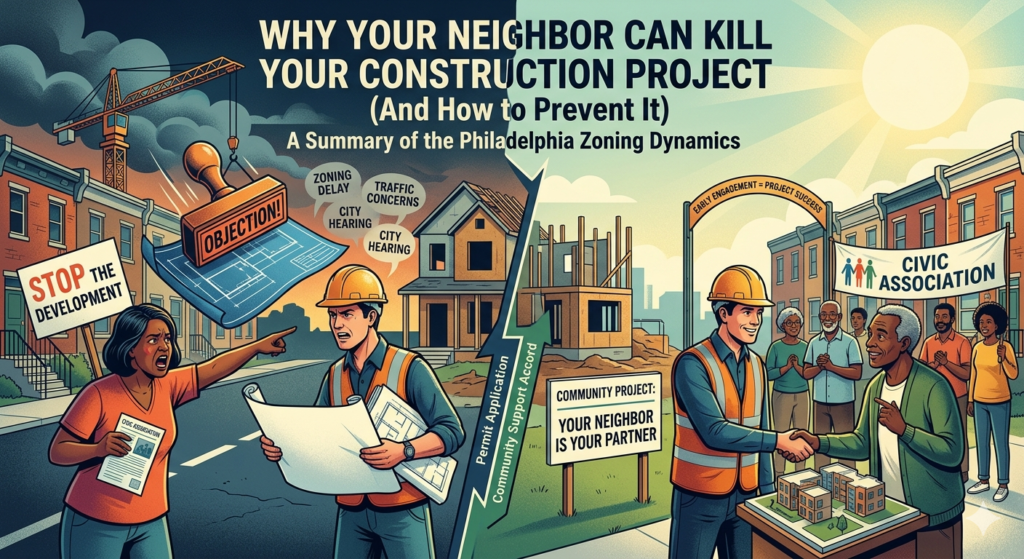
Neighbor construction objection is one of the most underestimated risks in real estate development. Not slow your project down — shut it down entirely.
When most people think about what can go wrong on a new construction project, they think about money. Permits taking too long. Contractors going over budget. Interest rates moving the wrong way. Those are all real risks.
But I kept seeing one risk come up in developer interviews that doesn’t get nearly enough attention: your neighbors. I came across a video from a developer who’s done multiple ground-up projects, and his message was blunt — one neighbor can kill everything. That got my attention.
How a Neighbor Construction Objection Actually Shuts Down a Project
Here’s the context that makes this make sense.
When you’re building new construction, you typically have to go through a municipal approval process. Depending on your city and what you’re building, this can involve zoning hearings, variance requests, or a public hearing where the project gets reviewed before final approval.
And at that hearing? The public can show up. Neighbors can show up. And if someone stands up at that microphone and objects — formally, on record — it can trigger delays, additional reviews, or enough political pressure to derail the project entirely.
A single neighbor construction objection at the wrong moment can cost you months and thousands of dollars in carrying costs while you wait for a resolution.
In Philadelphia specifically, this is not theoretical. Zoning board hearings are public. Civic associations have real influence. And in dense rowhouse neighborhoods where properties literally share walls, the idea that your construction project is nobody else’s business is just not realistic.
Why Neighbor Construction Objections Happen in the First Place
Most of the time, according to this developer, neighbor opposition comes down to one thing: they didn’t know what was happening.
Nobody told them. They didn’t get a notice. They found out from someone at the grocery store, or they drove by one day and saw a crew on the lot. By then they felt blindsided. And when people feel blindsided, they get defensive.
A lot of the time it’s not even about the project itself. It’s about feeling disrespected — like decisions were being made around them without anyone bothering to loop them in.
That’s actually fixable. But only if you get ahead of it before the neighbor construction objection becomes a formal complaint.
What Smart Developers Do to Prevent Neighbor Construction Objections
The strategy this developer laid out is simple — but requires actually doing it.
Meet your neighbors before anything starts. Don’t wait until permits are pulled or construction begins. Go knock on doors early. Introduce yourself, explain what you’re planning, and give them a way to reach you directly. This one step prevents most neighbor construction objections before they ever start.
Make yourself the first call when something bothers them. This is the key move. Tell your neighbors: if anything about this project is bothering you, call me first. Before you call the city. Before you talk to anyone else. Give them your number and actually mean it.
Complaints that come to you directly are problems you can solve. A neighbor construction objection that goes to a city council member or shows up at a zoning hearing becomes public record and can take on a life of its own.
If you know opposition is coming, build support first. Talk to other neighbors. Build a coalition before the hearing. One vocal opponent is a lot less powerful when five other neighbors show up to say they support the project.
The Philadelphia Angle on Neighbor Construction Objections
Philadelphia is a city of tight neighborhoods with long memories and strong civic associations. Germantown, Fishtown, Kensington, Point Breeze — these are communities where neighbors talk to each other, where civic associations show up to zoning hearings, and where a project that feels imposed on a block can generate real organized opposition.
According to HUD.gov, community opposition is one of the leading causes of development project delays in dense urban markets — and Philadelphia’s neighborhood civic structure makes it one of the most organized cities in the country when it comes to resident pushback on new construction.
That’s not a reason to avoid developing here. It’s a reason to take the relationship piece seriously from day one. The developers who succeed in Philadelphia long-term aren’t just the ones with the best financing or the sharpest eye for ARV. They’re the ones who know how to work within a community — and who get ahead of neighbor construction objections before they become formal complaints.
Use the Neighbor Objection Risk Checker to evaluate any development site before you start — including zoning hearing requirements and civic association activity in your target neighborhood.
What This Means for My Own Roadmap
I’m still in earlier stages — getting back into flipping, building toward ground-up eventually. But I’m filing this one away because it’s exactly the kind of thing that separates developers who get projects done from developers who get stuck.
The financing, the construction management, the numbers — those are all learnable. But knowing how to walk up to a stranger’s door, introduce yourself, and make them feel like a partner instead of an obstacle? That’s something you have to actively develop.
One neighbor with a grudge and a microphone at a zoning hearing can cost you months. A conversation over the fence at the beginning of a project might prevent all of it.
Not financial advice — just someone doing a lot of research and asking a lot of questions.