Off market real estate investing sounds like something only connected insiders can pull off. The reality is more accessible than that — and more systematic.
I’ve been studying how investors consistently find deals that never hit Zillow, never get listed on MLS, and never get bid up by twenty other buyers. Here’s what the process actually looks like.
Why Off Market Real Estate Investing Starts With Market Selection
Before you find a deal, you need to find the right market. And the right market is probably not where you live.
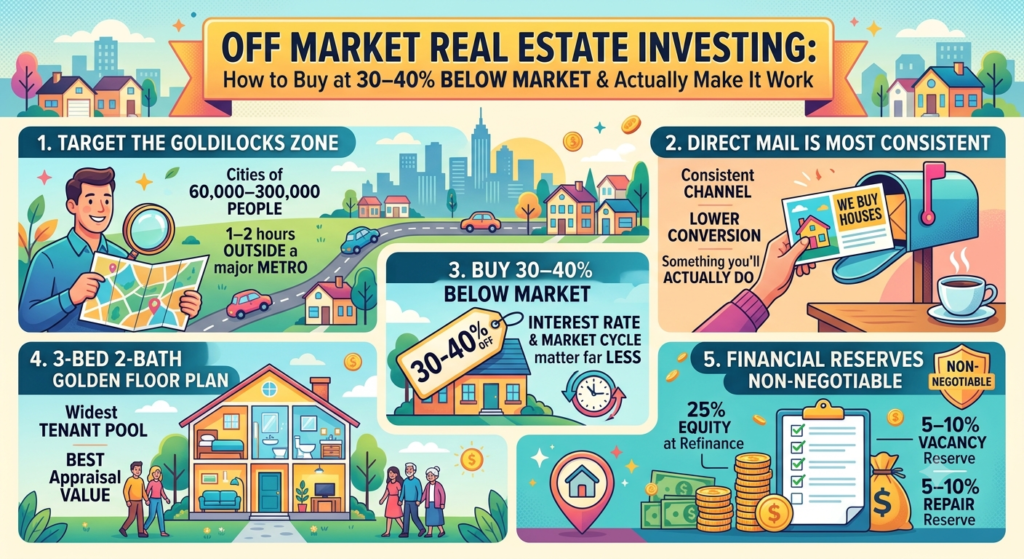
The sweet spot is what some investors call the Goldilocks Zone — cities with populations between 60,000 and 300,000 people, located one to two hours outside a major metro. Close enough to understand the market, far enough that prices haven’t been inflated by big-city spillover demand.
If you’re in Philadelphia, that means looking at places like Reading, Allentown, Harrisburg, or Wilmington — markets where prices are lower, competition is thinner, and the 30 to 40% discount deals actually exist.
Remote investing works here. You don’t need to live in your market. You need a reliable property manager, a good contractor, and a system for finding deals before they hit the open market.
The Most Consistent Way to Find Off Market Real Estate Investing Deals
Direct mail.
Not cold calling. Not driving for dollars. Not scrolling wholesaler lists. Direct mail — sending letters or postcards directly to property owners — is the most consistent off market real estate investing channel that serious investors use.
The conversion rate is lower than cold calling. But it’s something most people will actually do consistently, which matters more than the theoretical best approach you’ll abandon after two weeks.
The math that makes it worth it: if you can buy at 30 to 40% below market value, the interest rate doesn’t matter as much, the market cycle doesn’t matter as much, and your margin for error is significantly wider. The deal is made at acquisition. Everything else is execution.
Off Market Real Estate Investing: What to Do After You Buy
Getting the deal cheap is step one. What you do with it determines whether it actually works.
Keep it dry first. Before anything cosmetic, the building needs to be weathertight. Roof, exterior walls, foundation — if moisture is getting in, everything else you do is temporary. A dry shell holds its value. A wet one deteriorates faster than you can fix it.
Target the golden floor plan. Three bedrooms, two bathrooms. That configuration captures the widest pool of tenants — families, Section 8 voucher holders, and owner-occupant buyers if you ever sell. It also appraises best, which matters when you refinance.
Spend where it shows at appraisal. Kitchen and bathroom updates move the appraised value. New light fixtures in the hallway don’t. Prioritize the improvements that directly affect what a bank appraiser will put on paper, and work within budget on everything else.
Run your numbers through the Rental Property ROI Calculator before you commit to a renovation budget. Know what your target rent needs to be to hit your return, then work backward from there.
The Financial Rules That Keep Off Market Real Estate Investing Sustainable
Buying cheap is how you get in. These rules are how you stay in.
The 25% equity rule. When you refinance, stop at 75% LTV. Leave at least 25% equity in the property. That cushion is what protects you when rates move, values dip, or you need to sell at an inconvenient time. Investors who cash out to 80 or 90% LTV have no buffer — one bad year and they’re underwater.
Reserves before distributions. Before you pay yourself anything, set aside 5 to 10% of gross rents for vacancy and 5 to 10% for repairs. Every month, automatically. Properties that look cash flow positive on paper often bleed cash in practice because investors skip this step.
Title insurance. Non-negotiable on off market deals. You’re buying properties with histories you don’t fully know — liens, ownership disputes, unpaid taxes, estate complications. Title insurance covers you if something surfaces after closing. According to the American Land Title Association, title issues affect roughly one in three real estate transactions. On off market deals, that number skews higher.
How the Portfolio Builds Over Time
Off market real estate investing at scale works because the early deals create the capital for the next ones.
Buy below market → renovate strategically → refinance at stabilized value → pull out tax-free cash → repeat.
The tax-free piece is important. Cash pulled out through a refinance is debt, not income. You don’t pay taxes on it. That cash can fund the down payment on the next deal, cover reserves on your existing portfolio, or sit as liquidity until the right opportunity appears.
Think in portfolio terms, not individual deal terms. One property might underperform. Another might exceed projections. What matters is the average across everything you own — and whether the system as a whole is building equity and generating cash flow you can live on.
The investors who build real wealth through off market real estate investing aren’t the ones who found the perfect deal. They’re the ones who built a repeatable system for finding decent deals consistently — and executed it long enough for compounding to do its work.
Not financial advice — just someone doing a lot of research and asking a lot of questions.