Everyone keeps saying cash flow is dead. Rural real estate investing says otherwise.
The problem isn’t the market. The problem is where most people are looking. If you’re searching for deals in Philadelphia, New York, or any major metro, yes — the numbers don’t work. But drive 45 minutes to an hour outside those cities and you’re in a completely different market. Less competition, lower prices, and deals that would be impossible in the city are suddenly right there.
Here’s what rural real estate investing actually looks like in 2026.
Why Rural Real Estate Investing Still Produces Cash Flow
The 2% rule — where your monthly rent equals 2% of your total acquisition cost — is essentially impossible in most big cities right now. A $300,000 property would need to rent for $6,000 a month. Nobody’s paying that for a single-family in most markets.
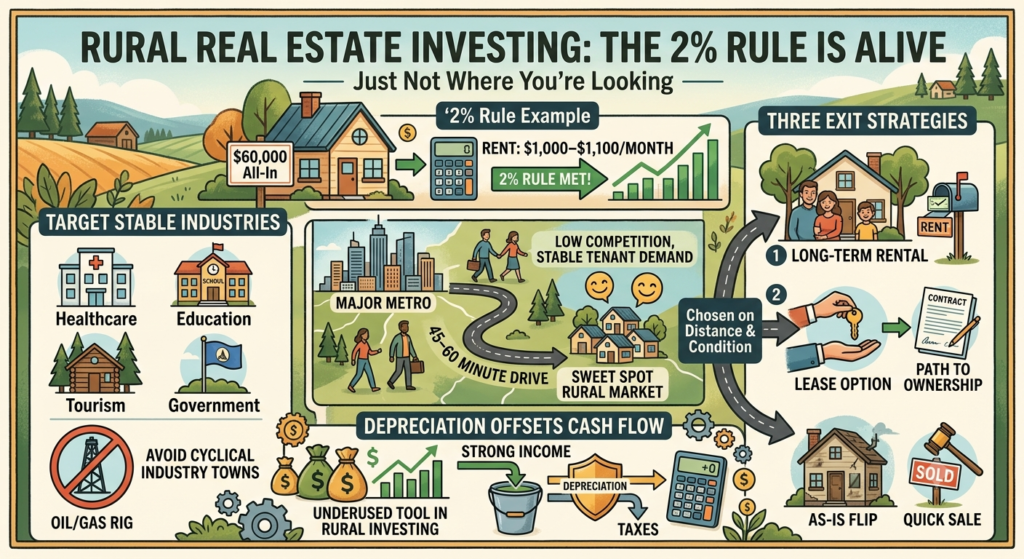
In rural markets, the math looks completely different. A property that costs $40,000 to buy and $20,000 to repair — total $60,000 in — can rent for $1,000 to $1,100 a month in the right rural market. That’s close to the 2% rule, and it’s still findable if you know where to look.
The reason this works is simple: lower purchase prices, lower competition, and tenant demand that’s driven by local employment rather than speculative buyers. Rural real estate investing isn’t sexy. That’s exactly why the numbers still work.
How to Pick the Right Rural Market
Not every small town is a good investment. This is where rural real estate investing gets specific.
Industry stability is everything. A town built around oil and gas looks great when commodity prices are up and falls apart when they drop. Cyclical industries create cyclical rental markets — boom and bust, high vacancy when things turn. You want towns supported by healthcare, education, casinos, tourism, or government employment. These industries don’t disappear overnight and they create consistent, year-round tenant demand.
Population trends matter. A shrinking town is a warning sign. You want at minimum a stable population — flat is acceptable, slow growth is better. Declining populations mean fewer tenants, longer vacancy, and a harder exit when you eventually sell.
Distance from a metro anchor. The sweet spot is 45 minutes to one hour outside a major city. Close enough that some residents commute. Far enough that prices haven’t been inflated by metro spillover. In Pennsylvania, that means markets like Pottsville, Sunbury, or Bloomsburg rather than anything within the Philadelphia or Pittsburgh suburbs.
Rural Real Estate Investing Exit Strategies That Actually Work
One of the underrated advantages of rural real estate investing is the flexibility on exit. You’re not locked into one path.
Long-term rental is the base case — buy, repair, rent, refinance, repeat. The BRRRR cycle works in rural markets just like anywhere else, often with better cash-on-cash returns because of the lower acquisition prices.
Lease option is the move when a property is too far out to manage efficiently. Instead of doing a full rehab, you sell the property on a lease option — the buyer pays you an option fee upfront, makes monthly payments that are higher than market rent, and has the right to purchase at a set price down the road. You get monthly cash flow without the management headache, and you exit at a profit when they exercise the option.
As-is flip works for properties that are genuinely too remote or too distressed to manage. Find an investor buyer, sell without rehabbing, take a smaller margin, and redeploy the capital somewhere cleaner. Not every deal deserves a full renovation.
Land strategies can also add value on rural properties with acreage. A property with ten acres and two structures can sometimes be split and sold in pieces for more than the whole. This requires checking local zoning and subdivision rules first — what’s allowed varies significantly by county.
Use the Exit Strategy Picker to run through your options before you commit to a single path on any rural deal.
The Financial Structure That Makes Rural Real Estate Investing Sustainable
Better cash flow doesn’t mean you can skip the fundamentals.
Reserves first. Set aside 5 to 10% of gross rents for vacancy and another 5 to 10% for repairs before you pay yourself anything. Rural properties can have longer vacancy periods between tenants — the tenant pool is smaller and turnover can take longer to fill. Budget for it.
Depreciation. This is one of the most underused tools in real estate investing at any level. The IRS allows you to depreciate residential rental property over 27.5 years, which creates a paper loss that offsets your rental income. In rural real estate investing where cash flow is strong, depreciation can significantly reduce your tax bill. According to the IRS, rental property depreciation applies to the structure value — not the land — and can be claimed every year you hold the property.
Portfolio diversification. Don’t put everything into long-term rentals in one rural market. Mix in lease option assets, land, and potentially some commercial exposure as your portfolio grows. When one asset class faces headwinds, others carry the weight.
What Rural Real Estate Investing Looks Like in Practice
The investors making this work in 2026 aren’t waiting for rates to drop or prices to fall. They’re finding markets where the numbers work today, building systems to manage remotely, and running disciplined exit strategies that don’t depend on market appreciation to produce returns.
It requires more research upfront — you need to understand the local economy, population trends, and tenant demographics before you buy. But that research is what keeps you out of the markets that look cheap because they’re dying, and into the markets that are cheap because nobody’s paying attention yet.
That gap is where rural real estate investing lives.
Not financial advice — just someone doing a lot of research and asking a lot of questions.