Most people imagine a real estate developer strategy as glamorous — big buildings, big checks, constant action. The reality is a lot more spreadsheet, a lot more phone calls, and a surprising amount of time staring at staircase storage solutions.
I’ve been studying how developers actually operate, and the gap between what people think this looks like and what it actually looks like is significant. Here’s what I found.
The Numbers Come First — Always
The single most important part of any real estate developer strategy is underwriting. Not design. Not location. Not relationships. Numbers first, everything else second.
The developers who consistently make money use simple rules to filter deals fast.
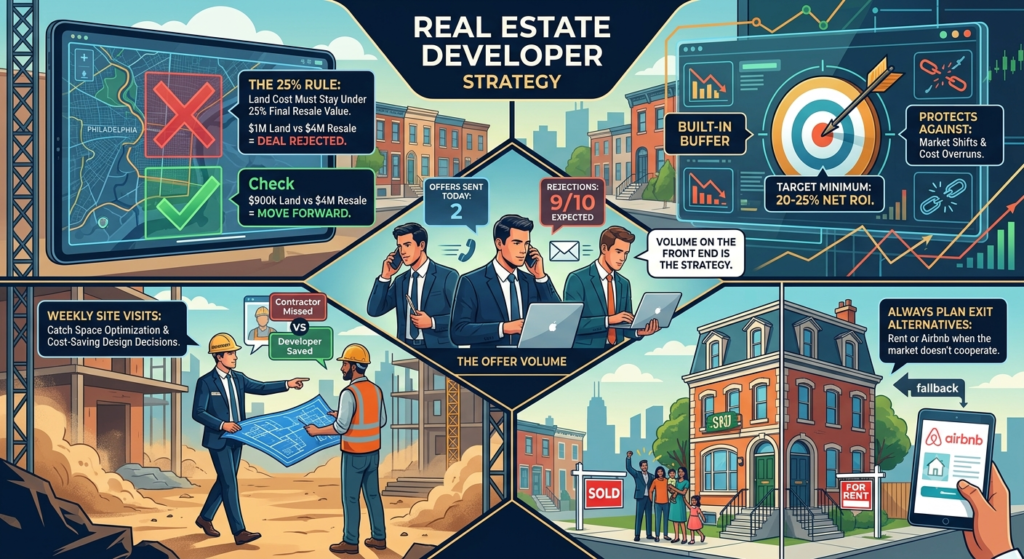
The 25% Rule: Land cost — including demolition — should never exceed 25% of the final resale value. If you’re building something that will sell for $400,000, you shouldn’t pay more than $100,000 for the land. This single filter eliminates most deals before you ever get emotionally invested.
Construction cost targets: Builder-grade construction typically runs $100 to $175 per square foot depending on your market. Know your local number before you underwrite anything.
ROI floor: If the deal doesn’t pencil out to at least 20 to 25% net profit after commissions, it doesn’t move forward. That buffer is what keeps you solvent when the market shifts, a subcontractor disappears, or something you didn’t expect shows up in the ground.
Before committing to any deal, run your numbers through the Philadelphia Flip Profit Calculator to see if your margins hold up before you ever make an offer.
Real Estate Developer Strategy Means Making Offers Constantly
The developers who build real pipelines treat offers like a daily habit.
One to two offers per day. Expect nine out of ten to be rejected. The one that goes through is the deal that matters.
Most beginners make three or four offers, get rejected, and conclude the market doesn’t work. That’s not how it works. The real estate developer strategy is a volume game on the front end — you have to be willing to lose nine times to win once.
Before every offer, run comps on similar properties completed within the last five years. Price conservatively. Then back into your offer price from your target margin of 25 to 30%. If the math doesn’t work at a price the seller will accept, you walk.
What Site Visits Are Actually For
Once a week, about an hour on site. That’s the cadence.
The point isn’t to micromanage the crew. It’s to catch the things that contractors and subs miss — or don’t bother flagging — because they’re not thinking about the end buyer.
Space optimization is the big one. In a 900 to 950 square foot unit, every decision affects how the space feels. Changing an awkward kitchen island to a U-shaped layout can make a small unit feel open. Using the space under a staircase as storage adds function without adding cost.
Cost-saving design decisions also happen on site. Instead of full railings throughout, install them only where required and use a half wall on the second floor — same aesthetic effect, roughly half the cost. Instead of an engineered retaining wall, use large boulders for a landscaping wall that saves thousands and looks intentional.
Curb appeal matters even during construction. A clean, organized job site signals quality to neighbors, future buyers, and anyone driving by. It’s a small thing that costs nothing and communicates everything.
The Real Estate Developer Strategy for Exits
Good developers don’t just plan for one outcome. They plan for what happens when the market doesn’t cooperate.
If you build to sell and the market softens before you close, you need an alternative. The standard fallback is rent — hold the property, cover the debt service with rental income, and wait for conditions to improve. If the location supports it, short-term rental through Airbnb can generate enough cash flow to carry the loan while you wait.
This is why your underwriting needs to work in multiple scenarios, not just the best case. Use the Exit Strategy Picker to run through your options before you commit to a single path.
According to the National Association of Home Builders, construction costs and market conditions vary significantly by region — which is exactly why local comps and conservative projections matter more than national averages.
How Developers Think About Time
This part surprised me.
The developers who build sustainably don’t work 80-hour weeks. The breakdown looks more like this: 30% with family, 30% on site visits and meetings, 40% on office work — underwriting, offers, financing, coordination.
The real estate developer strategy at scale isn’t about doing more. It’s about building systems so the business runs without you in every corner of it. Hire an operations manager. Use flat-fee contracts with subcontractors and offer bonuses for coming in under budget — it aligns incentives without you having to police every line item.
The goal is to spend your time on acquisitions and financing, not on fixing things that someone else should be managing.
Where This Goes Long Term
Single-family and townhouse development is the entry point. But the same real estate developer strategy scales.
Commercial development — Starbucks pads, bank branches, net lease retail — operates on the same principles with longer timelines and different tenant dynamics. Senior housing and assisted living facilities follow similar underwriting logic with added regulatory layers.
The numbers change. The discipline doesn’t.
Start with one deal. Apply the 25% rule. Hit your 20 to 25% ROI target. Build the system around it. That’s the real estate developer strategy.
Not financial advice — just someone doing a lot of research and asking a lot of questions.