I’ve been going deep on alternative real estate strategies lately — RV parks, extended stay hotels, self storage. But this one stopped me cold when I first ran the numbers.
A single house. Six elderly residents. $15,000 a month in net profit.
I had to look twice. Then I had to understand exactly how it works — and what it actually takes to pull it off.
Why the Numbers Work
Most people think of assisted living as those large corporate facilities — big buildings, hundreds of residents, institutional feel. That’s one model.
Residential Assisted Living (RAL) is something different. It’s a regular house — typically a larger single-family home — converted into a licensed care facility for a small number of elderly residents. Six to ten people, living in a home environment, receiving personal care assistance.
Here’s why the math is so different from regular real estate:
A standard rental property generates income from one household paying one rent check. An RAL generates income from multiple residents — each paying for not just a room, but a full package of services.
The national median cost of assisted living is $6,200 per month per resident — covering room, meals, housekeeping, personal care assistance, and supervision. macrotrends
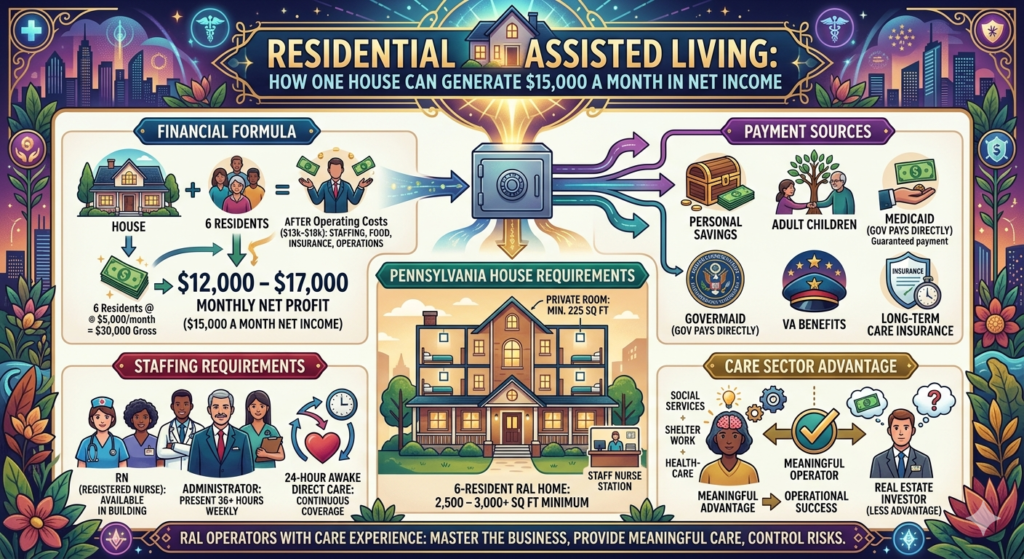
Six residents × $5,000/month = $30,000 gross monthly revenue
That’s from one house.
Who Pays for It?
Good question — and one I had to research carefully.
The short answer: it varies, and understanding the payment sources is critical for anyone thinking about this business.
Personal savings and assets — Many seniors pay out of pocket, drawing from retirement savings, pension income, or proceeds from selling their home. This is the most common payment source for middle-class families.
Adult children — When a parent’s savings run out or aren’t sufficient, family members often contribute. Some families split costs among siblings.
Medicaid — For lower-income seniors, Medicaid can cover assisted living costs through Pennsylvania’s waiver programs. This is significant for RAL operators: accepting Medicaid residents means the government pays you directly, eliminating collection risk and filling beds with residents who have guaranteed funding.
Veterans benefits — The VA’s Aid and Attendance benefit can provide qualifying veterans and their surviving spouses with assistance toward assisted living costs — up to roughly $2,200/month for eligible individuals.
Long-term care insurance — Some seniors purchased this coverage years ago specifically to fund future care needs.
The practical implication: an RAL that accepts Medicaid residents has a built-in referral pipeline and guaranteed payment. It also opens doors to residents who couldn’t afford private-pay rates — which matters both ethically and for occupancy stability.
The Real Cost Structure
Let me be honest about what the expenses actually look like, because $30,000 in gross revenue is very different from $15,000 in net profit.
Staffing — the biggest line item:
Pennsylvania requires a registered nurse to be available in the building, and an administrator must be present an average of 36 hours per week. macrotrends
- RN (can be part-time or consulting contract): $4,000–$6,000/month
- Direct care staff — you need 24-hour coverage, which means multiple people: $6,000–$8,000/month
- Administrator (could be the owner if qualified): variable
Other operating costs:
- Food (three meals daily for six residents): $1,500–$2,000/month
- Liability insurance: $500–$1,000/month
- Utilities, supplies, maintenance: $1,000–$1,500/month
Total monthly expenses: approximately $13,000–$18,000
Net profit: $12,000–$17,000/month
The $15,000 figure is real — but it’s at the optimistic end of a well-run operation. A realistic first-year target is probably $8,000–$12,000 as you work out operations and staffing.
Pennsylvania Licensing Requirements
This is where it gets serious — and where most people who think about this business stop thinking about it.
Pennsylvania licenses Residential Assisted Living facilities through the Department of Human Services. The requirements are substantial.
The space requirements alone:
Each single-occupancy living unit must have at least 225 square feet of floor space, excluding bathrooms and closets. Two-person shared units require at least 300 square feet. ASPE
Do the math: six residents in private rooms means six rooms of at least 225 square feet each — that’s 1,350 square feet of bedroom space alone, before you add common areas, a dining room, kitchen, staff space, and bathrooms.
A realistic RAL for six residents needs a home of at least 2,500–3,000 square feet. A standard Philadelphia row house won’t cut it. You’re looking at larger suburban homes or commercial properties converted for residential use.
Staffing requirements:
- Registered nurse available in the building
- Administrator present 36+ hours per week
- Direct care staff awake and on duty at all times
- All staff require criminal background checks
The licensing process:
- Application to Pennsylvania DHS
- Physical site inspection
- Fire safety approval from Department of Labor and Industry
- Compliance with building and health codes
- Proof of liability insurance
- Annual inspections ongoing
Fees:
- Application fee: $300
- Per-bed fee: $75/bed annually
The licensing process takes time — months, not weeks. And the building has to be right before you apply.
Who This Business Is Actually For
Here’s my honest assessment after researching this thoroughly.
Residential Assisted Living is not a passive income play. It is an operating business that happens to be housed in real estate. The distinction matters.
The people who do this well tend to share certain characteristics:
Care sector experience. People who’ve worked in healthcare, social services, or senior care understand the operational realities before they start. They know what a confused resident at 3am looks like. They understand medication management. They’ve dealt with family members who are grieving and difficult. That experience is worth a lot.
Someone who has spent years working in a shelter or social services environment — helping vulnerable people navigate difficult circumstances — has skills that translate directly to this work. The patience, the systems thinking, the ability to manage complex human situations. It’s not the same as assisted living, but the foundation is there.
Strong systems and hiring instincts. The business lives and dies on your staff. Finding, training, and retaining good direct care workers is the hardest operational challenge in this business. People who are good at building teams and managing people have a significant advantage.
Stomach for regulation. Annual inspections. Ongoing compliance. Documentation requirements. This is a regulated business and it operates like one. If paperwork and compliance feel overwhelming, this will be a difficult fit.
The Ethical Dimension
I want to say something that doesn’t usually show up in the financial analysis.
The residents of an RAL are elderly, often cognitively declining, and in a vulnerable position. They’re trusting you — and their families are trusting you — with their safety, their dignity, and their final years.
The financial upside is real. But the responsibility is real too. The operators who build successful, sustainable RAL businesses are almost universally people who genuinely care about the residents — not just the revenue. That care shows up in hiring decisions, in how complaints are handled, in whether corners get cut when no one’s looking.
The money is available because the work is hard and the stakes are high. The business rewards people who take both seriously.
Is This Right for You?
If you’re someone with a care background, strong operational instincts, and the patience to navigate a licensing process — Residential Assisted Living is worth serious research.
The financial profile is compelling: income from one property that significantly exceeds what any single-family rental could generate, with a built-in demand driver (aging Baby Boomers) that isn’t going away.
The barriers are real: licensing, staffing, space requirements, and the ongoing operational intensity of running a care facility.
For the right person, those barriers are exactly what creates the opportunity. The difficulty is the filter.
Not financial advice — just someone doing a lot of research and asking a lot of questions. Pennsylvania licensing requirements for assisted living residences are subject to change — verify current requirements with the Pennsylvania Department of Human Services before proceeding.