I’ve been writing about land flipping this week. Buying cheap parcels at tax sales. Using Google Earth for due diligence. Requesting OTC lists from county offices. The whole thing.
Then I came across a video from an experienced real estate investor saying the exact opposite. Don’t buy vacant land. No cash flow. Banks won’t finance it. Development takes years. Dead investment.
Two experts. Completely opposite advice. Same asset class.
So which one is right?
Both of them. And neither of them. Here’s why.
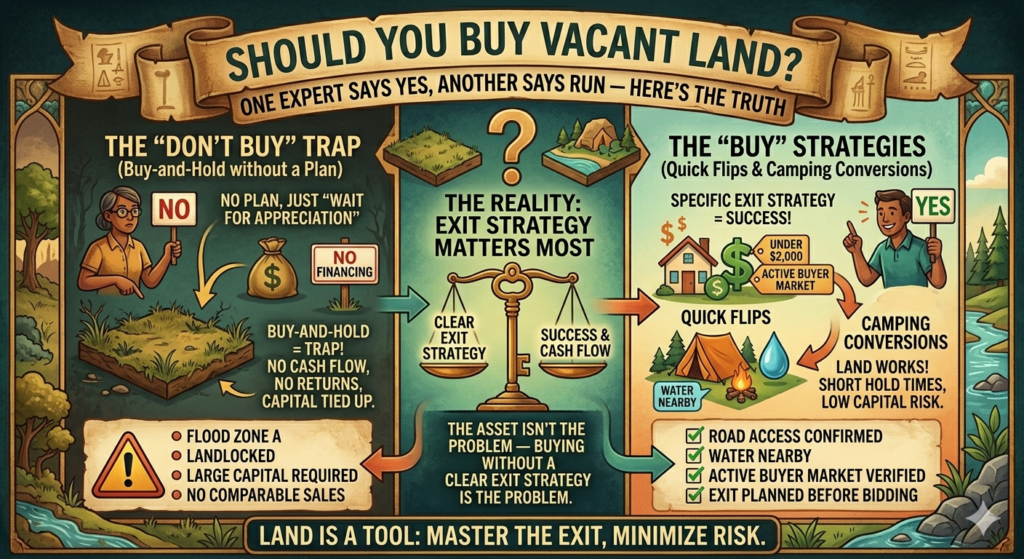
What the “Don’t Buy Land” Expert Is Actually Warning About
Let me be fair to the bearish argument first — because it’s not wrong. It’s just describing a specific type of land investment.
No cash flow. A piece of raw land sitting empty generates zero monthly income. No rent. No lease payments. Nothing. If you buy land and hold it waiting for appreciation, your capital is tied up producing nothing while it waits.
Compare that to a rental property generating $1,200/month. Every month you hold the rental, money comes in. Every month you hold the vacant land, nothing comes in.
Banks don’t like it. Conventional lenders are reluctant to finance raw land — especially undeveloped, rural parcels. No building means no appraisal in the traditional sense. No income means no DSCR to underwrite against. Most land purchases at the entry level are cash transactions.
If you’re tying up $50,000 in a land parcel with no income and no financing options, that’s $50,000 that could have been a down payment on a cash-flowing rental property.
Development is slow and risky. If your plan is to buy land and build something on it — great. But permits take months. Construction takes months or years. Costs overrun. Markets shift. A land development play is a long, capital-intensive process with a lot of ways to go wrong.
All of this is accurate. And for a certain type of land investment — buy and hold, waiting for appreciation, no near-term plan — it’s a legitimate warning.
What the “Buy Land” Strategy Is Actually Describing
Now here’s where context matters enormously.
The land flipping strategy we’ve been discussing is not buy-and-hold. It’s not development. It’s not passive appreciation waiting.
It’s a turnover business.
The model: Buy a parcel at a tax sale for $700. List it on LandWatch and Facebook Marketplace for $2,500. Sell it in 30–60 days. Move on to the next one.
Your capital is in the deal for weeks, not years. There’s no development. No construction. No permits. No waiting for appreciation. You’re buying at a discount and selling closer to market value — quickly.
That’s a completely different activity than “buy land and wait.”
The camping model: Buy a $700 parcel near water. Clear some brush. Add a fire pit. List on Hipcamp or Tentrr for $35/night. Now it generates cash flow. Not a lot — but something.
That’s not “no cash flow.” That’s turning raw land into an income-producing asset with minimal capital.
The Real Distinction: Strategy vs. No Strategy
Here’s the actual lesson hiding in the contradiction between these two experts.
The “don’t buy land” argument is correct when applied to land purchased without a clear, near-term exit strategy.
The “buy land” argument is correct when applied to land purchased with a specific plan — flip it, camp it, sell it fast.
The asset isn’t the problem. The strategy — or lack of one — is.
Dead investment = buying land with no plan and waiting.
Active investment = buying land with a specific exit before you bid.
Before you bid on any parcel, you should know the answer to at least one of these:
- Can I flip this for 2-3x my purchase price within 90 days?
- Can I list this as a camping site and generate monthly income?
- Is there a buyer pool for this specific type of land in this location?
If you can’t answer any of those questions, the “don’t buy land” expert is talking directly to you.
If you can answer them clearly, the “buy land” expert is talking to you.
When Land Actually Makes Sense
Based on everything I’ve been studying, here’s when vacant land works as an investment:
✅ Tax sale parcels under $2,000 with clear road access Low enough price that you’re not tying up significant capital. Road access means you can actually sell it.
✅ Water-adjacent parcels in recreational areas Proximity to lakes, rivers, or mountains dramatically expands your buyer pool and supports higher resale prices.
✅ OTC (over-the-counter) parcels from county offices No competition means better pricing. Better pricing means more margin when you sell.
✅ Parcels you can turn into camping sites quickly Minimal setup cost. Immediate income. Platforms like Hipcamp connect you to buyers instantly.
✅ Quick flip with a ready buyer pool If LandWatch and Facebook Marketplace show active buyers for similar parcels in that area, you have a market. If there’s no comparable sales activity — be careful.
When Land Is a Trap
❌ Buying and waiting for appreciation with no plan This is what the bearish expert is warning about. It’s legitimate.
❌ Landlocked parcels (no road access) Can’t develop it. Hard to sell it. Avoid.
❌ Flood zone A parcels with development plans Any future financing requires flood insurance. Development becomes complicated and expensive.
❌ Large parcels requiring significant capital with no near-term exit The more capital you tie up, the more the “no cash flow” problem matters. A $500 parcel sitting unsold for six months costs you almost nothing. A $50,000 parcel sitting unsold for six months is a real problem.
❌ Parcels in areas with no buyer demand No comparables. No recent sales. No active listings from other sellers. These are warning signs that your buyer pool may not exist.
My Honest Position
I’ve written two posts about land flipping this week because the strategy genuinely interests me — specifically the low-capital, fully-remote, no-tenant version.
But I think the “don’t buy land” expert is doing important work too. Because the beginner who reads “you can buy land for $50 and flip it for $3,000” and immediately starts bidding on every cheap parcel without a plan is going to have a bad time.
The strategy works when you apply it correctly:
- Small capital at risk
- Clear exit before you bid
- Water or road access confirmed
- Active buyer market verified
It doesn’t work when you buy cheap land hoping it appreciates into something valuable without any plan to make that happen.
Know which category you’re in before you bid.
Not financial advice — just someone doing a lot of research and asking a lot of questions.