I’ve been deep in a TikTok rabbit hole again.
This time it wasn’t about rowhouses or sheriff sales or BRRRR strategies. It was about self storage investing — and the more I watched, the more I understood why some of the most sophisticated real estate investors I follow keep quietly circling back to it.
Here’s what I learned, and why it’s changing how I think about cash flow.
The Question Every Investor Should Be Asking
A channel called East Coast Business Brokers put it in a way that stuck with me: the most important question in investing right now isn’t “what can I buy?” It’s “what asset produces the strongest cash flow with the least friction?”
Friction means headaches. Tenant calls at 11pm. Roof leaks. Evictions. Vacancy. The stuff that makes real estate investing feel like a second job.
Self storage investing, it turns out, scores unusually well on the friction question.
Why Self Storage Investing Makes So Much Sense
No one lives in a storage unit. That sounds obvious, but it changes everything about the landlord experience.
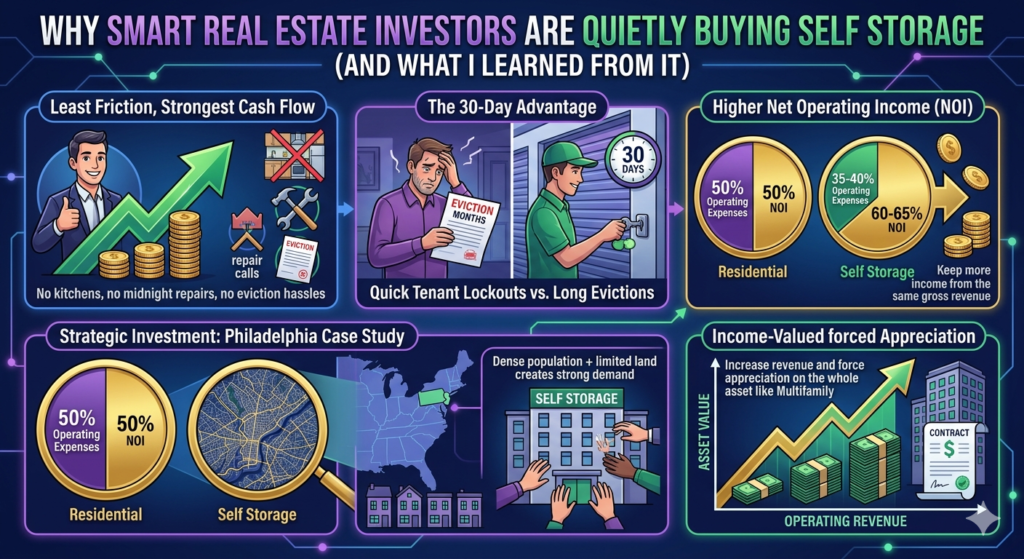
When a residential tenant stops paying rent, you have to go through a lengthy and expensive eviction process. When a self storage tenant stops paying, you lock their unit after 30 days and auction the contents. The legal process is dramatically simpler.
Self storage investing also benefits from what investors call recession resistance. When the economy is good, people buy stuff and need storage. When the economy is bad, people downsize and need storage. Divorce, death, relocation, business inventory — the reasons people rent storage units don’t go away in a downturn.
And the operational model is clean. No kitchens to maintain. No bathrooms to repair. No HVAC systems failing at midnight. The physical asset is essentially a concrete box with a door.
Self Storage Investing vs. Residential: The Cash Flow Comparison
Let me put some numbers on this.
A standard Philadelphia rowhouse rental might generate $1,400 to $1,800 per month in gross rent. After mortgage, taxes, insurance, maintenance, and vacancy, net cash flow on a well-purchased property might be $200 to $400 per month.
A small self storage facility — say, 50 units averaging $100 per month — generates $5,000 per month in gross revenue. Operating expenses for self storage typically run 35% to 40% of revenue, compared to 50% for residential. That leaves $3,000 or more in NOI per month on a facility that requires minimal hands-on management.
The scale is different. The friction is lower. And the valuation math — just like multifamily — is income-based, not comp-based. Increase your revenue, and you force appreciation on the entire asset.
What Self Storage Investing Looks Like in Philadelphia
Philadelphia isn’t the first market that comes to mind for self storage investing, but it should be on your radar.
Dense urban population. Limited land for new construction. Strong demand from college students, renters in transition, and small businesses without warehouse space. The fundamentals that make Philadelphia great for residential investing also create real demand for storage.
I’m not in a position to buy a self storage facility right now. I’m still working toward my first direct real estate deal. But understanding how the asset class works — the cash flow model, the operational simplicity, the recession resistance — is exactly the kind of education I’m building now so that when the opportunity comes, I’m ready.
The Bigger Picture
What self storage investing taught me is that the goal isn’t to find the most exciting asset. It’s to find the asset that produces the most reliable cash flow with the least amount of drama.
Rowhouses are where I’m starting. Self storage might be where I’m going.
The investors who build real wealth aren’t the ones chasing the flashiest deals. They’re the ones who quietly buy boring assets that produce predictable income — year after year, regardless of what the market is doing.
Not financial advice — just someone doing a lot of research and asking a lot of questions.