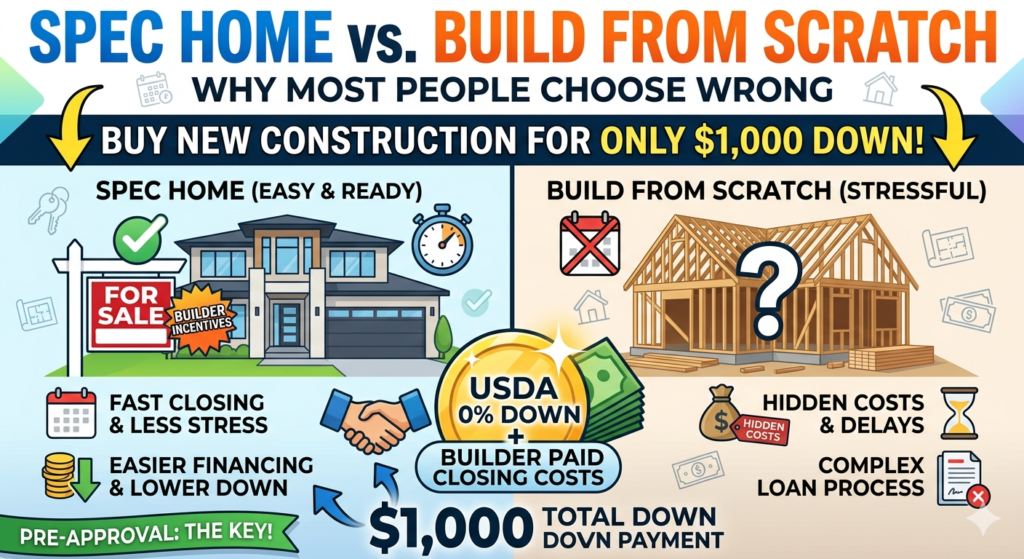
Spec home buying is the smarter alternative to building from scratch that almost nobody talks about. If you’ve ever thought about building a house from scratch, I want to talk you out of it — not because it’s impossible, but because spec home buying offers more leverage, less stress, and sometimes nearly zero out-of-pocket cost.
What Is a Spec Home?
A spec home — short for speculation home — is a house that a builder starts constructing before they have a buyer. They’re betting (speculating) that someone will want to buy it when it’s done or nearly done.
Builders need to keep their crews working. They can’t wait around for a custom buyer to show up before they break ground. So they build ahead of demand — and then sell.
The result: there are always spec homes in various stages of completion sitting in new developments, waiting for a buyer. And those buyers have more leverage than most people realize.
Why Building From Scratch Is Harder Than Spec Home Buying
Before we get into why spec home buying is a better play for most buyers, let’s talk about what custom construction actually involves — because the marketing leaves out a lot.
The base price is never the final price. Every builder starts with a base price that covers the most basic version of the home. The moment you start making decisions — flooring upgrades, lighting packages, hardware finishes, kitchen cabinet levels — the number climbs fast. It’s not unusual for buyers to add $20,000 to $50,000 in upgrades before they’ve even thought about landscaping.
Impact fees are real and nobody warns you. Depending on where you’re building, local municipalities charge impact fees — essentially a tax for the infrastructure burden your new home creates. In Pennsylvania, these vary by municipality but can add thousands to your closing costs. These fees are often buried in the fine print of a construction contract.
Construction loans are complicated. To finance a custom build, you typically need to own the land outright or have significant equity. Construction loans work differently than mortgages — you draw funds in stages, pay interest only during the build phase, and then the loan converts to a permanent mortgage at completion.
For a first-time buyer or early investor, managing a construction loan while also managing a builder relationship is genuinely stressful. Spec home buying sidesteps all of this.
The Spec Home Buying Advantage
When a builder has a spec home sitting at 60%, 80%, or 100% completion without a buyer, they have a problem. Every month that home sits unsold is a month they’re carrying construction loan interest. They want it off their books.
That urgency creates negotiating opportunity for you.
What you can negotiate on a spec home:
Closing costs. This is the big one. Builders will often agree to cover some or all of your closing costs in exchange for a clean offer at or near their asking price. On a $350,000 home, closing costs might run $8,000 to $12,000 — and if the builder absorbs those, your cash-to-close drops dramatically.
Finish selections. If the home isn’t fully complete, you may still be able to choose flooring, countertops, paint colors, or fixtures. You’re getting a semi-custom home without paying custom prices or managing the build timeline.
Price. If the home has been sitting for a while, there’s room to negotiate — especially if the builder is carrying multiple unsold units.
Timeline. A spec home that’s already framed and nearly complete might close in 6 to 8 weeks. Compare that to 12 to 18 months for a custom build. For someone renting and ready to move, that speed has real financial value.
How to Buy a Spec Home for Around $1,000 Out of Pocket
This is where USDA financing changes the spec home buying math entirely.
The USDA loan offers 100% financing for homes in eligible areas. No down payment. The program is designed for low-to-moderate income buyers purchasing in rural or suburban areas that meet USDA’s geographic criteria.
USDA loan basics for spec home buying:
- Down payment: 0%
- Income limit: roughly $120,000 for a household of 4 (varies by county)
- Credit score: 620+ recommended
- Property must be in a USDA-eligible area (check eligibility at usda.gov)
- Must be your primary residence
The $1,000 scenario:
If you’re buying a spec home using USDA financing and negotiate the builder to cover closing costs — here’s what your out-of-pocket looks like:
| Item | Cost |
|---|---|
| Earnest money deposit | ~$500 |
| Home inspection | ~$400–500 |
| Miscellaneous | ~$100–200 |
| Total out of pocket | ~$1,000 |
You’re closing on a brand new home. No down payment. No closing costs. Just the deposit and inspection.
This isn’t a loophole. It’s two legitimate programs — USDA financing and builder-paid closing costs — working together the way they were designed to work.
The catch: USDA eligibility is geographic. Not every Philadelphia suburb qualifies. Areas like parts of Chester County, Montgomery County, and Bucks County have USDA-eligible pockets worth exploring. Check specific addresses at usda.gov.
What About FHA for Spec Home Buying?
If the home or location doesn’t qualify for USDA, FHA is the next option.
FHA requires 3.5% down — so on a $300,000 spec home, that’s $10,500. Still relatively low compared to conventional financing. And if you negotiate the builder to cover closing costs, you’re only bringing the down payment to the table.
FHA doesn’t have the geographic restriction that USDA does, which makes it more flexible for suburban Philadelphia spec home buying.
How to Find Spec Homes for Spec Home Buying in Philadelphia’s Suburbs
New construction activity in the Philadelphia metro area is concentrated in the outer suburbs — Chester County, Montgomery County, Bucks County, parts of Delaware County.
Where to look:
Zillow and Realtor.com: Filter by “New Construction” and look for homes listed as available now (not “pre-sale” or “to-be-built”) — those are spec homes.
Builder websites directly: Ryan Homes, NVR, Pulte, Toll Brothers, and regional builders all list available inventory on their sites.
Drive new developments: If you see active construction, stop in at the model home and ask what’s available now and what the builder’s incentives are for quick-close buyers.
Ask about incentives: Builders run promotions especially at the end of a quarter — end of March, June, September, and December are often the best times to ask about spec home buying deals.
According to HUD.gov, new construction homebuyers who arrive with pre-approval letters and financing ready consistently receive more favorable builder incentives than buyers who shop without pre-approval — because builders treat pre-approved buyers as real closings, not prospects.
The Hidden Spec Home Buying Negotiating Advantage
Builders love buyers who are ready to move quickly. If you have your USDA or FHA pre-approval letter in hand before you start spec home buying, you go from “someone browsing” to “someone we should close.”
That’s when the conversation about closing cost coverage and finish selections gets real.
Get pre-approved before you start shopping. It costs nothing and changes everything about how the conversation goes.
Use the Mortgage Affordability Calculator to model your spec home buying budget — including USDA vs FHA scenarios — before you walk into any builder’s sales office.
Not financial advice — just someone doing a lot of research and asking a lot of questions. USDA eligibility and loan terms change — verify current requirements with an approved USDA lender before making any decisions.