The first time I heard about subject to real estate deals, I thought it was too good to be true. Take over someone’s existing mortgage without going to a bank. No credit check. No new loan. No down payment. Just step in, take over the payments, and own the property.
Then I watched Jason Crouch actually do it — and walk away with $50,000 to $60,000 in profit on a deal where he didn’t put in a single dollar of his own money.
Let me break down exactly how it worked.
What Is Subject to Real Estate?
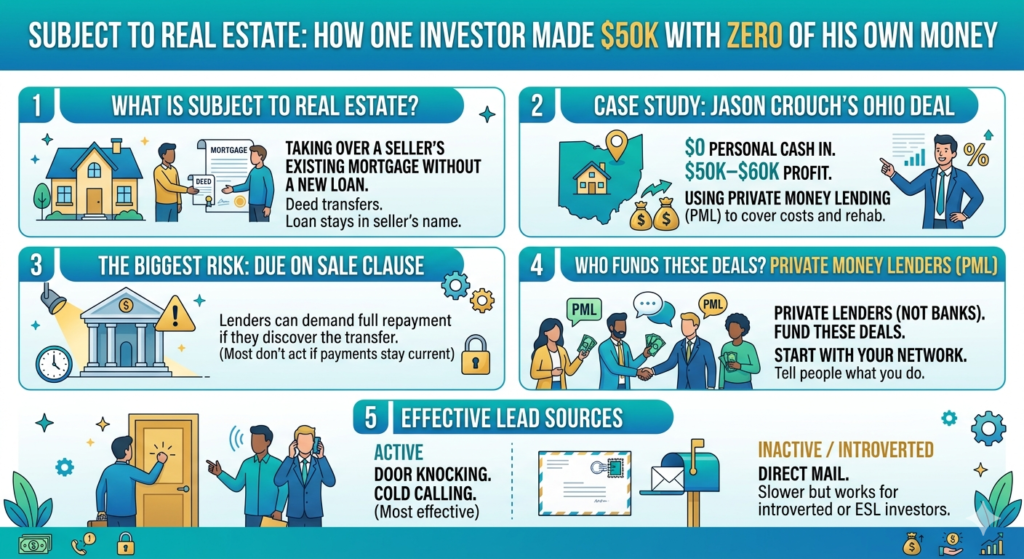
Subject to real estate means you purchase a property “subject to” the existing mortgage. The loan stays in the seller’s name. You take over the monthly payments. The deed transfers to you.
The bank doesn’t know. The seller is relieved. You own an asset without qualifying for a new loan.
It sounds like a loophole. It’s actually a legitimate — if unconventional — financing strategy that’s been used for decades.
The Deal: How Jason Did It With $0 Down
Jason found a condo in Ohio. The owner was facing foreclosure — behind on payments, no way out, desperate to avoid the credit damage of a full foreclosure.
Here’s how the deal broke down:
| Item | Amount |
|---|---|
| Existing mortgage (assumed) | $55,000 |
| Seller’s back payments covered | $1,500 |
| Moving costs paid to seller | $12,000 |
| Bird dog fee + closing costs | $5,000 |
| Rehab costs | $40,000 |
| Total all-in | ~$114,000 |
| Final sale price | $180,000 |
| Net profit | ~$50,000–$60,000 |
Every dollar came from a Private Money Lender — not Jason’s pocket. Not a bank. A private individual who funded the deal in exchange for a return.
Jason put in roughly 20 hours of work. The profit was close to a full year’s average American salary.
Subject to Real Estate and the “Due on Sale” Risk Nobody Talks About
Here’s the part the gurus leave out.
Most mortgages contain a “Due on Sale” clause. This means if the lender discovers the property has been transferred to a new owner — which is exactly what happens in a subject to deal — they have the legal right to demand the entire loan balance immediately.
In practice, lenders rarely exercise this right as long as payments are being made on time. They’re a business. They want their monthly payment. They’re not actively looking for reasons to call the loan due.
But the risk exists. And you should know about it before you go near a subject to real estate deal.
Ways investors manage this risk:
- Keep payments current, always — a missed payment draws attention
- Work with a real estate attorney who understands subject to structures
- Have a plan for refinancing out of the subject to within a set timeframe
- Use a land trust to obscure the transfer in some states (consult an attorney)
This isn’t a reason to avoid subject to real estate entirely. It’s a reason to go in with eyes open.
The Other Piece: Private Money Lending
Jason didn’t use his own cash. He used a Private Money Lender (PML) — a private individual, not a bank or hard money institution, who funds deals in exchange for a fixed return.
Private money lenders are typically:
- Friends or family with capital sitting in low-yield accounts
- Local investors looking for passive returns
- People in your network who don’t want to deal with properties directly
The pitch isn’t complicated: “I have a deal that will return X% in Y months. Your money is secured by the property. Want to participate?”
This is the “other people’s money” strategy that gets talked about constantly in real estate circles — but most beginners don’t know where to actually find those people. The answer is usually closer than you think. It starts with telling people what you do.
Why I Find This Strategy So Hard to Execute
I want to be completely honest here.
Subject to real estate as a strategy makes total sense to me. The math works. The concept is sound. Jason’s deal is proof it can generate serious money with zero personal capital.
But here’s my reality: finding these deals requires talking to people. Really talking to them.
Jason and his son do door knocking — literally walking up to strangers’ doors, introducing themselves, and starting conversations with distressed homeowners. They make follow-up calls. They build relationships.
I want to do that. I genuinely do. But I’m extremely introverted, and my English gets worse when I’m nervous. The idea of knocking on a door in my second language and convincing someone to hand over their mortgage to me — it’s terrifying in a way that’s hard to explain if you haven’t experienced it.
So for now, I’m studying the structure. I’m learning what makes a good subject to deal. I’m building the knowledge so that when I do find a way to source these deals — through direct mail, through a partner, through whatever works for someone like me — I’ll be ready to analyze them and execute.
Because the strategy itself? It’s one of the most powerful things I’ve come across in this entire space.
Subject to Real Estate vs. Other Creative Finance Strategies
| Strategy | Credit Needed | Cash Needed | Best For |
|---|---|---|---|
| Subject To | No | Very little | Distressed sellers with existing mortgage |
| Seller Finance | No | Negotiable | Sellers who own free and clear |
| Hard Money | Sometimes | 10–20% down | Fix and flip with fast timeline |
| BRRRR | Yes (refi) | Some | Long-term rental portfolio |
Subject to real estate sits in its own category — it’s most powerful when a seller is in distress, has an existing mortgage, and needs out fast.
According to BiggerPockets, subject to deals are most common in markets with motivated sellers and where interest rates make assuming an older, lower-rate mortgage particularly attractive.
Run the Numbers Before You Do Anything
Use the Hard Money Loan Calculator to model your private money costs alongside the assumed mortgage.
If you ever find yourself in front of a potential subject to deal, the first thing you need to know is whether the numbers actually work. What’s the all-in cost including the assumed mortgage, rehab, and private money? What’s the ARV? What does your exit look like?
Not financial advice — just someone doing a lot of research and asking a lot of questions.