If you’ve spent any time researching off-market real estate, you’ve probably heard something like this:
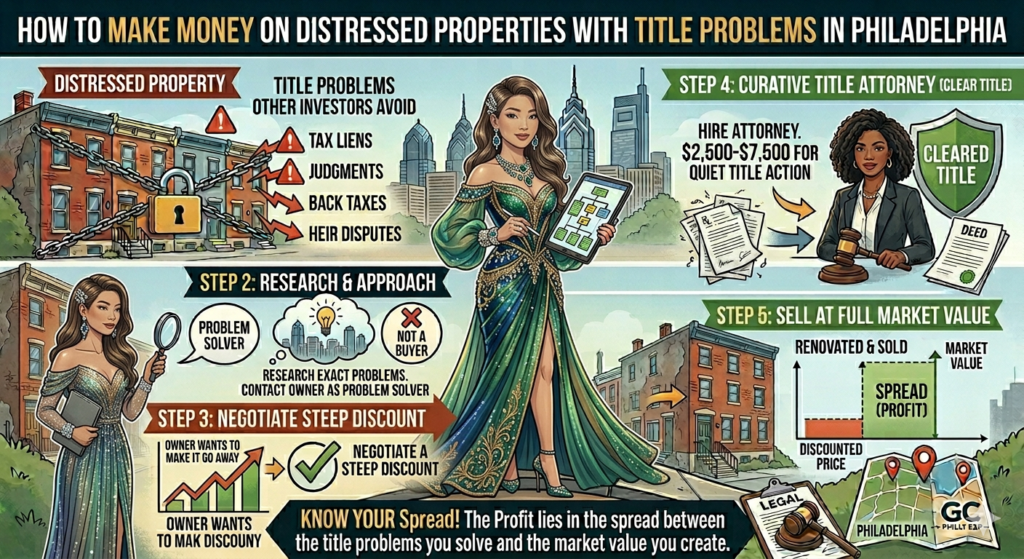
“Buy distressed properties with title problems at a steep discount, clear the title, sell at market value.”
I’m not going to promise you millions — that’s not what this blog is about. But the underlying strategy? It’s real. It’s legitimate. And it’s one of the most underutilized opportunities in Philadelphia real estate right now.
Here’s what I found when I went down the rabbit hole.
Why Title Problems Real Estate Creates Opportunity
Most investors see a property with liens, judgments, or ownership disputes and immediately move on. Too complicated. Too risky. Too much work.
That reaction is exactly what creates the opportunity.
When nobody wants to touch a property, the price drops. Sometimes dramatically. And if you’re the person who knows how to solve the problem — or knows who to hire — you can buy at a steep discount, clear the title, and sell at full market value.
The margin isn’t coming from renovation. It’s coming from complexity — and your willingness to deal with it when other investors won’t. That’s the core of the title problems real estate strategy.
What “Title Problems” Actually Mean
A clouded title means there are issues in the public record that have to be resolved before the property can be sold. Common ones include:
Liens — unpaid contractors, utility balances, mechanic’s liens, IRS or state tax liens. Someone is owed money, and they’ve attached that debt to the property. It can’t be sold until the lien is cleared.
Judgments — if a property owner lost a lawsuit and owed money to a creditor, contractor, or former spouse, that judgment can attach to their real estate automatically. It sits there, invisible to most buyers, until a title search digs it up.
Multiple owners / heir disputes — someone passes away and leaves a house to five kids. Four want to sell. One has disappeared or simply refuses. The property is stuck. Nobody can sell without all owners signing off.
Back taxes — Philadelphia has its own system for delinquencies, utility liens, water and sewer balances, code enforcement liens, and municipal claims. And here’s the Philadelphia-specific wrinkle most investors don’t know: many of these liens can only be found during an in-person visit to the municipal building — not online.
That complexity is your advantage. Most casual investors won’t bother. The ones who know how to navigate title problems real estate find deals nobody else is looking at.
How the Strategy Works — Step by Step
Step 1: Find the properties
You’re looking for properties with messy title histories in the public record. In Philadelphia, that means searching through:
- Office of Property Assessment (OPA) — ownership and tax records
- Philadelphia Court of Common Pleas — judgments and liens
- Philadelphia L&I — code violations and municipal liens
- Recorder of Deeds — deed history and encumbrances
You’re looking for properties where the record is complicated. Multiple liens. Old judgments. Heir disputes. Back taxes. The messier the better — as long as the problems are solvable.
Step 2: Document exactly what the problems are
Before you contact anyone, figure out what you’re dealing with. What liens exist? Who holds them? How much are they? Are there missing owners? Is there a redemption period on back taxes?
This documentation tells you whether the deal is actually workable — and gives you the information you need to make a logical, low offer the seller can understand.
Step 3: Find the owner and make contact
This is where skip tracing comes in — tools like PropStream or BatchSkipTracing to find contact information for owners who are hard to locate.
Your pitch isn’t “I want to buy your house cheap.” Your pitch is: “I know about the liens, the back taxes, the judgment from 2019. I can take all of this off your hands. You don’t have to figure any of it out. Here’s what I can offer.”
You’re positioning yourself as the solution to a problem they probably have no idea how to solve.
Step 4: Hire a curative title attorney
This is the step most investors skip — and it’s where all the money is.
There are two main paths for clearing a clouded title: a quiet title action (a court case that legally clears all claims, typically $2,500–$7,500) or a title search and insurance process ($800–$2,500). The quiet title action gives you a court-ordered clear title you can legally defend, but takes more time. Title insurance is faster and cheaper.
A curative title attorney specializes in exactly this — negotiating with lien holders, filing quiet title actions, tracking down missing heirs. Their fee is part of your deal cost. Budget for it upfront.
Step 5: Sell at market value
Once the title is clean, list with a realtor and sell at full market value. Your profit is the spread between what you paid and what you sell for — minus attorney fees, lien payoffs, and closing costs.
That’s the full title problems real estate cycle.
Why Philadelphia Is Especially Good for This
Philadelphia is particularly rich in this type of opportunity for a few reasons.
Old housing stock means long ownership histories — and long histories mean more chances for problems to accumulate. Liens from decades ago. Estates that were never properly settled. Judgments that were never paid off.
Philadelphia’s neighborhoods — Germantown, Kensington, West Philly, North Philly — have pockets of long-term homeownership where these situations are common. Houses that have been in families for 40 years, now in probate. Properties with water liens going back a decade. These deals exist. They’re just not on Zillow.
Pennsylvania also uses a unique 3-stage tax sale process — upset sale, judicial sale, and repository. The judicial sale is particularly useful because the court order wipes out most liens, mortgages, and judgments attached to the property, giving the buyer a clean title. Understanding this process gives Philadelphia investors a legitimate path to acquiring deeply discounted properties with cleared titles. According to Zillow Research, foreclosure activity in Philadelphia increased significantly in 2025 — which means more motivated sellers who need someone to solve their problems.
The Honest Reality Check
This is not easy or passive. A clouded title can block refinancing, complicate future sales, and expose you to liability from prior ownership disputes if you don’t resolve it properly.
The timeline is unpredictable. A lien negotiation might take two weeks. A quiet title action might take six months. A missing heir might take a year to locate. Every day you’re holding costs money.
And in Philadelphia specifically, finding all the liens requires an in-person visit to the municipal building. You either do this yourself or pay someone who knows how.
But here’s the thing: all of that complexity is exactly why the opportunity exists. Every investor who says “too complicated” and moves on is leaving a deal for the person who figures it out.
In Philadelphia’s market right now, that person could be you.
Want to run the numbers on a distressed deal? Use the Philly Flip Profit Calculator below to model your acquisition cost, title resolution expenses, and projected sale price before you commit.
Not financial advice — just someone doing a lot of research and asking a lot of questions.