Most people know their monthly mortgage payment. Very few know what they are actually paying for.
When you make a mortgage payment, the money does not all go toward paying down your loan. In the early years of a 30-year mortgage, the majority of every payment goes straight to the lender as interest. The portion that actually reduces your balance — the principal — is surprisingly small at first.
I did not fully understand this until I started studying real estate seriously. Once I did, it changed how I think about every property decision I make.
Let me show you exactly what a $300,000 mortgage looks like in Philadelphia, month by month and year by year.
The Numbers on a $300,000 Philadelphia Purchase
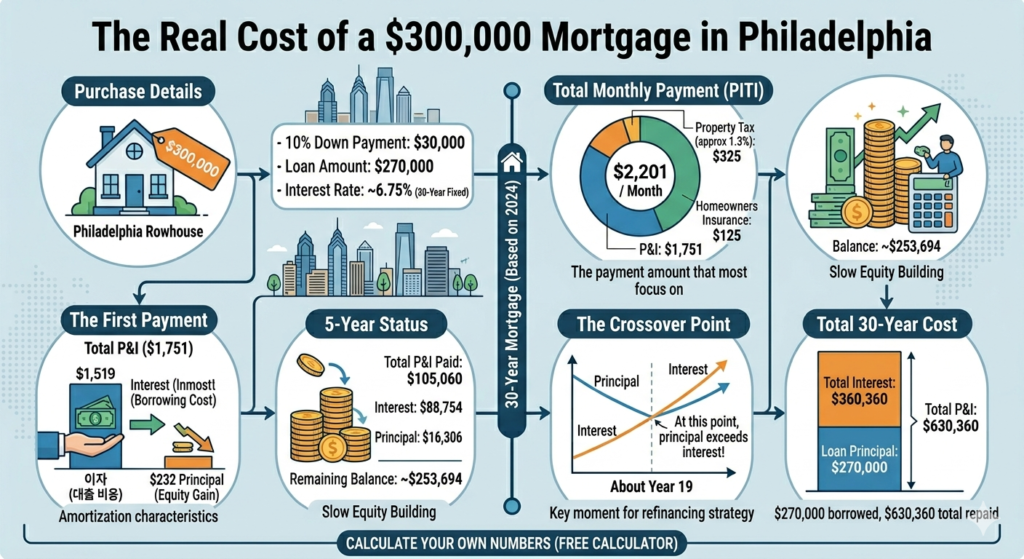
Let’s use a real example. A $300,000 rowhouse in Philadelphia. You put 10% down — $30,000. Your loan amount is $270,000. At today’s rate of approximately 6.75% on a 30-year fixed mortgage, here is what your payment looks like:
Principal and interest: $1,751 per month Philadelphia property tax (approximately 1.3% annually): $325 per month Homeowner’s insurance: approximately $125 per month Total monthly payment (PITI): approximately $2,201 per month
That is the number most people focus on. But it is not the whole story.
What Your First Payment Actually Does
In your very first mortgage payment of $1,751 in principal and interest, here is the breakdown:
Interest: $1,519 Principal: $232
You paid $1,751. Only $232 of it reduced your loan balance. The other $1,519 went to the lender as the cost of borrowing.
This is not a mistake or a trick. It is how amortization works. Your loan is structured so that you pay proportionally more interest when the balance is high and more principal as the balance decreases over time.
The First Five Years
After 60 payments — five years of paying $1,751 every month — here is where you stand:
Total paid in principal and interest: $105,060 Total interest paid: $88,754 Total principal paid: $16,306 Remaining balance: approximately $253,694
You have paid over $105,000 and your loan balance has dropped by only $16,000. That is the reality of a 30-year mortgage in the early years.
It is not a reason to panic. It is a reason to understand what you own and plan accordingly.
The Crossover Point
There is a moment in every 30-year mortgage when your monthly principal payment finally exceeds your monthly interest payment. On this loan, that crossover happens around year 19.
Before year 19, more of every payment goes to interest than principal. After year 19, more goes to principal than interest.
This is why real estate investors talk about refinancing and equity strategies so much. In the early years of a mortgage, you are building equity slowly — primarily through appreciation, not paydown.
The Total Cost of a 30-Year Mortgage
Over the full life of a 30-year mortgage on $270,000 at 6.75%, here is the complete picture:
Total principal and interest payments: $630,360 Original loan amount: $270,000 Total interest paid over 30 years: $360,360
You borrowed $270,000. You paid back $630,000. The difference — $360,000 — is what the lender earned for lending you the money.
This is not unique to Philadelphia. This is how 30-year mortgages work everywhere. But in Philadelphia, where $300,000 buys you a real house in a real neighborhood, understanding this math gives you options that buyers in more expensive markets simply don’t have.
What This Means for Philadelphia Investors
If you are buying a primary residence, the math above is simply the cost of homeownership. You build equity over time, you benefit from appreciation, and at the end of 30 years you own the property free and clear.
If you are buying an investment property, the calculation looks different. Your tenant’s rent is covering the mortgage payment — including that heavy interest load in the early years. Meanwhile, appreciation is building your equity from the top down even while principal paydown does so from the bottom up.
This is why buy-and-hold investors in Philadelphia who bought in neighborhoods like Point Breeze and Germantown five to ten years ago are sitting on significant equity today — not primarily because they paid down their mortgages, but because the market moved.
The 15-Year Alternative
If you can afford the higher payment, a 15-year mortgage dramatically changes the math.
On the same $270,000 loan at 6.25% (15-year rates are typically lower):
Monthly principal and interest: $2,315 Total interest over 15 years: $146,700
You save over $213,000 in interest compared to the 30-year loan. The tradeoff is a higher monthly payment — about $564 more per month.
For investors with strong cash flow, the 15-year mortgage builds equity faster and costs significantly less over time. For buyers who need the lower payment to qualify or maintain cash reserves, the 30-year makes more sense.
There is no universally correct answer. The right choice depends on your cash flow, your investment strategy, and what you plan to do with the property over time.
Run Your Own Numbers
Every purchase is different. Your interest rate, down payment, loan term, and Philadelphia property tax rate all affect what your mortgage actually costs you.
Use the free Mortgage Calculator below to see your exact monthly payment, total interest, and full amortization schedule before you make any offer.