I learn best when I see real numbers.
Not hypotheticals. Not “let’s say you buy a house for X.” Actual deals, actual figures, actual outcomes. So when I came across a video where a hard money lender walked through one of his client’s active flip projects with the full deal breakdown on screen, I basically watched it three times.
Here’s what the deal looked like — and what it taught me about how hard money lending actually works in the real world.
The Deal Snapshot
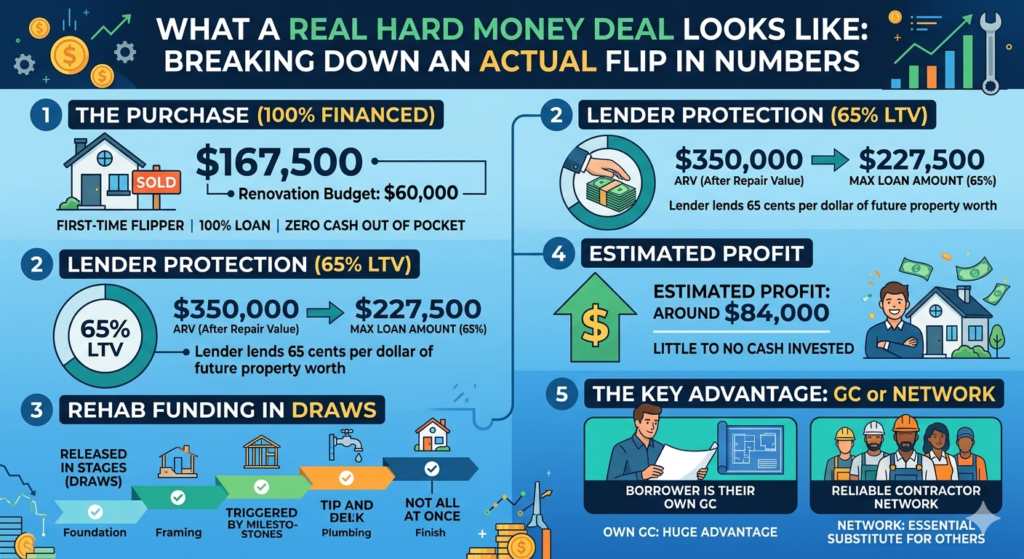
This was a first-time flipper’s project. Single family home on a dead-end street, strong resale market in the area, good comps nearby. Here are the numbers:
| Line Item | Amount |
|---|---|
| Purchase Price | $167,500 |
| Renovation Budget | $60,000 |
| Total Loan Amount | $227,500 |
| After Repair Value (ARV) | $350,000 |
| Loan-to-Value (LTV) | 65% |
And here’s the part that gets people’s attention — 100% of both the purchase price and the renovation costs were financed through the hard money loan. The borrower didn’t have to bring cash to the table for either.
Wait — 100% Financed? How Does That Work?
This is where people get confused, so let me break it down.
Hard money lenders don’t lend based on your credit score or your income like a traditional bank. They lend based on the deal — specifically, the ARV. If the numbers make sense and there’s enough equity cushion, some hard money lenders will cover the full purchase plus rehab costs.
In this case:
- Total loan: $227,500
- ARV: $350,000
- LTV: 65%
That 65% LTV is the key number. The lender is only lending 65 cents for every dollar the property will be worth after repairs. That’s their protection. If the borrower defaults and the lender has to take the property, they’re buying a $350K asset for $227K. They’re covered.
For the borrower, 100% financing means they can get into a deal without tying up their own cash — which is exactly the kind of leverage strategy that makes flipping accessible when you’re starting out.
What Was Actually Happening on Site
The lender visited the property for the first draw inspection — which is how hard money renovation loans work. You don’t get the full rehab budget upfront. You get it in stages called draws, released as you hit construction milestones.
At the time of this inspection:
- Demo was almost completely done
- Framing was starting in the basement
- Second floor was cleared and ready for next phase
- Project was moving fast
The lender noted that the borrower being a GC himself was a major advantage — he knew how to manage the work, keep the momentum going, and hit the milestones needed to trigger each draw.
This matters. A lot. Which is why finding a good GC before you start is so critical — I wrote about that in my last post.
The Math If Everything Goes to Plan
Let’s run the numbers on what this deal could look like at the end:
| ARV (sale price) | $350,000 |
| Total loan payoff | $227,500 |
| Hard money interest (est. 12% for 6 months) | ~$13,650 |
| Closing costs + agent fees (est. 7%) | ~$24,500 |
| Estimated profit | ~$84,000 |
That’s roughly $84K profit on a deal where the borrower put in little to no cash of their own.
Obviously this assumes the renovation stays on budget, the ARV holds, and the timeline doesn’t drag. All of those are real risks. But the structure of the deal — 65% LTV, strong comps, experienced operator — gives this one a solid foundation.
What This Teaches You About Evaluating Hard Money Deals
A few things I took away:
LTV is everything. 65% or below gives both the lender and borrower breathing room. If comps soften or renovation runs over, there’s still margin. Deals at 80%+ LTV leave almost no cushion.
The draw system protects everyone. You don’t get the rehab money all at once — you earn it in stages by completing work. This keeps the project moving and keeps the lender’s risk managed.
Being a GC (or knowing one really well) is a massive advantage. This borrower was his own GC. For the rest of us, having a reliable contractor relationship before you start is the closest thing to that advantage.
Hard money is expensive — but it’s speed and access. Traditional loans take 30-60 days and require income documentation. Hard money can close in days and doesn’t care about your W-2. For flips where timing matters, that premium is often worth it.
Applying This to Philadelphia
Philadelphia has an active hard money lending market. There are local lenders who know the market, understand Philly comps, and have funded deals in Germantown, Kensington, Brewerytown, and beyond.
The key is finding deals where the ARV is strong enough to support the loan structure. In Philly’s current market, that means doing your comp research carefully — knowing what renovated properties are actually selling for in that specific neighborhood, not just the zip code.
Run the numbers before you talk to a lender. Know your purchase price, your renovation estimate, and your ARV. Walk in with a deal, not a question.
Not financial advice — just someone doing a lot of research and asking a lot of questions.