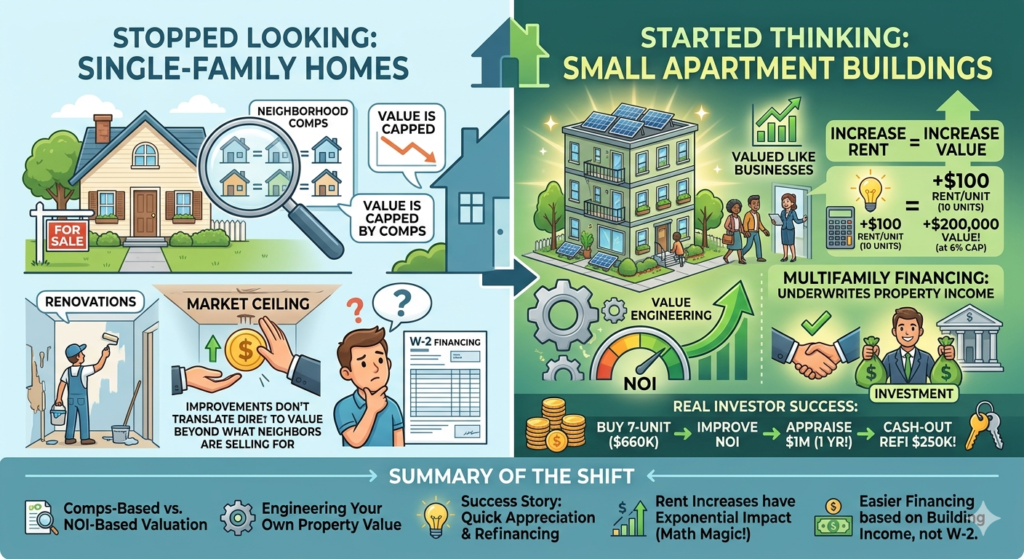
I’ll be honest — for the longest time, my real estate dream looked like this: find a distressed single-family home, fix it up, sell it, repeat. Maybe hold a few along the way. Build up slowly.
And that’s not a bad plan. But the more I study this stuff, the more I keep running into the same idea from experienced investors: single-family homes are the slow road. Small apartment buildings are the jet.
Let me explain what I mean.
The Problem With Single-Family: You’re at the Mercy of Your Neighbors
Here’s something that took me a while to fully understand. When you own a single-family home — or even a duplex or triplex — its value is determined almost entirely by what other homes in the neighborhood sold for recently. That’s it. Comparable sales. Comps.
So let’s say you buy a beat-up rowhouse in a working-class Philadelphia neighborhood, put $40,000 into it, turn it into the nicest house on the block. Gorgeous kitchen. Updated bathrooms. New roof.
If the house next door sold for $160,000 last month, your appraisal is probably coming in around $160,000. Maybe $170,000 if you’re lucky and the appraiser is in a good mood.
You didn’t get to decide that. The neighborhood decided it for you.
That’s the ceiling on single-family investing — and it’s a ceiling you have almost no control over.
Apartment Buildings Are Valued Like Businesses
This is where it gets interesting.
Once you cross into small apartment buildings — we’re talking 5+ units — the rules change completely. These properties aren’t valued based on what the building down the street sold for. They’re valued based on how much income they generate.
Specifically: Net Operating Income (NOI).
NOI is basically your rental income minus your operating expenses (property taxes, insurance, maintenance, management — not including your mortgage). And the formula for value is:
Value = NOI ÷ Cap Rate
Cap rate is just the market’s expected return on that type of property in that area. In Philadelphia, you might see cap rates of 6–8% on small multifamily buildings.
So here’s where it gets exciting. If your NOI goes up — because you raised rents, cut expenses, reduced vacancies — your building’s value goes up. Directly. Immediately. You’re not waiting for the neighborhood to catch up. You’re engineering the value yourself.
A Real Example That Stopped Me Cold
I came across a story from an investor who bought a 7-unit apartment building for $660,000. He put down $132,000 — about 20%.
Within a year, he improved the building’s NOI. Fixed up units, got better tenants, pushed rents closer to market rate. Nothing crazy. Just basic blocking and tackling.
One year later, the building appraised at $1,000,000.
He then did a cash-out refinance and pulled out $250,000 — tax free, because it’s a loan, not income — while keeping the building. His original $132,000 investment not only came back, he pulled out nearly twice that and still owns the asset.
Try doing that with a single-family flip.
The Rent Math Is Wild Once You See It
Here’s the thing about multifamily that doesn’t click until someone shows you the numbers.
Say you own a 10-unit building and you raise rents by $100 per unit per month. That’s $1,000 extra per month, $12,000 per year in additional NOI.
At a 6% cap rate: $12,000 ÷ 0.06 = $200,000 increase in property value.
One hundred dollars per door.
Now scale that up. 20 units, $100 rent increase = $400,000 in added value. Same math, bigger number.
With a single-family home, raising the rent doesn’t change the appraised value one dollar. The bank doesn’t care what your tenant pays. They care what the house next door sold for.
So Why Doesn’t Everyone Just Buy Apartment Buildings?
Fair question. A few reasons:
The barrier feels higher. A 7-unit building in Philadelphia might cost $500,000 to $800,000. That sounds intimidating compared to an $80,000 rowhouse. But the financing structures for commercial multifamily are actually more flexible in some ways — lenders are underwriting the income of the property, not just your personal W-2.
Management is more complex. More units means more tenants, more maintenance calls, more moving parts. This is where having a good property manager becomes worth every penny.
Finding deals takes more work. These properties don’t show up on Zillow the same way. You need to build relationships with commercial brokers, get on the right lists, or find off-market deals.
But here’s the thing — the investors who figure this out early tend to scale fast. While everyone else is grinding through single-family flips one at a time, the multifamily investors are engineering value and pulling cash out of buildings they still own.
Where I’m At With This
I’m still in the research and foundation-building phase with multifamily. The single-family flip strategy makes sense as an entry point — build capital, build experience, build relationships with lenders and contractors.
But I’m thinking about it differently now. Every flip isn’t just a flip. It’s a step toward being able to walk into a room and talk credibly about a $600,000 apartment building acquisition.
The single-family world teaches you how real estate works. The multifamily world is where the math gets genuinely interesting.
There’s a Multi-Unit Cash Flow Calculator on this site if you want to run your own numbers — plug in units, rents, expenses, and cap rate and see what a building might actually be worth based on its income.
Not financial advice — just someone doing a lot of research and asking a lot of questions.