One of the things I keep noticing as I study new construction is how differently experienced developers talk about timelines versus how beginners think about them. Beginners — myself included, honestly — tend to think in straight lines. You get the permits, you break ground, you build, you’re done. The timeline is the timeline.
Experienced developers think in buffers.
I came across a video recently from a developer documenting a ground-up project in real time, and it was one of those refreshingly honest breakdowns that actually shows you what goes wrong instead of just the highlight reel. The short version: it rained. A lot. And that one variable cascaded into a situation that delayed the project by two weeks before a single yard of concrete had been poured.
Here’s what happened, and what it taught me about construction timelines.
The Rain Problem
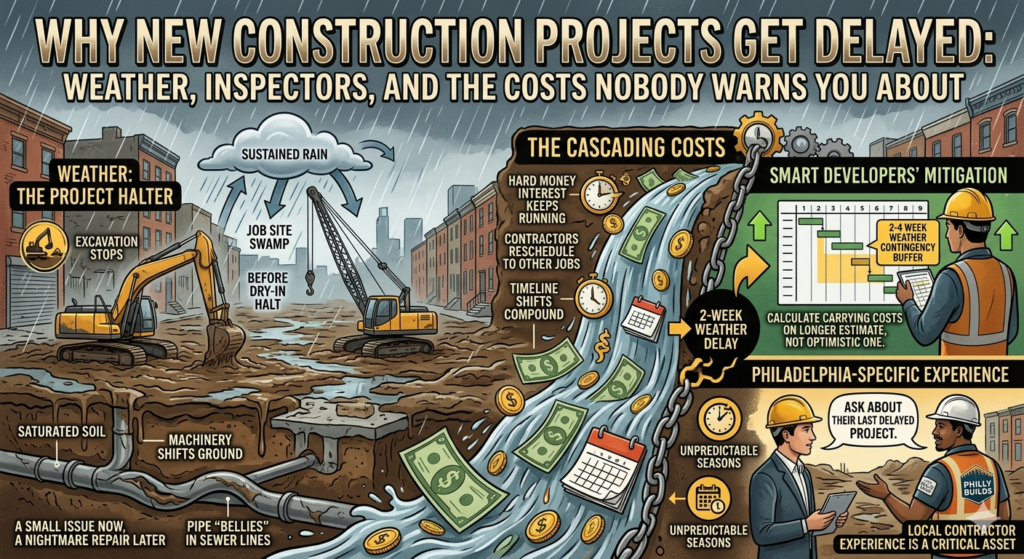
The developer was in Austin, and the rain came in nonstop. Not a passing storm — sustained rain that turned the job site into what he described as a swamp. The ground was so saturated that heavy machinery couldn’t move without sinking, and excavation was completely impossible.
He made a point that stuck with me: rain is essentially the only thing that can bring a construction project to a full stop before the building reaches dry-in stage. Dry-in is the point where the structure is enclosed enough to be protected from the elements — roof, walls, windows. Until you get there, you’re exposed. And when you’re exposed and the ground is soaked, you’re not building.
Most people budgeting for a new construction project think about material costs and labor costs. How many people are budgeting for two weeks of zero progress because of weather?
Then the Inspector Called
Here’s where it got more complicated.
The inspector called and flagged a concern about the sewer pipes running under the foundation. Because the soil was so saturated, there was a real risk of the pipes developing what’s called “bellies” — sections where the pipe sags or dips instead of maintaining a consistent downward slope.
Why does that matter? Sewer pipes work on gravity. They need a steady grade to move waste in one direction. If a pipe develops a belly, waste pools in that low spot. You get blockages, backflow, odor, and eventually a repair job that requires digging up the foundation to fix. That’s not a small problem. That’s a nightmare that shows up years later when someone’s already living in the house.
The cause? Heavy machinery moving over saturated soil shifts the ground. And when the ground shifts, so do the pipes underneath it.
The inspector technically passed the project — he could have failed it but didn’t. The developer made the call to stop work anyway, voluntarily, until conditions improved. Because he understood that a technically passing inspection today doesn’t protect you from a foundation plumbing disaster two years from now.
That decision cost him two weeks.
The Real Cost of Construction Delays
Two weeks might not sound catastrophic. But let’s think about what two weeks actually costs on a construction project:
Hard money carrying costs. If you’re financing the build with a construction loan or hard money, you’re paying interest every single day — whether workers are on site or not. Two weeks of dead time is two weeks of interest with zero progress to show for it.
Contractor scheduling. Your GC and subcontractors have other jobs. A two-week weather delay doesn’t mean they sit and wait for you. It means they move to another project, and when conditions improve, you’re back in the scheduling queue.
Cascading timeline shifts. A two-week delay at the foundation stage can easily become a four or six week delay by the time you account for rescheduling, resequencing trades, and any additional inspections required.
Seasonal windows. Depending on your market, delays at certain times of year push you into weather windows you didn’t plan for — or past them entirely.
None of this is in the viral “I built a house and made $200K” content. But it’s all real, and it’s all part of what developers actually manage.
The Philadelphia Angle
I think about this a lot in the context of building here. Philadelphia weather is not gentle. Winters are real, springs are wet, and anybody planning a ground-up project in this market needs to be thinking about what happens when a February foundation pour gets pushed back three weeks because of frozen ground or a March rainstorm that doesn’t quit.
The good news is that Philadelphia has a relatively deep pool of experienced local contractors who’ve built in these conditions for decades. The lesson is to lean on that experience when building out your timeline — don’t take a contractor’s “optimistic” schedule at face value. Ask them what happened on their last project when weather intervened. That conversation tells you a lot.
What Smart Developers Do Differently
The developer in this video mentioned something I thought was worth saving: he had built buffer time into his schedule specifically for situations like this. He wasn’t happy about the two-week delay. But he wasn’t panicking either, because the contingency was already there.
That’s the difference between a developer who’s done this before and one who hasn’t. The experienced ones don’t build schedules that assume everything goes right. They build schedules that assume something will go wrong and leave room for it.
Practically, that means:
Adding a weather contingency buffer of at least two to four weeks into any ground-up timeline, more in markets with unpredictable seasons. Building carrying cost calculations around a timeline that’s longer than your optimistic estimate — not shorter. Having a clear protocol with your GC for what happens when work stops: who calls whom, how rescheduling works, what the communication chain looks like. Understanding your loan draw schedule and how delays interact with it — some construction loans have strict draw timelines that don’t flex easily.
What This Means for My Roadmap
I’m still working toward ground-up development — flipping first, then single family new construction, then multi-unit. But stories like this one are exactly why I’m studying the process in detail now rather than figuring it out on the fly later.
The financing, the zoning, the neighbor relations, the weather delays, the inspector calls — none of this is secret knowledge. It’s just the stuff that doesn’t make it into the highlight reels. The developers who build successfully over the long term are the ones who planned for all of it.
Two weeks before concrete. That’s where this project hit its first real wall. And the developer handled it well — because he’d already planned for the possibility that something like this would happen.
That’s the lesson I’m filing away.
Not financial advice — just someone doing a lot of research and asking a lot of questions.