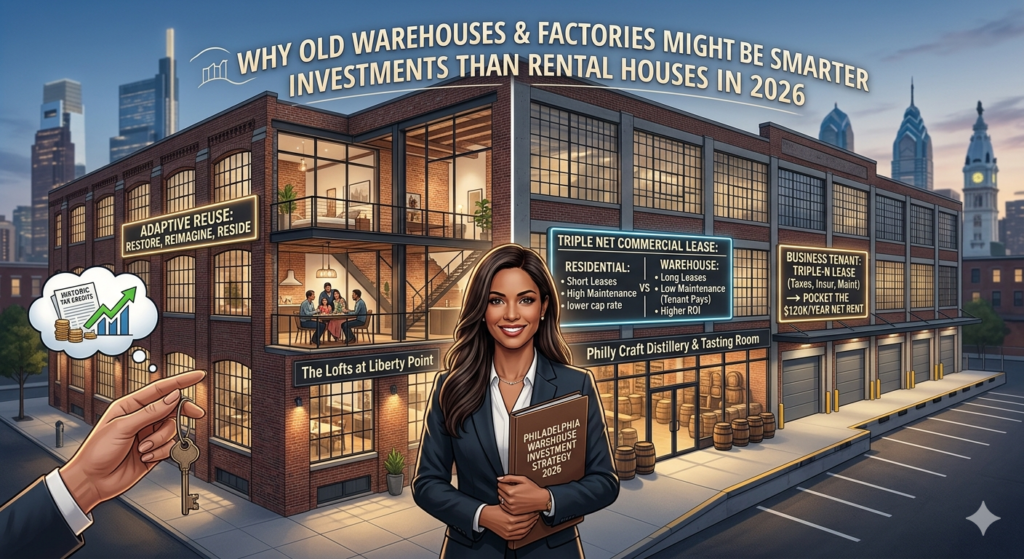
I’ve been driving around Philadelphia a lot lately. Looking at neighborhoods, checking out properties, trying to understand what this city is becoming.
And one thing keeps catching my eye — old brick buildings. Former factories. Empty warehouses. Buildings that look like they’ve been sitting untouched for decades, with these incredible bones and that unmistakable industrial character.
Some of them are already being transformed. I’ve watched developers turn what used to be manufacturing floors into loft apartments with exposed brick and 14-foot ceilings. Others are still sitting empty, waiting.
That got me thinking about a different kind of real estate investment — one that most beginners never consider.
The Standard Advice: Buy Rental Houses
Every beginner real estate book tells you the same thing. Single family homes. Small multifamily. BRRRR. House hack.
That’s all valid. I’m doing it too — looking at four-unit buildings in Germantown right now.
But there’s a whole other world of real estate investing that operates completely differently. And in a city like Philadelphia, with its industrial history and hundreds of underutilized commercial buildings, it might actually be more accessible than people think.
The Commercial Warehouse Strategy
I came across a video recently where an investor laid out a simple strategy:
- Find a distressed commercial warehouse on LoopNet.com — something that’s been sitting for a long time and needs significant work
- Offer roughly half the asking price — and keep making offers until someone says yes
- Renovate it to a high standard
- Lease it for around $120,000 per year
Is it really that simple? Not exactly. But the underlying concept is sound — and the numbers are very different from residential investing.
Why Commercial Is a Different Game
Here’s what nobody tells beginners about commercial real estate:
1. Tenants sign long leases
Residential tenants sign 12-month leases. Commercial tenants — businesses renting warehouse space — typically sign 3, 5, or even 10-year leases. Once you have a good tenant, they’re there for years. No annual turnover. No constant re-leasing.
2. Triple Net Leases (NNN)
This is the part that changes everything.
In a Triple Net lease, the tenant pays:
- Base rent
- Property taxes
- Insurance
- Maintenance and repairs
You collect the check. They handle almost everything else. Compare that to residential landlording where you’re fielding calls about broken toilets at midnight.
3. No Fair Housing complications
Residential rentals come with strict fair housing laws and tenant protections — especially in Philadelphia where evictions can take 3-6 months. Commercial leases operate under different rules. If a business tenant doesn’t pay, the process is generally faster and cleaner.
4. Value tied to income, not comps
Residential properties are valued based on comparable sales. Commercial properties are valued based on the income they generate — the cap rate model. If you increase the rent, you directly increase the property value. That’s a different kind of control.
Philadelphia’s Secret: All Those Empty Brick Buildings
Here’s what I keep noticing as I drive around this city.
Philadelphia was one of America’s great industrial cities. Textile mills, manufacturing plants, warehouses, foundries — they built this city in the 1800s and early 1900s. And when manufacturing left in the mid-20th century, they left behind hundreds of these incredible brick structures.
Some have already been transformed. Fishtown, Northern Liberties, Brewerytown — these neighborhoods are filled with former factories that are now luxury loft apartments at $2,000-$3,000/month. The bones were there. Developers saw it. Neighborhoods changed.
But outside the gentrified core — further out in Northeast Philly, along the Delaware, in parts of North and West Philly — there are still warehouses and former commercial buildings sitting empty. Solid brick construction. Good bones. Waiting.
Two Ways to Play This in Philadelphia
Option 1: Adaptive Reuse — Convert to Residential
This is what the flippers I’ve been watching are doing. Buy an old factory or warehouse, convert it to apartments or condos, sell or hold.
The appeal:
- Brick buildings have incredible character that new construction can’t replicate
- High ceilings, large windows, open floor plans — exactly what luxury renters want
- Philadelphia has historic tax credits that can offset renovation costs significantly
The challenge:
- Zoning conversion from commercial to residential requires permits and approvals through L&I
- Can be expensive and time-consuming
- Needs an experienced GC who’s done this kind of conversion before
Option 2: Commercial Lease — Keep It as Warehouse Space
If the building is in an area zoned for commercial or industrial use, sometimes the best move is to keep it commercial.
Renovate to a functional, clean warehouse standard. Find a business tenant — logistics company, contractor storage, light manufacturing, last-mile delivery operation. Sign a Triple Net lease.
In the Philadelphia suburbs and outer neighborhoods, warehouse demand has actually increased significantly with the growth of e-commerce. Businesses need distribution and storage space, and they’ll pay for it.
At $120,000/year in rent on a building you bought at a deep discount — the math can be very compelling.
The Honest Reality for Beginners
I’m not about to go buy a warehouse tomorrow. Commercial real estate financing works differently from residential — lenders want to see business tenants, lease agreements, and income history before they’ll lend. It’s a more complex transaction.
But understanding this world changes how I look at buildings.
That empty brick factory I drove past last week in Kensington — I used to see an eyesore. Now I see a question: what’s the zoning? Who owns it? What would it cost to make it functional? What could it rent for?
The shift from “that’s not for me” to “let me understand what that opportunity actually is” — that’s the mindset change that eventually leads somewhere.
Residential first. Learn the game. But keep your eyes open to what else is out there.
Philadelphia has more of “what else” than most cities its size. That’s one of the things I’m starting to appreciate about being here.
Not financial advice — just someone doing a lot of research and asking a lot of questions.