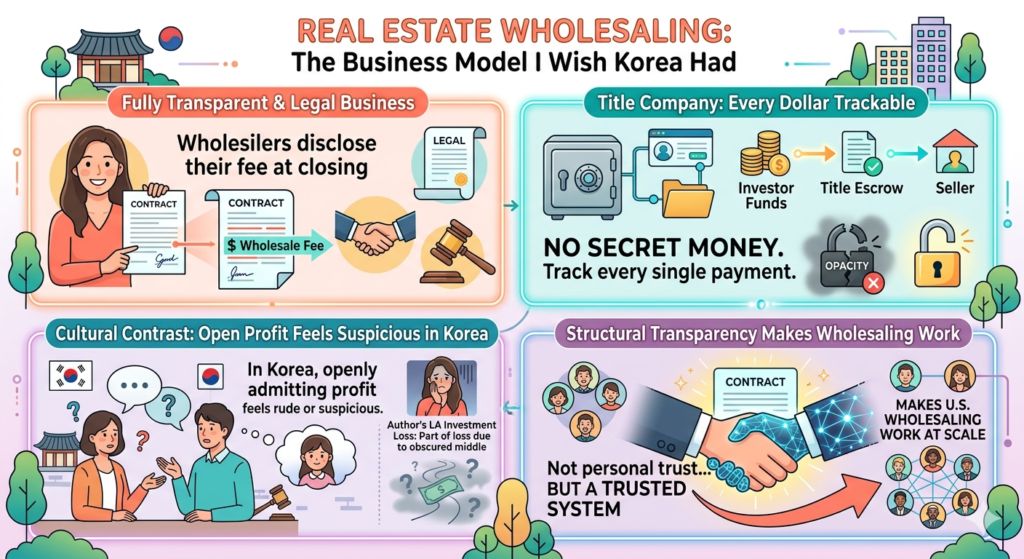
I grew up in a culture where talking about money openly — especially admitting how much you’re making in the middle of a deal — is considered rude at best and suspicious at worst.
In Korea, if someone told you they were pocketing $15,000 from a transaction you were part of, the immediate reaction would be: how do I cut this person out?
So when I first learned how real estate wholesaling actually works in America, I had to sit with it for a minute. Because what I was seeing wasn’t a loophole or a gray area. It was a fully transparent, legally recognized business model built on something Korea is still working toward: trust.
What Real Estate Wholesaling Actually Is
Real estate wholesaling is simpler than it sounds.
A wholesaler finds a distressed property — usually something a regular buyer wouldn’t want — and negotiates a purchase contract with the seller. Then, instead of buying the property themselves, they assign that contract to another investor for a fee.
The wholesaler never owns the property. They own the right to buy it. And they sell that right.
Here’s what real estate wholesaling looks like in real numbers:
Wholesaler negotiates with seller: purchase price $30,000 Wholesaler finds an investor buyer willing to pay $45,000 Wholesaler assigns the contract and collects $15,000
That $15,000 shows up on the official closing documents. The title company handles all the money. The seller knows. The buyer knows. Everyone knows.
And that’s exactly what stopped me cold.
The Part That Blew My Mind
In real estate wholesaling in America, the fee is disclosed. Publicly. In writing. At closing.
The wholesaler doesn’t hide what they’re making. They don’t pretend to be a neutral party. They say: “I’m making $15,000 on this deal. You’re getting the property at the price you agreed to. We good?”
And the answer is usually yes — because the seller got their price, the buyer got their deal, and the wholesaler provided a real service: finding a distressed property, negotiating the contract, and connecting two parties who never would have found each other.
I kept thinking: in Korea, this kind of transparency would feel almost aggressive. Admitting out loud that you’re profiting from someone else’s transaction? That’s not how we do things. We tend to obscure the middle. And because the middle is obscured, it becomes fertile ground for misunderstanding — and sometimes, for fraud.
Why Transparency Makes Real Estate Wholesaling Work
The reason real estate wholesaling functions at scale in America comes down to one thing: the title company.
Every real estate transaction in the U.S. runs through a title company — a neutral third party that handles all the money, verifies the legal chain of ownership, and distributes funds according to the closing documents. No one can secretly redirect money. No one can quietly cut someone out of a deal. Every dollar is accounted for, in writing, before anyone signs anything.
This is why someone like Mat Yuriditsky can buy properties remotely — from his couch, across the country — and why real estate wholesaling can operate transparently nationwide. The system is designed so that trust doesn’t have to be personal. It’s structural.
In Korea, we’re still building that infrastructure. And in its absence, we rely on personal relationships and community trust — which works until it doesn’t. I know this firsthand. My first real estate investment was handled by people from my own community, people I trusted because of shared background. I walked away with $20,000 on a $170,000 investment, and I still don’t know exactly where the rest went.
What This Taught Me About American Real Estate
America isn’t perfect. There are plenty of bad actors in real estate here too.
But the structural transparency — title companies, recorded deeds, public disclosures, licensed professionals — makes it significantly harder to obscure money flows in ways I’ve seen happen elsewhere.
Real estate wholesaling exists because the system can support it. The money is trackable. The contracts are enforceable. And openly saying “I’m making $15,000 on this deal” isn’t rude — it’s just business.
I find that genuinely impressive. Not naive — impressive. It takes a long time to build the kind of institutional trust that makes that level of transparency normal.
I’m still learning how to operate in this system. But the more I learn, the more I appreciate that it exists.
If you’re trying to figure out which real estate strategy fits your situation, I built a Real Estate Deal Type Classifier that might help.
Not financial advice — just someone doing a lot of research and asking a lot of questions.