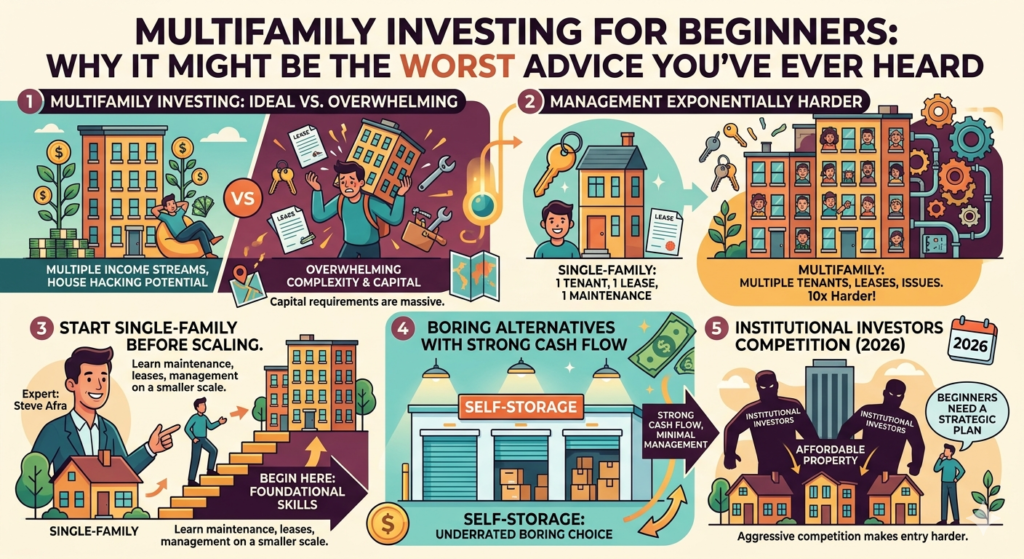
Multifamily investing beginners are being sold a dream that often turns into a nightmare. Buy a duplex, live in one unit, rent out the rest, let your tenants pay your mortgage — sounds perfect, right?
The more I research this, the more I think it’s one of the most dangerous pieces of advice floating around in the beginner investing space. Let me explain why.
Why Multifamily Investing Beginners Get Hooked on the Idea
The pitch is genuinely compelling. Multiple income streams from one purchase. If one unit goes vacant, others keep producing rent. Higher cash flow potential than a single-family home. And with house hacking, your housing costs can drop dramatically or disappear entirely.
On paper, it makes perfect sense. In practice, it’s a completely different story.
What Multifamily Investing Beginners Don’t Hear From the Gurus
Here’s what gets left out.
Managing multiple units is exponentially more complex than managing one.
With a single-family home, you have one tenant, one lease, one set of systems. With a fourplex, you have four of everything — four tenants, four sets of plumbing issues, four leases, four potential evictions. For someone who has never managed a rental before, that complexity can be overwhelming fast. And when you’re overwhelmed, you make expensive mistakes.
The capital requirements are significantly higher.
Multifamily properties cost more to buy, more to rehab, and more to maintain. Down payments are larger. Financing is more complicated. If you go in undercapitalized — which most beginners do — you’re one bad month away from a serious problem.
The tenant situation is different.
In multifamily buildings at the entry-level price point most beginners can afford, screening tenants is more critical and the margin for error is smaller. A bad tenant in a single-family home is a problem. A bad tenant in unit 2 of your fourplex, where you live in unit 1, is a much bigger problem.
According to BiggerPockets, most successful multifamily investors started with single-family properties first — and recommend that path for anyone just getting started.
What Multifamily Investing Beginners Should Do Instead
Start with a single-family home.
Not because it’s more glamorous — it’s not. But because it lets you learn the fundamentals without getting hit by everything at once. One property. One tenant. One set of systems. Get that right first.
Once you’ve successfully managed a single-family rental, you’ll have the experience, the confidence, and probably the equity to move into multifamily with your eyes open.
The “Boring” Alternative Nobody Talks About
Self-storage came up in this research too. No toilets. No tenants calling at midnight about a broken heater. No complex renovations. Just units people rent to store their stuff — with surprisingly strong cash flow and low management overhead.
Not as exciting as a multifamily deal. But it works. And that’s the whole point.
What the Market Looks Like Right Now
As of 2026, the gap between homeowners and renters in net worth is widening. Large institutional investors are actively buying affordable housing at scale — which means competition for entry-level multifamily properties is coming from players with far more capital and experience than most beginners.
That’s not a reason to avoid real estate. It’s a reason to be strategic about where you start.
Run the Numbers Before You Decide
The Multi-Unit Cash Flow Calculator can show you exactly what a multifamily deal looks like before you commit.
If you’re seriously considering multifamily investing, use the calculator below to see what the actual cash flow looks like after mortgage, taxes, insurance, maintenance, and vacancy. A lot of deals that look great on the surface look very different with real numbers in.
Not financial advice — just someone doing a lot of research and asking a lot of questions.