Commercial real estate risk is something most beginners don’t think about until it’s too late — and this story is exactly why.
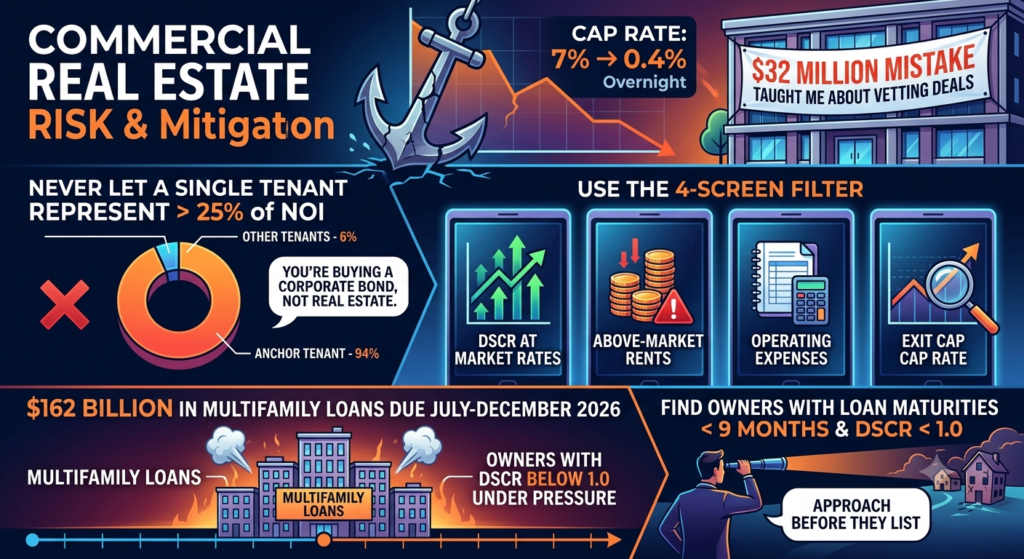
A investor paid $32 million for a retail center with 12 tenants. Sounds solid, right? Except one anchor tenant was responsible for 94% of the rent. When that tenant filed for Chapter 11 bankruptcy, the cap rate dropped from 7% to 0.4% overnight. The DSCR fell to 0.12. The loan balance ended up $4 million higher than the property’s value.
One tenant. One filing. Everything gone.
Here’s what that case study taught me about commercial real estate risk — and why the same principles apply even if you’re looking at a small mixed-use building or a strip mall, not a $32 million retail center.
The Anchor Tenant Problem Nobody Talks About
The first commercial real estate risk most investors miss is tenant concentration.
If a single tenant is responsible for more than 25% of your NOI, you’re not really buying real estate. You’re buying a corporate bond with a parking lot attached. Your investment lives or dies based on that one company’s financial health — not the property itself.
The right way to think about it: you’re not underwriting an address. You’re underwriting a tenant’s credit.
Before you buy any commercial property, ask yourself what happens if your biggest tenant leaves tomorrow. If the answer is “the deal falls apart,” that’s your answer about whether it’s actually a deal.
The 4-Screen Filter for Commercial Real Estate Risk
Ed Streit, a commercial real estate investor who reviews around 80 deals to select just 4, uses this filter before he gets serious about anything:
Screen 1 — DSCR at market rates Run the debt service coverage ratio using current market interest rates, not the seller’s financing. If the deal only works at a 3% rate and you’re financing at 6%, it doesn’t work.
Screen 2 — Above-market rents If tenants are already paying above market rent, that’s a red flag. When leases come up for renewal, rents will drop. Your NOI projections need to account for that.
Screen 3 — Operating expenses below 32% If a seller is showing operating expenses under 32%, assume the numbers are fake until proven otherwise. Real buildings cost more to run than that. Sellers clean up their books before listing.
Screen 4 — Exit cap rate If the projected exit cap is too tight relative to your entry cap, your upside is already priced in. You’re paying for growth that may never come.
Running your own numbers through a DSCR Calculator before you even talk to a broker is the move. Know what the deal looks like at today’s rates before you get emotionally invested.
The 2026 Refinancing Crisis and Why It’s Actually an Opportunity
Here’s where commercial real estate risk becomes a real estate opportunity — if you’re paying attention.
Between July and December 2026, approximately $162 billion in multifamily loans are coming due. These loans were originated when rates averaged 3.6%. Current refinancing rates are around 6.3%. That’s a 2.7 percentage point gap that a lot of owners simply can’t bridge.
In markets like Austin, Nashville, and Atlanta — where rent growth has stalled — some of those owners are going to panic sell. They won’t list on MLS. They won’t call a broker. They’ll reach out quietly to anyone who can close fast and take the problem off their hands.
According to the Federal Reserve’s financial stability report, commercial real estate remains one of the most closely watched sectors for stress in 2026 precisely because of this refinancing wall.
How Smart Investors Are Positioning Right Now
The investors who win in this environment aren’t waiting for deals to hit the market. They’re building their own lists.
The criteria is simple: owners with loan maturities within 9 months and a DSCR below 1.0. Those owners are under pressure. They need to refinance into a rate they probably can’t qualify for, or they need to sell.
If you can find them before they list — and come with a real offer — you’re not competing with anyone. You’re solving a problem.
For smaller investors in Philadelphia, the same logic applies at a different scale. Mixed-use buildings, small retail strips, and multifamily properties with commercial ground floors all face the same refinancing math. The owners feeling the most pressure right now aren’t the big institutions. They’re the individual landlords who bought in 2020 and 2021 at low rates and now can’t make the numbers work.
That’s where the opportunity is.
What This Means for Beginners Looking at Commercial Real Estate
You don’t need $32 million to learn from a $32 million mistake.
The commercial real estate risk principles that destroyed that retail center deal apply at every price point. Tenant concentration risk is real whether you’re buying a $500,000 mixed-use building or a $32 million retail center. DSCR math doesn’t care about deal size. Exit cap rates matter on a four-unit with a commercial unit on the ground floor just as much as they do on a regional shopping center.
Start small. Run the four screens. Never let a single tenant represent more than 25% of your income. And right now, pay attention to who’s refinancing — because their stress is your opportunity.
Not financial advice — just someone doing a lot of research and asking a lot of questions.