Small multifamily investing is one of those strategies that sounds unsexy until you understand what’s actually happening under the hood.
Big institutional investors ignore it. Individual landlords don’t fully understand it. And that gap — right in the middle — is where the opportunity lives.
Here’s what I’ve been learning about why the 6 to 50 unit range might be the most underrated space in real estate investing right now.
Why Small Multifamily Investing Starts at 6 Units
This is the part most beginners don’t know.
A duplex, triplex, or fourplex is valued like a house — based on what similar properties sold for nearby. You have no control over that number. The market decides your asset’s value, and you just live with it.
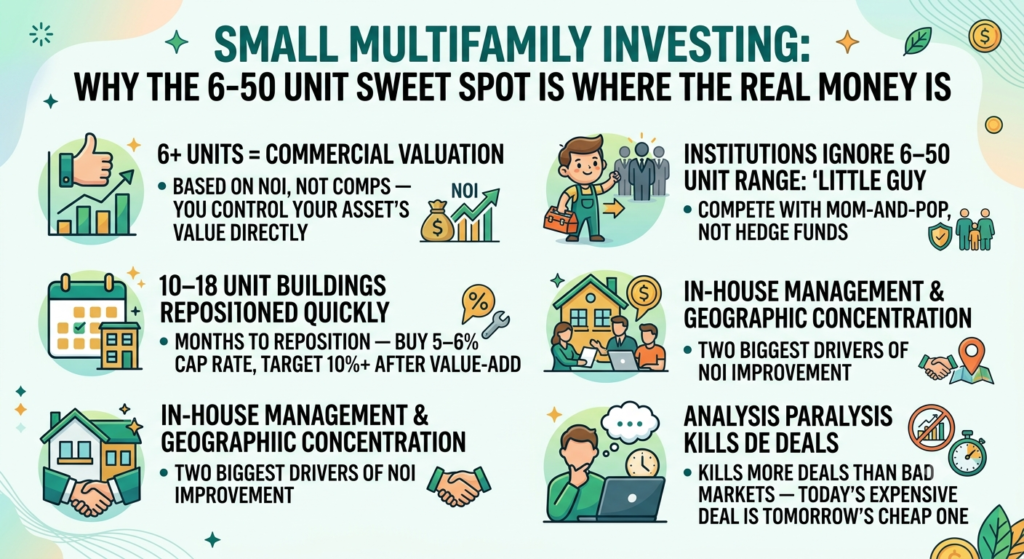
The moment you cross into 6 units or more, the rules change completely. Now you’re in commercial territory, and commercial properties are valued based on income — specifically your Net Operating Income. That means you can directly engineer your property’s value by increasing rents, reducing expenses, and improving occupancy.
You’re not waiting for the market to give you equity. You’re building it yourself.
That shift in how value is calculated is the entire foundation of small multifamily investing done right.
The Competition Problem — and Why It Works in Your Favor
Here’s something the big players don’t want you to think about.
Institutional investors — hedge funds, REITs, private equity firms — need to deploy massive amounts of capital. A 10-unit building in Philadelphia doesn’t move the needle for them. They’re chasing 100, 200, 500 unit deals. They have entire acquisition teams built around sourcing those properties.
In the 6 to 50 unit range, you’re competing with mom-and-pop landlords. Individual owners. People who bought a building 20 years ago and haven’t optimized anything. That’s a fundamentally different competitive landscape than trying to outbid an institution.
Lower competition means better prices, better terms, and more room to negotiate creative structures like seller financing or master lease arrangements.
How Small Multifamily Investing Creates Value Fast
The repositioning speed in this range is what makes small multifamily investing so compelling compared to larger assets.
A 200-unit complex takes years to reposition. You’re coordinating hundreds of units, multiple phases of renovation, complex financing structures, and a management team just to execute the plan.
A 10 to 18 unit building? You can complete renovations in months. Update the units, raise rents to market rate, stabilize occupancy, and refinance to pull your capital back out. The BRRRR cycle — Buy, Rehab, Rent, Refinance, Repeat — runs faster at this scale than at any other.
The value-add playbook is straightforward: buy at a 5 to 6% cap rate, execute improvements, and target a 10%+ cap rate within one to two years. The gap between entry and stabilized value is where the equity gets created.
Specific improvements that move the needle:
- Kitchen and bathroom updates in each unit
- Flooring replacement
- LED lighting throughout common areas
- Roof, boiler, and parking lot upgrades
- Adding laundry or other amenities tenants will pay for
Each improvement increases NOI. Higher NOI means higher appraised value at refinance. Run your numbers through the Multi-Unit Cash Flow Calculator before you start to make sure your renovation budget actually produces the NOI lift you need.
Operations Is Where the Money Actually Is
Every experienced small multifamily investing operator says the same thing: the money is in the operations, not the acquisition.
Third-party property managers are not motivated the way you are. They’re managing dozens of properties simultaneously. They’ll spend $20,000 on a repair and raise the rent $50 because it’s not their money and it’s not their building. Their incentive is to keep things moving, not to optimize your returns.
In-house management changes the math. When your team handles maintenance, tenant placement, and day-to-day operations, costs go down and response times go up. Tenants stay longer. Turnover drops. NOI goes up.
The other move is geographic concentration. If you own three buildings within a few miles of each other, one maintenance person can cover all three efficiently. Spread those same three buildings across three different cities and you’ve tripled your management complexity for the same number of units.
According to the National Multifamily Housing Council, operating efficiency is consistently cited as the primary driver of returns in multifamily investing — which is exactly why in-house management pays off at scale.
The Mindset That Actually Gets You Into Deals
One thing that comes up constantly in small multifamily investing is analysis paralysis.
Beginners run numbers on twenty deals, find reasons to pass on all of them, and wonder why they haven’t bought anything. Meanwhile, experienced investors are making offers on deals that aren’t perfect and finding ways to make the numbers work.
The framework that helps: what looks expensive today will look cheap in five years. Inflation is persistent. Construction costs keep going up. Replacement cost for existing buildings keeps rising. The building you pass on at $800,000 today may well be a $1.2 million asset in a decade — and you’ll wish you had bought it.
That’s not an argument for buying bad deals. It’s an argument for not letting the perfect be the enemy of the good deal.
Find a mentor who’s done it. Build a network of people actively investing. Get into your first deal. The experience from one transaction will teach you more than a year of studying ever could.
Not financial advice — just someone doing a lot of research and asking a lot of questions.