Sweat equity real estate is the strategy most beginners overlook because they’re too focused on finding the money.
The money is the wrong starting point. The right starting point is finding a problem you can solve — and then getting paid in ownership instead of just cash.
Tyler Cauble calls it the secret to buying commercial real estate without cash. Here’s how it actually works.
What Sweat Equity Real Estate Actually Means
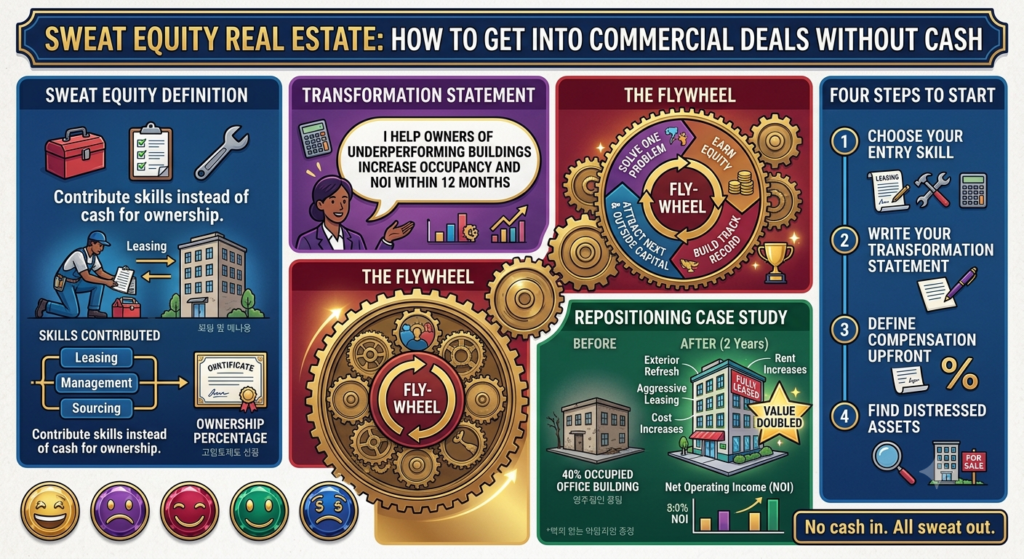
Sweat equity real estate means you contribute value — skills, time, problem-solving — instead of capital, and you receive ownership in return.
Most people assume you need money to get into commercial real estate. What you actually need is something an owner values more than they value keeping all the equity. If you can lease up a struggling building, improve operations, cut costs, and raise NOI, you’ve created real value. The question is whether you’ve negotiated to capture some of that value for yourself.
That negotiation is the skill. The execution is the proof.
The Three Principles Behind Sweat Equity Real Estate
Define your transformation statement. Before you approach any owner, you need to know exactly what problem you solve and for whom. Not “I want to get into commercial real estate.” Something specific: “I help owners of underperforming office buildings in Philadelphia increase occupancy and NOI within 12 months.”
That specificity is what makes owners take you seriously. You’re not asking for a favor. You’re offering a service with a defined outcome.
Package your value. You don’t need to own a building to have expertise worth trading for equity. Leasing skills, property management systems, deal sourcing, contractor relationships, marketing — any of these can be packaged and offered to an owner who lacks them.
The structure is straightforward: you solve the problem, they compensate you with a percentage of the equity instead of — or in addition to — a management fee or leasing commission.
Define the revenue model upfront. Vague agreements fall apart. Before you start work, document exactly how you’ll be compensated — leasing commissions, monthly management fees, and the equity percentage you’ll receive once the asset hits a defined performance benchmark. Get it in writing before you do anything.
The Flywheel: How Sweat Equity Real Estate Compounds
One successful sweat equity deal doesn’t just produce returns. It produces the track record that makes the next deal possible.
The cycle works like this:
Find a distressed asset or motivated owner → solve the problem → get compensated in fees and equity → use that track record to attract the next owner, the next deal, and eventually outside capital.
Each successful repositioning is proof you can do it again. Owners with struggling assets start finding you instead of the other way around. Investors who want exposure to commercial real estate but lack the operational skills become partners. The flywheel accelerates.
This is how operators without capital build commercial portfolios — not by saving up for a down payment, but by building a reputation for solving problems other people can’t or won’t solve.
The Case Study: 40% Occupied to Double the Value in Two Years
Tyler Cauble took on a Dickerson Pike office building that was running at 40% occupancy and bleeding cash. His approach was systematic.
Repositioning the asset. The exterior was renovated and common areas were updated. First impressions drive leasing — brokers and prospects form opinions before they walk through the door.
Aggressive leasing. Broker outreach, online listings, cold calls, direct marketing. Every available channel was activated simultaneously. Vacancy doesn’t fill itself.
Operating cost reduction. LED lighting throughout, thermostats locked, window tinting installed. Small changes, but compounded across a building they reduce utility costs meaningfully and improve NOI without raising a single rent.
Rent increases. Once the improvements were in place and occupancy climbed, rents were raised to reflect the improved asset quality. Higher rents on more occupied units drove NOI up significantly.
Two years later, the building was worth double what it was at acquisition. That value creation — built through sweat equity real estate skills rather than capital — is what ownership participation captures.
Run the numbers on any value-add deal through the Rental Property Analyzer before you commit to a sweat equity arrangement. Know what NOI improvement is required to hit your target equity value, and make sure the deal structure actually rewards you for achieving it.
How to Start Your First Sweat Equity Real Estate Deal
Step 1: Choose your entry point. Leasing, property management, deal sourcing — pick the one you can execute best right now. You don’t need to be good at all of them. One skill executed consistently is enough to start.
Step 2: Write your transformation statement. Who do you help? What specific result do you deliver? Write it out until it’s concrete enough that an owner would understand immediately what they’re getting.
Step 3: Define your compensation structure. Decide before you start: management fee, leasing commissions, equity percentage, performance benchmarks. Document everything.
Step 4: Find distressed assets and motivated owners. Owners who are cash-poor but asset-rich are your best partners. They have something valuable that isn’t performing. You have the skills to make it perform. That’s the trade.
According to the Urban Land Institute, value-add commercial strategies consistently outperform stabilized asset purchases over five-year hold periods — which is exactly why operators who can execute repositioning attract capital even when they start with none.
The path into commercial real estate doesn’t require a large bank account. It requires a clear value proposition, the execution to back it up, and the negotiating skill to turn that execution into ownership.
Not financial advice — just someone doing a lot of research and asking a lot of questions.