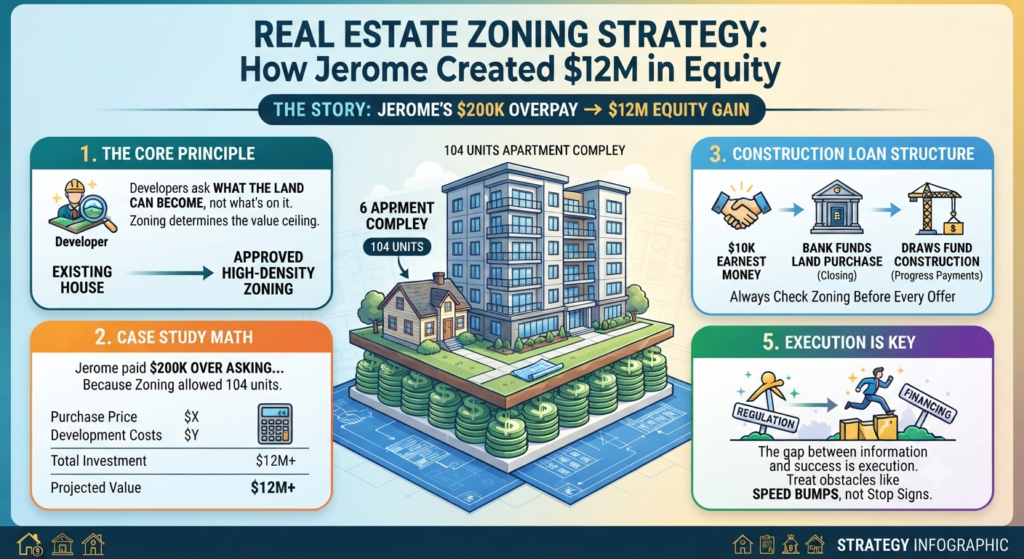
Most investors walk away from a deal the moment the price goes above asking. Jerome Maldonado walked toward it — and paid $200,000 over asking price on purpose.
The result: $12 million in equity after development.
That’s what a real estate zoning strategy actually looks like when you’re reading a deal correctly.
Why Real Estate Zoning Strategy Matters More Than Purchase Price
Everyone focuses on price. The developers who build real wealth focus on what the land can become.
A deteriorated house on a lot zoned for 104 units isn’t a house. It’s a development site with a house in the way. The house price is irrelevant. What matters is what the zoning allows — and what that translates to in finished project value.
Jerome’s framework is simple: stop looking for the cheapest deal. Start looking for the deal with the most potential. Those are rarely the same property.
When you apply a real estate zoning strategy correctly, you’re not buying what’s there. You’re buying what’s possible. The $200K premium he paid over asking was irrelevant against a $12 million equity outcome. The math only works if you read the zoning first.
How to Read a Real Estate Zoning Strategy Like a Developer
Most buyers see a rundown house and price the rehab. Developers see the same property and ask a completely different set of questions.
What does the zoning allow? Residential single-family, multi-unit, mixed-use, commercial — the permitted use determines the ceiling on value. A lot zoned for four units is worth fundamentally more than the same lot zoned for one, even if the existing structure is identical.
What’s the density potential? Units per acre, floor area ratio, height limits — these numbers define how much income-producing space you can build. More density means more NOI. More NOI means more appraised value at refinance or sale.
What’s selling in this market? Jerome targets areas where homes sell fast — not six to twelve months on market. If inventory is sitting, the market is telling you something. Find the zip codes where properties move in weeks, not months. Then find underutilized land there.
Can you buy land at $150K in a market where homes sell at $1M? That spread — between land cost and finished product value — is where the profit lives. The real estate zoning strategy is about finding that gap before anyone else does.
The $10K Entry Point: How Construction Loans Make It Work
You don’t need to be sitting on hundreds of thousands of dollars to execute a real estate zoning strategy. The financing structure is what makes smaller entry points possible.
Here’s how the construction loan structure works:
Step 1: Find the site. Negotiate a purchase contract with a modest earnest money deposit — sometimes as low as $10,000 — while you complete due diligence and secure financing.
Step 2: Get a construction loan approved based on the after-completion value (ARV) of what you’re building — not what’s there today. Banks lend against the finished project value, typically 70 to 80% of ARV.
Step 3: At closing, the construction loan funds pay the seller in full. Your $10K earnest money was the only out-of-pocket until this point.
Step 4: Construction draws. The remaining loan funds are disbursed in stages as construction milestones are completed — foundation, framing, roofing, finish work. A bank inspector verifies each phase before releasing the next draw.
Step 5: Sell or refinance on completion. Sale proceeds pay off the construction loan. What’s left is your profit.
Jerome’s case study: under $10,000 into a deal, construction loan covers land and build costs, $300,000 projected profit at completion. The real estate zoning strategy is the front end. The construction loan is the financing engine that makes it executable.
Run your numbers through the New Construction Cost Calculator before you commit to any development deal. Know your all-in cost, your projected sale price, and your margin before you sign a contract.
One Lot, Four Houses: What Real Estate Zoning Strategy Looks Like in Practice
The most accessible version of real estate zoning strategy isn’t a 104-unit apartment complex. It’s a single-family lot that turns out to be zoned for four.
Jerome’s example: a property everyone else saw as one house. He saw it as four buildable lots. Outcome: $1.2 million in profit.
The process:
Check the zoning designation before you make an offer. In Philadelphia, you can look up zoning on the city’s Atlas platform — RSA-5 allows single-family, RM-1 allows multi-unit rowhouse development. The zoning code tells you the ceiling.
Confirm with a land use attorney or zoning consultant that your intended use is permitted or achievable through a variance. Variance processes vary by municipality but are often more accessible than people assume — especially if the project adds housing supply in a supply-constrained market.
Price the project based on finished units, not the existing structure. If four townhouses in that neighborhood sell at $400,000 each, your project gross is $1.6 million. Work backward from there to determine what you can pay for the land and still hit your margin.
According to the American Planning Association, zoning reform is accelerating across U.S. cities as municipalities respond to housing supply shortages — which means more opportunities for developers who understand how to work with zoning regulations, not just around them.
The Mindset Behind Real Estate Zoning Strategy
Jerome makes one point that matters more than any of the tactics: the gap between information and success is execution.
Most people read about real estate zoning strategy. They understand the concepts. They can explain construction loans and density calculations. And then they don’t buy anything.
The reason is that execution carries risk — rejection, failure, deals that don’t close. Knowledge feels safe. Action doesn’t.
His framework for getting past it: treat business obstacles like speed bumps. You don’t stop driving because of a speed bump. You slow down, go over it, and keep moving. The problem isn’t the obstacle. It’s treating every obstacle like a reason to stop.
The developers who compound wealth through real estate zoning strategy aren’t smarter than everyone else. They make offers when others are still analyzing. They close when others are still waiting for certainty. They build while others are still studying.
Not financial advice — just someone doing a lot of research and asking a lot of questions.